
Victorian Majolica and Encaustic Hearth Surrounds represent the pinnacle of 19th-century British ceramic fireplace architecture, popularized by Minton, Maw & Co., and William De Morgan. High-relief molded majolica earthenware tiles featuring tinted translucent lead glazes framed the cast-iron firebox, while durable multi-colored clay-inlaid encaustic tiles paved the floor hearth, engineered to withstand intense thermal cycling and ember impacts.
At a Glance: Key Takeaways
- Dual Ceramic Typology: Sculptural high-relief majolica wall friezes paired with flat, clay-inlaid encaustic floor hearths.
- Minton Tinted Translucent Glazes: Flowing colored glazes pooling in relief hollows to create jewel-like chiaroscuro depth.
- Plastic-Inlaid Encaustic Craft: Colored liquid slip clays pressed into stamped biscuit cavities, firing pattern through the full tile body.
- Refractory Firebox Mortars: Calcium-aluminate and fireclay mortars accommodating thermal shock up to 600°C.
- Perimeter Thermal Expansion Joints: Engineered 3mm brass or fiber expansion joints isolating hearth tiles from cast-iron stove frames.
In-Depth Guides in this Directory
Explore specialized subtopic blueprints, technical dimensions, and execution checklists:
High-Relief Molded Earthenware & Tinted Lead Glazes
Plaster mold casting, fluid lead-silicate glaze chemistry, and chiaroscuro optical pooling in Victorian majolica tiles.
Clay-Inlaid Encaustic Hearth Floor Tiles & Firebox Friezes
Manufacturing, Gothic Revival slip-inlay chemistry, and geometric floor layouts of Minton encaustic fireplace hearth tiles.
Thermal Expansion Joints & Refractory Mortar Installation
Thermal engineering of Victorian fireplaces: refractory mortar formulation, heat-buffer expansion joints, and cast-iron frame isolation.
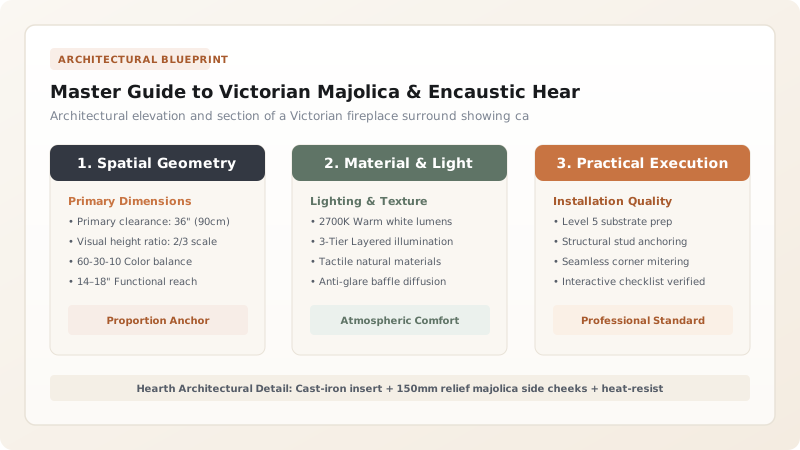
1. The Victorian Fireplace as the Cultural & Architectural Hearth
In 19th-century Victorian Britain, the fireplace was the undisputed social, spiritual, and aesthetic focal point of the home. Advancements in industrial ceramic engineering—led by Herbert Minton in Stoke-on-Trent—transformed the fireplace from a smoky sooty cavern into a dazzling showcase of high art.
A complete Victorian hearth assembly integrated two distinct ceramic systems:
- Fireplace Cheeks & Friezes (Majolica): Vertical side panels lining the cast-iron grate, crafted from high-relief molded earthenware coated in brilliant, glassy colored lead glazes that reflected firelight into the parlor.
- The Floor Hearth (Encaustic Pavement): The horizontal floor apron in front of the firebox, paved with ultra-dense, non-slip inlaid encaustic tiles designed to catch falling coal embers without scorching or cracking.
2. High-Relief Majolica: The Liquid Glaze Effect
Victorian majolica tiles (introduced at the Great Exhibition of 1851) differ fundamentally from Renaissance majolica. Instead of opaque white tin glaze painted with flat pigments, Minton's majolica utilized a buff earthenware body pressed into carved plaster-of-Paris molds with deep relief (often 5mm to 12mm deep), depicting botanical flora, acanthus scrolls, and mythic beasts.
The bisque-fired tiles were dipped in thick, translucent lead-silicate glazes tinted with metallic oxides (cobalt for royal blue, copper for emerald green, antimony for amber, and manganese for aubergine). In the heat of the glost kiln (980°C to 1,020°C), the molten glaze became fluid, draining away from high ridges and pooling thickly in carved valleys.
This thickness variation created self-shading, jewel-like optical depth: pale, translucent highlights over raised petals and deep, luminous shadow tones in the recesses.
3. Encaustic Inlay Dynamics & Thermal Shock Resistance
The floor hearth endured brutal mechanical and thermal punishment: falling iron pokers, heavy coal scuttles, and burning embers heating the center to 200°C while perimeter edges remained at room temperature.
Glazed tiles would crack and craze instantly under this thermal stress. Instead, Victorians laid encaustic tiles. Encaustic tiles have no glaze; the geometric decorative pattern (Gothic quatrefoils, medieval fleur-de-lis) is formed from different colored clays inlaid directly into the body to a depth of 3mm to 6mm. Even after 150 years of heavy coal scuttle abrasion, the pattern remains perfectly intact because it is integral to the ceramic tile body.
Victorian Fireplace Ceramic Specifications
Use this reference table to calculate exact physical dimensions, ratios, and specifications before purchasing:
| Tile Component | Ceramic Classification | Surface Treatment | Thermal / Mechanical Role |
|---|---|---|---|
| Vertical Side Cheeks | High-relief pressed earthenware | Translucent colored majolica glazes | Reflects firelight; withstands 150°C radiant heat |
| Upper Mantle Frieze | Decorative relief tile panels (6"×6") | Artisanal tube-lined or relief majolica | Visual focal point beneath carved timber mantelpiece |
| Floor Hearth Paving | Inlaid encaustic unglazed stoneware | Matte unglazed body (pattern inlaid 4mm) | Non-slip; absorbs dropped coal embers without damage |
| Hearth Curb Border | Heavy-duty glazed bullnose coping tiles | Rich dark chocolate or bottle-green glaze | Mechanical bumper containing floor ash and embers |
Thermal & Code Constraints
Every successful decoration project must account for physical and environmental constraints:
Building Code Non-Combustible Hearth
Building regulations require a non-combustible hearth projecting at least 300mm in front of the firebox and 150mm beyond the sides.
Antique Tile Rarity
Genuine Minton or Maw majolica tiles are rare collector pieces; replicate with authentic hand-molded artisan reproductions.
Protocol for Installing Victorian Hearth Tiles and Firebox Cheeks
Execute this professional sequence to achieve flawless results without backtracking:
Cast-Iron Grate Thermal Isolation
Position cast-iron register grate; apply 3mm ceramic fiber insulation tape around rear perimeter flanges to buffer thermal expansion.
Fireplace Cheek Lath Bedding
Spread refractory calcium-aluminate mortar along brick jambs; press relief majolica tiles into place with 1.5mm joint spacers.
Sub-Hearth Concrete Leveling
Pour a 50mm non-combustible concrete hearth slab; screed level with a 10mm recess to accommodate tile and mortar thickness.
Encaustic Geometric Dry-Fitting
Lay out encaustic geometric pattern dry on floor; verify symmetrical border cuts around the fireplace center axis.
Tile Soaking & Mortar Setting
Dampen porous encaustic tiles; bed into heat-resistant lime-cement mortar, tamping level across joints with a wooden block.
Mineral Refractory Grouting
Grout joints with dark charcoal heat-resistant refractory mortar; wipe clean immediately to prevent encaustic surface staining.
Common Mistakes & Countermeasures
Avoid these costly errors that compromise aesthetics, ergonomics, and budget:
Using modern mastic or PVA-based adhesives behind fireplace cheek tiles
Laying encaustic floor tiles tight against the cast-iron grate without expansion gaps
Project Execution Checklist
Track your physical progress. Checkboxes persist automatically on this device:
Frequently Asked Questions
What is the difference between antique majolica and encaustic tiles?
Majolica tiles are glazed relief earthenware used for vertical walls and fireplace surrounds, featuring sculptural relief and rich translucent colored glazes. Encaustic tiles are unglazed, flat floor tiles where patterns are formed by different colored clay slips inlaid deep into the tile body, designed for heavy foot traffic and hot embers.
How do you clean soot and smoke stains off antique fireplace tiles?
Mix a gentle paste of bicarbonate of soda and water with a few drops of dish soap. Apply to the soot stains with a soft nylon brush, allow 15 minutes to penetrate, and wipe clean with warm water. Never use harsh oven cleaners or muriatic acid, which strip the delicate lead glaze.


