
Victorian majolica tiles achieved their radiant depth through the harmony of high-relief molding and fluid tinted glazes. Earthenware clay was pressed into carved plaster molds to create 10mm relief contours. Dipped in transparent lead-silicate glazes colored with metallic oxides, the glaze flowed during firing, pooling in recesses to produce deep, self-shaded optical chiaroscuro.
At a Glance: Key Takeaways
- Sculpted Plaster of Paris Molds: Hand-carved master models creating deep 5mm to 12mm botanical and heraldic relief.
- Dust-Pressing vs Plastic Clay: High-pressure metal screw presses compacting semi-dry clay powder into warp-free biscuit tiles.
- Lead-Silicate Translucent Melt: High-gloss flux lowering glaze melting point to 980°C for exceptional optical clarity.
- Optical Liquid Pooling: Thick glaze puddles in deep recesses creating rich saturated shadow tones naturally.
- Color Chemistry: Cobalt (royal blue), copper (emerald), iron (amber/honey), and manganese (deep blackberry aubergine).
1. Plaster Mold Carving & Prosser's Dust-Press Patent
Before 1840, ceramic tiles were hand-thrown or molded from plastic wet clay, causing severe warping, uneven shrinkage (up to 15%), and irregular edges. In 1840, Richard Prosser and Herbert Minton patented the dust-pressing process.
Fine earthenware clay was dried, pulverized into a damp powder (approx. 8% moisture), and compressed inside steel dies under heavy toggle presses exerting over 10 to 15 MPa of mechanical pressure. This produced bisque tiles (biscuit) of absolute planar precision, perfectly square edges, and uniform density that resisted warping during subsequent kiln firings.
For majolica, the front die plate was carved with deep three-dimensional relief: water lilies, Gothic acanthus leaves, heraldic lions, and Renaissance strapwork carved with sharp undercuts that captured firelight.
2. Fluid Glaze Dynamics & Self-Shading Chiaroscuro
The magic of Victorian majolica lies in the physical rheology of the molten glaze. Formulated from high concentrations of lead monoxide (litharge or red lead, \(\text{PbO}\), 45% to 55%) and silica (\(\text{SiO}_2\), 35% to 40%), the glaze possesses an exceptionally low viscosity when molten at 1,000°C.
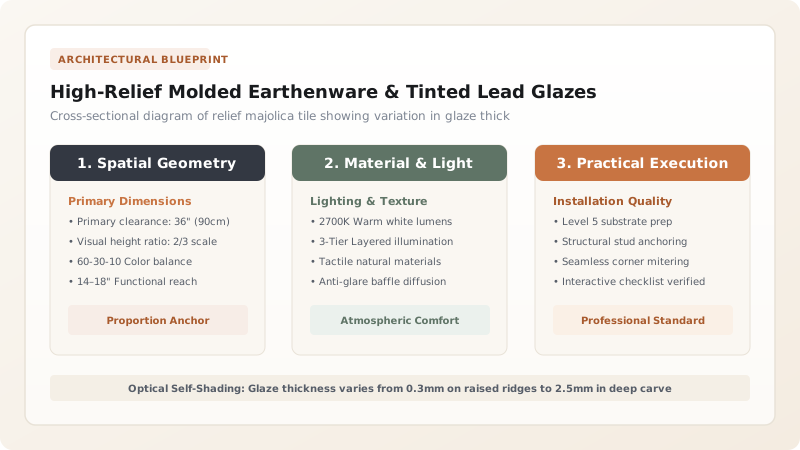
As the tile fires horizontally in the glost kiln, surface tension causes the molten tinted glass to drain away from sharp raised edges, leaving a micro-thin, translucent film (approx. 0.2mm to 0.4mm thick). Conversely, the liquid glass pools deeply in carved hollows, accumulating to depths of 1.5mm to 3.0mm.
According to the Beer-Lambert Law of Light Absorption:
Where \(x\) is the glaze thickness and \(\alpha\) is the absorption coefficient of the metal oxide pigment. Light passing through the thin crests is minimally absorbed, reflecting the bright buff clay below as radiant highlights. Light entering the deep valleys travels through five times more colored glass, emerging as deep, brooding, saturated jewel tones.
3. Metal Oxide Color Formulations
Victorian master glazers developed specialized metal oxide palettes capable of withstanding the intense heat of the glost kiln without bubbling or burning out:
- Victorian Green: 2.0% to 3.5% cupric oxide (\(\text{CuO}\)) yielding brilliant, translucent emerald and malachite greens.
- Royal Majolica Blue: 0.3% to 0.8% cobalt carbonate (\(\text{CoCO}_3\)) yielding deep, luminous sapphire and midnight blues.
- Honey Amber: 3.0% to 5.0% ferric oxide (\(\text{Fe}_2\text{O}_3\)) producing golden topaz and caramel hues.
- Aubergine / Port Wine: 1.5% to 2.5% manganese dioxide (\(\text{MnO}_2\)) creating rich purple-brown and blackcurrant tones.
Victorian Majolica Glaze Chemistry Palette
Use this reference table to calculate exact physical dimensions, ratios, and specifications before purchasing:
| Glaze Color | Colorant Oxide | Weight Percentage | Optical Effect in Relief |
|---|---|---|---|
| Minton Emerald Green | Cupric Oxide (CuO) | 2.5% to 3.0% | Brilliant apple-green ridges over dark forest-green hollows |
| Sapphire Blue | Cobalt Carbonate (CoCO3) | 0.5% to 0.8% | Vibrant cerulean highlights with midnight-navy depths |
| Golden Amber | Red Iron Oxide (Fe2O3) | 4.0% to 5.0% | Luminous honey-gold ridges over dark caramel pooling |
| Deep Aubergine | Manganese Dioxide (MnO2) | 2.0% to 2.8% | Rich plum-purple highlights with dark espresso valleys |
Pyrotechnic & Chemical Constraints
Every successful decoration project must account for physical and environmental constraints:
Thermal Crazing Stress
The thermal expansion coefficient of the glaze must match the earthenware body within 0.3 × 10⁻⁶/K to prevent fine crackle crazing.
Lead Volatilization
High-lead glazes volatilize toxic lead vapor at temperatures exceeding 1,050°C; keep firing temperatures strictly under 1,020°C.
Protocol for Glazing and Glost-Firing Relief Majolica Tiles
Execute this professional sequence to achieve flawless results without backtracking:
Bisque Firing & Dusting
Dust-press clay into carved plaster dies; fire to 1,150°C to create dense, porous bisque tiles; blow clean of dust with compressed air.
Glaze Slurry Compounding
Ball-mill lead frit, silica, and metallic oxides to 325-mesh; adjust specific gravity to 1.72 g/cm³ using calcium chloride suspender.
Flood Dipping
Dip the relief tile face horizontally into the glaze pool for 4 seconds; withdraw with a gentle wave motion to evenly coat deep recesses.
Edge & Foot Sponge Cleaning
Sponge all four perimeter edges and the reverse tile foot completely clean of glaze to prevent tiles from fusing to kiln shelves.
Kiln Stacking on Refractory Spurs
Support tiles horizontally on three-pointed ceramic stilts inside fireclay saggars to prevent dripping glaze adhesion.
Glost Firing & Slow Cooling
Fire in an oxidizing atmosphere to 1,000°C; hold peak heat for 45 minutes to allow glaze pooling, then cool slowly over 16 hours.
Common Mistakes & Countermeasures
Avoid these costly errors that compromise aesthetics, ergonomics, and budget:
Firing tiles in a vertical orientation inside the kiln
Failing to sponge glaze off the perimeter tile edges
Project Execution Checklist
Track your physical progress. Checkboxes persist automatically on this device:
Frequently Asked Questions
Why did Victorian majolica tiles craze with fine hairline crackle lines over time?
Over decades of exposure to seasonal humidity, porous earthenware biscuits slowly absorb moisture and expand slightly (moisture expansion). The vitreous glass glaze cannot expand, putting the glaze under tensile stress that relieves itself by forming a fine network of hairline crackle lines (crazing), which is a prized hallmark of antique authenticity.
Can modern lead-free glazes duplicate the look of antique Victorian majolica?
Modern lead-free glazes (based on boron and alkali frits) can produce vibrant colors, but they possess a lower refractive index (n ≈ 1.50 vs n ≈ 1.65 for lead) and higher melt viscosity, resulting in slightly less translucent optical clarity and less pronounced pooling in deep recesses.


