
Fireplaces experience extreme thermal stress: the cast-iron firebox can reach 300°C while surrounding tiles remain at 60°C. Installation mandates using heat-resistant refractory calcium-aluminate or lime-pozzolana mortars combined with engineered thermal expansion joints (ceramic fiber rope and solid brass perimeter trims) that absorb differential expansion without cracked tiles.
At a Glance: Key Takeaways
- Differential Thermal Expansion: Cast iron expanding at 12 × 10⁻⁶/K vs ceramic tile expanding at 6 × 10⁻⁶/K.
- Refractory Calcium-Aluminate Mortar: High-temperature binder maintaining compressive bond up to 600°C.
- Ceramic Fiber Expansion Ropes: Flexible non-combustible rope gaskets isolating cast-iron flanges from ceramic cheeks.
- Solid Brass Hearth Trim Dividers: Architectural brass saddles absorbing differential movement between hearth and wood floor.
- Zero Portland Cement at Heat Line: Eliminating cement hydration breakdown caused by heat above 250°C.
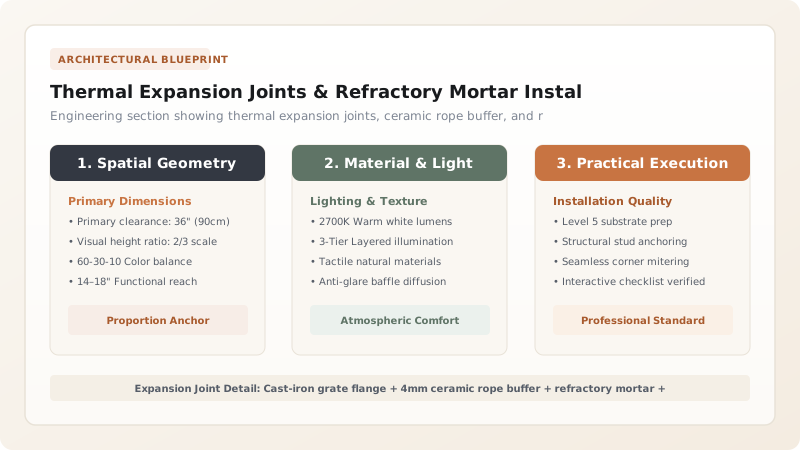
1. The Physics of Differential Thermal Expansion
A coal or wood fire burning inside a Victorian cast-iron grate generates temperatures between 500°C and 800°C inside the firebox. The cast-iron grate heats rapidly, reaching 250°C to 350°C, while the ceramic tiles set 100mm away reach 60°C to 90°C.
Furthermore, cast iron has a coefficient of thermal expansion (\(\alpha_{\text{iron}} \approx 12 \times 10^{-6}/\text{K}\)) that is twice that of dense ceramic tile (\(\alpha_{\text{ceramic}} \approx 5.5 \times 10^{-6}/\text{K}\)). Over a 900mm wide grate opening, the metal expands horizontally by:
If the ceramic tiles are installed tightly against the cast-iron frame with rigid mortar, this 3.2mm horizontal expansion acts like a hydraulic ram, generating shear stresses exceeding 25 MPa that fracture the tile bodies, crack the majolica glaze, and pop tiles off the brickwork.
2. Refractory Mortar vs Portland Cement Breakdown
Standard modern Portland cement thin-sets and mortars must never be used in close proximity to a firebox. Standard Portland cement hardens through the hydration of calcium silicates, forming calcium hydroxide (\(\text{Ca(OH)}_2\)) and calcium silicate hydrates (C-S-H).
When heated above 250°C, calcium hydroxide undergoes dehydration decomposition, turning back into powdery quicklime: \(\text{Ca(OH)}_2 \xrightarrow{\Delta} \text{CaO} + \text{H}_2\text{O} \uparrow\). The cement matrix loses 80% of its structural strength, crumbles into loose powder, and releases the tiles completely.
Victorian installations require refractory calcium-aluminate cement (hydraulic fireclay mortar) or a traditional mix of 1 part slaked hydraulic lime (NHL 5), 1 part fine refractory grog (crushed firebrick), and 1 part silica sand. These mineral binders retain full mechanical bond strength up to 800°C without chemical decomposition.
3. Detail Engineering: Ceramic Fiber Gaskets & Brass Trims
To accommodate differential movement, two critical perimeter joints must be incorporated into the installation:
- The Grate-to-Cheek Joint: A continuous 4mm expansion gap between the cast-iron grate flange and the majolica cheek tiles, packed with non-combustible ceramic fiber rope (or woven basalt rope) and capped with high-temperature refractory sealant.
- The Hearth-to-Floor Joint: The junction between the outer edge of the encaustic tile hearth and the surrounding wooden parquet floor. A heavy solid architectural brass angle or T-bar (typically 20mm × 5mm) is anchored to the subfloor with an expansion clearance gap. This brass saddle absorbs timber moisture expansion while providing a permanent decorative border.
Hearth Mortar and Joint Performance Comparison
Use this reference table to calculate exact physical dimensions, ratios, and specifications before purchasing:
| Mortar / Joint Material | Maximum Service Temp | Compressive Bond at 300°C | Thermal Movement Absorption |
|---|---|---|---|
| Refractory Calcium-Aluminate Mortar | 1,200°C | Maintains 100% bond (> 15 MPa) | Low; requires dedicated expansion rope joints |
| Traditional Lime-Firebrick Grog Mortar | 600°C | Maintains 85% bond (flexible) | Moderate natural elasticity; ideal for historic cheeks |
| Standard Portland Cement Thin-Set | 250°C | Fails; decomposes into powder | Zero; brittle shear failure guarantees tile cracking |
| Ceramic Fiber Rope Gasket (4mm) | 1,000°C | N/A (elastic gasket) | Compresses 60% under metal expansion without fatigue |
Thermal Safety Constraints
Every successful decoration project must account for physical and environmental constraints:
Curing Fire Protocol
Fresh refractory mortar must cure for at least 14 days before lighting the first fire; initial fire must be small kindling only.
Subfloor Joist Clearance
Wooden floor joists beneath hearth slabs must maintain a minimum 125mm clearance from flue hearth masonry.
Protocol for Installing Firebox Cheeks and Expansion Joints
Execute this professional sequence to achieve flawless results without backtracking:
Cast Iron Flange Insulation
Adhere 4mm ceramic fiber gasket tape along the contact flanges of the cast-iron firebox insert.
Brick Substrate Preparation
Clean fireplace brickwork; rake joints 10mm; pre-wet with water to prevent mortar desiccation.
Refractory Bedding Application
Mix calcium-aluminate refractory mortar with clean water; trowel a 6mm bed onto brick cheek recesses.
Majolica Cheek Setting
Butter tile backs with refractory mortar; press tiles into place, maintaining 4mm clearance to cast iron.
Ceramic Rope Caulking
Tuck 4mm ceramic fiber rope into the gap between tile edge and cast iron; cap with black refractory sealant.
Brass Perimeter Trim Fixing
Anchor solid brass dividing trims between the tiled floor hearth and surrounding wooden flooring using slotted brass screws.
Common Mistakes & Countermeasures
Avoid these costly errors that compromise aesthetics, ergonomics, and budget:
Grouting tightly between cast-iron grate and ceramic cheek tiles with rigid cement
Using flammable silicone or acrylic caulk around firebox perimeter
Project Execution Checklist
Track your physical progress. Checkboxes persist automatically on this device:
Frequently Asked Questions
Can regular modern tile thin-set be used for the floor hearth in front of the fireplace?
For the floor hearth at least 200mm away from the grate, high-quality polymer-modified thin-set is acceptable because temperatures rarely exceed 80°C. However, for tiles lining the vertical cheeks or within 150mm of the burning fire, only refractory calcium-aluminate or lime-fireclay mortars are safe.
Why is a brass divider strip historically used around the hearth?
Solid brass has an attractive golden luster that complements Victorian woodwork, is non-combustible, and provides a crisp mechanical edge that buffers the differential seasonal expansion between the rigid ceramic tile hearth and the expanding wooden floorboards.


