
Encaustic hearth tiles are unglazed ceramic masterpieces where the decorative pattern is inlaid deep into the tile body using colored liquid clays. Rediscovered during the Gothic Revival by Herbert Minton and A.W.N. Pugin, these tiles feature rich geometric patterns (buff, terracotta, black, and cobalt) that cannot wear off under foot traffic or ember drops, providing an indestructible hearth pavement.
At a Glance: Key Takeaways
- Inlaid Clay Body: Decorative patterns molded 3mm to 6mm deep using liquid slip clays rather than surface printing.
- Matching Shrinkage Chemistry: Formulating different colored clays to shrink at identical 9% rates during drying and firing.
- Zero Surface Glaze: Unglazed vitreous stoneware body eliminating slip hazards and scorch marks from hot embers.
- Pugin Gothic Geometric Layouts: Intricate 4-tile and 16-tile repeating medallions framed by geometric border frets.
- High Thermal Density: Vitrified dense body resisting thermal shock cracking under localized hearth ember heat.
1. Pugin & The Gothic Revival Rediscovery
During the medieval era, Cistercian monasteries and royal palaces were paved with inlaid earthen tiles. The technique was lost during the Reformation until A.W.N. Pugin and Herbert Minton reconstructed the process in the 1830s for the rebuilding of the Palace of Westminster.
Pugin championed encaustic tiles as the supreme architectural flooring: authentic, honest, durable, and free of superficial deception. When applied to domestic fireplace hearths, encaustic tiles created an indestructible apron that celebrated sacred geometry: fleur-de-lis, stylized oak leaves, heraldic crosses, and interlaced geometric borders that grounded the Victorian fireplace in timeless historical majesty.
2. The Plastic Slip-Inlay Manufacturing Process
Fabricating an authentic encaustic tile is an exacting ceramic feat:
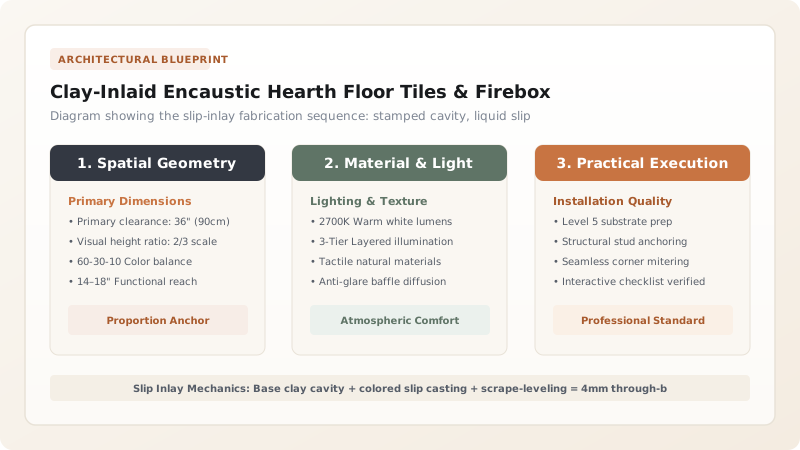
- The Stamped Cavity: A base tile of dense red or chocolate-brown plastic clay is pressed inside a steel mold. The face die features raised relief patterns that emboss a 3mm to 5mm deep cavity into the raw clay face.
- Liquid Slip Casting: Liquid clay slip—tinted with natural mineral oxides (buff kaolin, yellow ochre, cobalt blue, or black manganese)—is poured into the embossed cavities while the base tile is still damp.
- Slow Shrinkage Matching: Both clays must shrink at precisely the identical rate (typically 9.2% ± 0.2%) as they dry. If the inlay clay shrinks faster than the base, it pulls away, creating gaps; if it shrinks slower, it buckles and cracks.
- The Scraper Pass (Planatura): Once leather-hard, a craftsman draws a heavy steel scraper blade across the face, shaving away excess slip until the crisp, sharp geometric pattern is revealed perfectly flush with the base clay body.
3. Vitrification & Thermal Ember Resistance
The scraped tiles are fired in bottle kilns to 1,120°C to 1,180°C—well above the firing temperature of standard earthenware. At this temperature, the clay particles sinter and vitrify, reducing water absorption to under 2% to 3%.
This high density gives encaustic tiles immense compressive strength (over 80 MPa) and exceptional thermal shock endurance. When red-hot coal embers pop out of the grate and land onto the tile, the temperature can spike to 300°C in seconds. Glazed tiles would craze and discolor permanently; the vitreous unglazed encaustic tile absorbs the heat without flaking, scorching, or cracking.
Encaustic Tile Mineral Formulations & Colors
Use this reference table to calculate exact physical dimensions, ratios, and specifications before purchasing:
| Inlay Clay Color | Base Raw Material | Mineral Pigment Addition | Firing Temperature Range |
|---|---|---|---|
| Buff / Cream White | Devon Ball Clay + Kaolin | Zero (natural calcination white) | 1,120°C to 1,160°C |
| Terracotta Red | Etruria Marl Iron Clay | Zero (natural 8% Fe2O3 hematite) | 1,100°C to 1,140°C |
| Jet Black | Dark local ball clay | 6% Manganese dioxide + 2% Cobalt | 1,140°C to 1,180°C |
| Cobalt Blue | White kaolin slip | 3% Cobalt aluminate blue | 1,120°C to 1,150°C |
Installation Constraints
Every successful decoration project must account for physical and environmental constraints:
Hearth Extension Sizing
The tiled hearth must extend at least 300mm in front of the fireplace opening to catch flying embers safely.
Lippage Tolerance
Because encaustic tiles are unglazed and flat, edge lippage must not exceed 0.5mm to avoid catching coal scuttle rims.
Protocol for Laying an Encaustic Fireplace Hearth
Execute this professional sequence to achieve flawless results without backtracking:
Subfloor Slab Verification
Inspect concrete hearth base; verify slab is non-combustible, level to 1mm tolerance, and fully cured.
Dry-Lay Centerline Mapping
Snap chalk lines connecting the firebox centerline to the hearth edge; dry-lay tiles from center outward to establish border cuts.
Tile Pre-Wetting Protocol
Dip encaustic tiles in clean water for 30 seconds to suppress surface suction while maintaining saturated surface-dry state.
Refractory Bedding Mortar
Trowel a 6mm bed of heat-resistant lime-cement mortar with a notched trowel; butter backs of individual tiles.
Level Tamping with Beater Batten
Press tiles into bed with 1.5mm joint spacing; tamp level across multiple tiles using a wide wooden batten to eliminate lippage.
Dark Charcoal Grouting
Grout with fine dark gray or black non-sanded refractory grout; sponge clean immediately with fresh water.
Common Mistakes & Countermeasures
Avoid these costly errors that compromise aesthetics, ergonomics, and budget:
Using light-colored or white grout across an encaustic hearth
Applying topical gloss acrylic sealers over encaustic hearth tiles
Project Execution Checklist
Track your physical progress. Checkboxes persist automatically on this device:
Frequently Asked Questions
How do you remove old wax and dirt buildup from historic encaustic tiles?
Scrub the tiles with warm water and liquid black soap using a medium-stiff natural bristle brush. For stubborn grease and old wax, apply a paste of bicarbonate of soda and water, let sit for 20 minutes, scrub gently, and rinse thoroughly with clean water.
Why are encaustic tiles called 'encaustic' if no wax is used in modern manufacturing?
The term 'encaustic' originally referred to ancient Greek wax-painting techniques (from Greek 'enkaustikos' meaning burning in). In the 19th century, Victorian antiquarians mistakenly believed medieval inlaid tiles were made using colored wax enamels; by the time the slip-inlay technique was proven, the name 'encaustic' was permanently fixed in the architectural lexicon.


