
Portuguese Azulejos are monumental tin-glazed ceramic tiles (traditionally 14cm × 14cm) that clad the exterior facades and church interiors of Lisbon, Porto, and Sintra. Dating from the 16th century through the Baroque and Pombaline eras, azulejos utilize opaque white stanniferous (tin-opacified) glazes hand-painted with cobalt blue (azul) mineral pigments. Bedded in flexible natural hydraulic lime mortars, they protect building masonry from Atlantic humidity while transforming entire streetscapes into monumental public art.
At a Glance: Key Takeaways
- Tin-Opacified Stanniferous Glaze: Fusing tin oxide (SnO2) with silica to create a milk-white, light-reflecting ceramic enamel.
- Cobalt Blue Pigmentation: High-temperature cobalt oxide (CoO) firing to brilliant ultramarines that never fade under sunlight.
- Pombaline Urban Revetments: Post-1755 Lisbon earthquake standard using ceramic facades for fire-spread and damp defense.
- Breathable Hydraulic Lime Bedding: Setting tiles in NHL 2 or NHL 3.5 lime mortar to allow substrate vapor evaporation without salt blistering.
- Architectural Trompe-l'Œil Framing: Fictive balustrades, cartouches, drapery, and religious panels extending architectural perspective.
In-Depth Guides in this Directory
Explore specialized subtopic blueprints, technical dimensions, and execution checklists:
Tin-Opacified Stanniferous Glazes & Cobalt Pigment Firing Chemistry
Pyrotechnology of Portuguese azulejos: tin oxide opacification, cobalt oxide painting chemistry, and high-temperature kiln oxidation.
Architectural Trompe-l'Œil Panels & Baroque Altarpiece Surrounds
Compositional perspectives, architectural illusionism, and modular layout of Baroque azulejo panels in Portuguese palaces and churches.
Salt Efflorescence Prevention & Hydraulic Lime Tile-Setting Standards
Subflorescence mitigation, desalination poultices, and NHL natural hydraulic lime bedding protocols for historic Portuguese azulejo revetments.
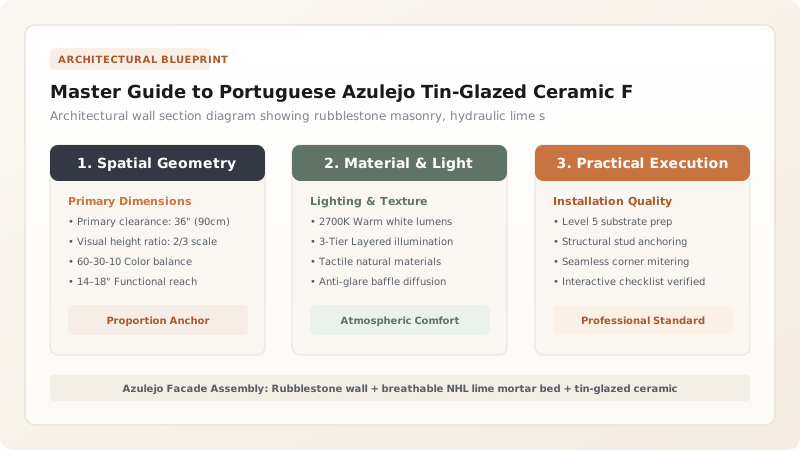
1. History & Evolution of the Portuguese Azulejo
Derived from the Arabic al-zillīj ('polished stone'), the azulejo was introduced to Portugal in the late 15th century by King Manuel I following his visits to Moorish Seville. What began as geometric relief-cut tilework evolved during the 17th and 18th centuries into a uniquely Portuguese architectural art form: monumental historiated narrative tile panels executed in monochrome cobalt blue and white.
Following the catastrophic 1755 Lisbon Earthquake, Prime Minister the Marquis of Pombal industrialized azulejo production. Entire four-story residential facades across the rebuilt Baixa district were covered from ground to roofline in glazed ceramic tiles. This was not merely ornamental: the impervious glazed surface acted as an extraordinary protective raincoat against driving Atlantic salt rains, while providing a non-combustible firebreak between neighboring townhouses.
2. The Chemistry of the Stanniferous (Tin) Glaze
Unlike transparent lead glazes used on rustic pottery, authentic azulejos rely on stanniferous (tin-opacified) glaze—the core technology of majolica and faience:
A base glaze of silica sand (\(\text{SiO}_2\)), lead oxide (\(\text{PbO}\)), and soda ash is melted and ground into a fine powder. To this, artisans add 5% to 8% tin oxide (stannic oxide, \(\text{SnO}_2\)). When applied as a liquid slip over a porous terracotta biscuit tile (chacota) and fired to 980°C to 1,020°C, the tin oxide does not dissolve into the glass; instead, microscopic suspended \(\text{SnO}_2\) crystals precipitate throughout the glass layer.
These micro-crystals scatter incoming light waves, rendering the glaze completely opaque, milk-white, and brilliantly reflective, providing a luminous backdrop for painted cobalt brushwork.
3. Hydraulic Lime Bedding & Salt Efflorescence Prevention
The foremost cause of azulejo failure across historic Portuguese facades is improper mortar selection. When tiles are set using modern Portland cement adhesives, the impervious cement traps subterranean ground moisture behind the wall.
Soluble salts (halite, gypsum, and nitrates) dissolved in the groundwater migrate toward the surface. Blocked by the cement and the impermeable glazed tile face, the salts crystallize directly at the mortar-tile interface (subflorescence). As salt crystals expand, they exert crystallization pressures exceeding 50 MPa, popping the glazed tile off the wall or fracturing the ceramic biscuit into crumbly dust.
Conservation standards dictate that exterior azulejos must be bedded in Natural Hydraulic Lime (NHL 2 or NHL 3.5) and clean silica sand. The microporous lime allows water vapor to breathe outward through the 2mm tile joints without generating salt crystallization pressures.
Portuguese Azulejo Production & Installation Standards
Use this reference table to calculate exact physical dimensions, ratios, and specifications before purchasing:
| Technical Metric | Authentic Artisanal Portuguese Azulejo | Modern Industrial Ceramic Replica | Performance & Heritage Impact |
|---|---|---|---|
| Biscuit Body (Chacota) | Hand-pressed porous calcareous clay (14cm × 14cm) | Extruded dust-pressed white porcelain stoneware | Open pore structure keys perfectly to hydraulic lime mortar |
| Glaze Composition | Lead-alkali frit opacified with 6% tin oxide (SnO2) | Zirconium silicate opacified lead-free glaze | Milk-white depth and micro-crazing luster vs cold sterile white |
| Painting Technique | Freehand majolica painting onto raw unfired glaze | Screen-printed or digital inkjet ceramic printing | Fluid calligraphic brushwork with varying cobalt tone depths |
| Installation Mortar | NHL 2 / NHL 3.5 natural hydraulic lime mortar | Polymer-modified Portland cement thin-set | Complete subfloor vapor breathability vs salt spalling risk |
| Joint Detailing | 1.5mm to 2.5mm tight lime joints | 4mm to 6mm modern sanded cement grout | Historic continuous narrative continuity across facade panels |
Conservation & Structural Constraints
Every successful decoration project must account for physical and environmental constraints:
Biscuit Moisture Expansion
High-calcium clay biscuits expand 0.05% when saturated; leave 2mm joints to prevent compressive edge-spalling.
Theft Prevention
Historic 18th-century facade azulejos are prime targets for illegal removal; use lime mortars with high shear cohesion.
Protocol for Laying and Painting Hand-Crafted Azulejo Tiles
Execute this professional sequence to achieve flawless results without backtracking:
Biscuit Firing (Primeira Cozedura)
Hand-mold 14cm × 14cm × 12mm clay tiles; dry slowly for 3 weeks and fire to 950°C to create porous chacota biscuits.
Stanniferous Glaze Dipping
Dip biscuits into liquid tin-lead glaze suspension; allow to dry into a powdery, chalky white coating.
Pouncing Design Transfer (Estampilhado)
Prick cartoon drawings with needles; rub powdered charcoal (estamilho) through perforations to transfer outlines onto raw glaze.
Cobalt Blue Brush Painting
Paint freehand with natural cobalt oxide ground in water; modulate shading from delicate sky-blue to deep navy.
High-Fire Glaze Fusion
Fire painted tiles to 1,020°C in an oxidizing kiln atmosphere, permanently fusing glaze and pigment into vitreous enamel.
Hydraulic Lime Bedding & Grouting
Soak biscuits in water; bed into 10mm NHL 3.5 lime mortar; fill hairline 2mm joints with pure slaked lime putty.
Common Mistakes & Countermeasures
Avoid these costly errors that compromise aesthetics, ergonomics, and budget:
Setting exterior facade azulejos with impermeable Portland cement thin-set
Painting over fired glazed tiles with cold enamel or acrylic paint during restoration
Project Execution Checklist
Track your physical progress. Checkboxes persist automatically on this device:
Frequently Asked Questions
Why are Portuguese azulejos predominantly blue and white?
In the late 17th century, the global luxury market was swept by a craze for Chinese Ming Dynasty blue-and-white porcelain imported by the Dutch East India Company. Portuguese ceramicists responded by abandoning earlier polychrome tiles in favor of the sophisticated monochrome cobalt blue and white aesthetic, which became Portugal's national architectural signature.
How do you clean dirt and algae off historic facade azulejos?
Never use high-pressure washers, acidic descalers, or abrasive scouring pads, which shatter fragile glaze crazing. Clean gently with warm water, soft horsehair brushes, and pH-neutral conservation soaps (such as non-ionic surfactants like Vulpex or Synperonic A7).


