
Preserving historic azulejos requires mitigating salt crystallization (subflorescence). Rising damp containing soluble nitrates, chlorides, and sulfates wicks into masonry walls; if trapped behind impermeable modern cements, crystallization pressures (up to 50 MPa) detach the glazed tiles. Restoration mandates setting tiles in breathable Natural Hydraulic Lime (NHL 2) mortars that allow water vapor to escape harmlessly through joints.
At a Glance: Key Takeaways
- Subflorescence Crystallization Pressure: Salt crystals generating destructive forces exceeding 50 MPa at the biscuit-mortar interface.
- Natural Hydraulic Lime (NHL 2 / NHL 3.5): Breathable, flexible mortar binder with low elastic modulus and zero soluble alkalis.
- Desalination Cellulose Poulticing: Extracting ground salts from loosened tiles using demineralized water and Arbocel cellulose pulp.
- Capillary Break Construction: Installing lime-gravel French drains at building plinths to stop rising damp at the source.
- Glaze Crazing (Craquelê) Sealing: Consolidating antique fractured glaze networks with microcrystalline wax.
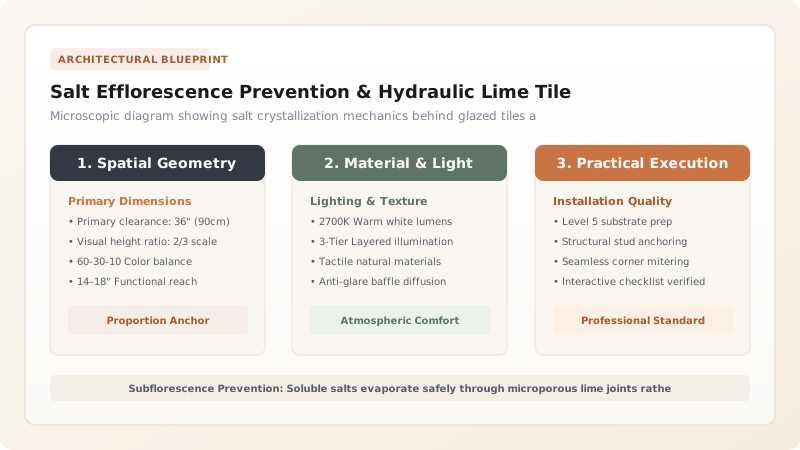
1. The Thermodynamics of Subflorescence & Tile Detachment
Historic stone and brick masonry in Lisbon and Porto is perpetually subject to rising damp carrying soluble salts: halite (\(\text{NaCl}\)) from ocean salt spray, gypsum (\(\text{CaSO}_4\cdot 2\text{H}_2\text{O}\)) from acidic rain, and nitrates from historical soil contamination.
Because the glazed ceramic face of an azulejo is completely vitreous and impermeable, moisture cannot evaporate through the front of the tile. Water must travel toward the tile edges. When ambient humidity drops, the salt solution becomes supersaturated:
If salt crystallizes within the open porous biscuit or at the mortar interface (subflorescence), crystallization pressure \(\Delta P_{\text{crystal}}\) can exceed 50 to 100 MPa. Because the tensile strength of porous terracotta biscuit is only 2 to 4 MPa, the expanding salt crystals pulverize the ceramic biscuit into powder, popping the glazed surface cleanly off the wall.
2. The Chemistry of Natural Hydraulic Lime (NHL 2) Bedding
To prevent subflorescence destruction, conservators strictly reject Portland cement adhesives. Portland cement has two fatal flaws: it is vapor-impermeable (trapping salts), and it contains high concentrations of soluble alkalis (sodium and potassium sulfates) that directly contribute new salts to the wall.
The international conservation standard is Natural Hydraulic Lime (NHL 2 or NHL 3.5):
- High Vapor Breathability: NHL 2 mortar has a water vapor diffusion resistance coefficient of \(\mu \approx 6\text{ to }10\), allowing moisture vapor to migrate freely through the joints and evaporate safely into the open air.
- Low Compressive Modulus: Its low modulus of elasticity (\(E \approx 4\text{ to }6\text{ GPa}\)) absorbs seasonal thermal expansion without transferring shear stresses to the fragile antique ceramic biscuits.
- Salt Purity: Certified NHL limes contain less than 0.1% soluble salts, introducing zero chemical hazards to the historic fabric.
3. Desalination Protocols for Salvaged Antique Tiles
Before an antique detached azulejo can be reinstalled, absorbed salts must be extracted. If a salt-laden tile is bedded into new mortar, the residual salts will immediately react with moisture and re-crystallize.
Tiles undergo immersion desalination: tiles are submerged in baths of demineralized water. Electrical conductivity (\(\mu\text{S/cm}\)) of the bath water is monitored daily using digital conductivity meters. As salts leach out of the porous biscuit, water is replaced every 48 hours until conductivity drops below 50 \(\mu\text{S/cm}\), indicating that over 95% of soluble chlorides and nitrates have been removed.
Mortar Selection for Azulejo Facade Installation & Restoration
Use this reference table to calculate exact physical dimensions, ratios, and specifications before purchasing:
| Mortar Binder | Vapor Diffusion Resistance (μ) | Soluble Alkali Content | Heritage Conservation Status |
|---|---|---|---|
| Natural Hydraulic Lime (NHL 2) | μ = 6 to 8 (highly breathable) | < 0.05% (zero salt hazard) | Approved international conservation standard |
| Natural Hydraulic Lime (NHL 3.5) | μ = 10 to 12 (breathable) | < 0.08% (safe) | Standard for exposed exterior facade revetments |
| Air-Lime Putty (CL90) + Pozzolana | μ = 8 to 10 | Near zero | Excellent for sheltered cloister interiors |
| Modern Portland Cement Thin-Set | μ = 30 to 50 (vapor barrier) | > 1.5% (high salt risk) | STRICTLY FORBIDDEN (causes irreversible tile destruction) |
Conservation Constraints
Every successful decoration project must account for physical and environmental constraints:
Desalination Duration
Complete desalination of heavily contaminated tiles can take between 4 and 12 weeks of continuous water baths.
Structural Wall Movement
Historic rubble walls settle continuously; lime bedding must remain low-modulus to absorb building micro-movement.
Protocol for Desalination and Re-Bedding of Historic Azulejos
Execute this professional sequence to achieve flawless results without backtracking:
Careful Extraction & Labeling
Gently chisel old degraded mortar from behind loose tiles using wooden wedges; record coordinates on archival sheets.
Immersion Desalination Bath
Soak detached tiles in demineralized water baths; change water until electrical conductivity drops below 50 µS/cm.
Substrate Masonry Raking & Flushing
Rake stone joints to 20mm depth; flush wall with clean water and apply a sacrificial lime poultice to extract wall salts.
NHL 2 Scratch Coat Application
Trowel an 8mm basecoat of NHL 2 hydraulic lime and washed quartz sand; allow to cure for 14 days under damp burlap.
Azulejo Re-Bedding
Butter tile backs with fresh NHL 2 lime paste; seat tiles firmly along original alignment lines, leaving 2mm joints.
Breathable Lime Pointing
Point joints with a fine slurry of non-hydraulic lime putty (CL90) and silver silica sand; sponge clean immediately.
Common Mistakes & Countermeasures
Avoid these costly errors that compromise aesthetics, ergonomics, and budget:
Re-installing salvaged azulejos without prior desalination washing
Sealing exterior tile joints with modern silicone or polyurethane caulking
Project Execution Checklist
Track your physical progress. Checkboxes persist automatically on this device:
Frequently Asked Questions
Can broken or missing azulejos be repaired seamlessly?
Yes. Ceramic conservators bond fractured biscuits using reversible acrylic adhesives (such as Paraloid B72), fill missing areas with mineral micro-balloons in lime paste, and retouch painted losses using high-stability reversible conservation enamels.
Why shouldn't you clean azulejos with household bleach or vinegar?
Vinegar contains acetic acid, which dissolves the calcium carbonate binder in the mortar and etches the glaze. Bleach introduces sodium hypochlorite salts into the porous ceramic biscuit, directly triggering severe subflorescence salt crystallization that shatters the tile.


