
The signature luminescence of Portuguese azulejos derives from the chemistry of stanniferous majolica glazes. A lead-silicate glass is rendered opaque white through suspended tin oxide (SnO2) micro-crystals. Painting directly onto the unfired raw glaze with pulverized cobalt aluminate pigments results, upon 1,020°C firing, in vitreous fusion where blue cobalt ions dissolve into the molten glaze matrix.
At a Glance: Key Takeaways
- Tin Dioxide Opacification: 5% to 8% SnO2 creating refractive index mismatch that scatters light waves into brilliant white.
- Cobalt Aluminate Glass Dissolution: CoO dissolving into the silicate melt to form a tetrahedral cobalt-silica coordinate complex.
- Raw Glaze In-Glaze Painting (Gran Fuego): Painting onto chalky unfired glaze where corrections are impossible.
- Calcareous Biscuit Chemistry: 15% to 20% CaCO3 in clay reacting with silica to eliminate glaze crazing (thermal matching).
- Oxidizing Kiln Dynamics: Pure oxygen environment required to prevent cobalt reduction from turning gray or black.
1. The Refractive Physics of Stannic Oxide (SnO2)
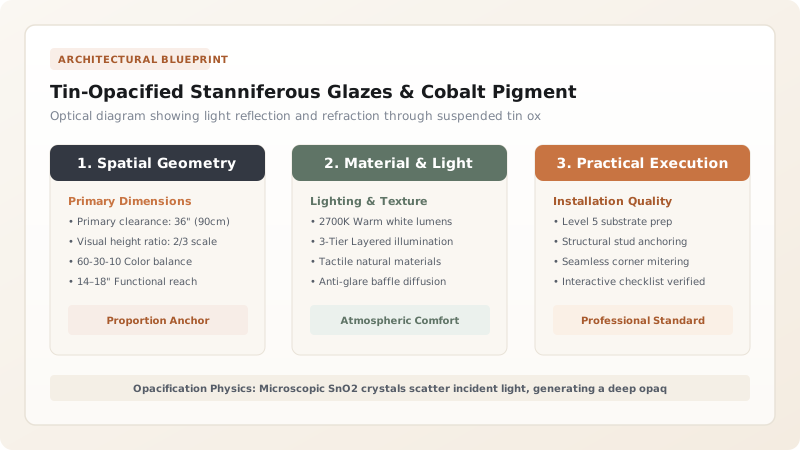
The opaque milk-white color of an azulejo is not caused by a white dye or pigment; it is caused by Mie scattering of light waves within the glassy matrix. Lead-silicate glass has a refractive index of approximately \(n_{\text{glass}} \approx 1.55\), while tin oxide crystals have a much higher refractive index of \(n_{\text{tin}} \approx 2.04\).
When light enters the glaze, the extreme refractive index mismatch between the glass and the suspended sub-micron \(\text{SnO}_2\) particles causes light to bounce repeatedly inside the glaze before reflecting out. This omnidirectional scattering creates an incomparable depth of white—warm, slightly translucent, and far more luminous than modern industrial zirconium silicate glazes (\(\text{ZrSiO}_4\)), which appear harsh, flat, and sterile.
2. Cobalt Oxide (CoO) Coordination Chemistry
The blue color of azulejos is produced by cobalt oxide (\(\text{CoO}\)), historically sourced from German Saxony or North African mineral deposits. Cobalt is an extraordinarily intense colorant: a concentration of merely 0.25% to 1.5% is sufficient to produce deep, vibrant blue.
When fired to 1,020°C, the cobalt oxide dissolves into the liquid silicate melt, where cobalt ions (\(\text{Co}^{2+}\)) enter four-fold tetrahedral coordination with oxygen atoms within the silica network: \([\text{CoO}_4]^{6-}\). This tetrahedral coordination produces three intense optical absorption bands across the yellow, green, and red spectrum, transmitting only pure, luminous deep blue and ultraviolet wavelengths.
3. The 'Gran Fuego' Technique: Painting on Raw Glaze
Azulejos are painted using the demanding gran fuego (high-fire in-glaze) technique. The biscuit tile is dipped in the liquid tin glaze suspension and dried until it forms a powdery, fragile white crust. The painter must paint directly onto this absorbent, chalk-like surface with squirrel-hair brushes dipped in water-ground cobalt pigment.
The powdery glaze instantly sucks the water out of the brush; strokes cannot be erased, blended, or reworked. Every brushstroke must be decisive and final. Furthermore, before firing, raw cobalt oxide appears as a dull, dirty gray-black powder; the artist must mentally visualize the final brilliant blue hues based entirely on the thickness of the applied gray wash.
Stanniferous Glaze & Pigment Firing Formulations
Use this reference table to calculate exact physical dimensions, ratios, and specifications before purchasing:
| Glaze Component | Percentage by Weight | Chemical Formula | Technical Function |
|---|---|---|---|
| Silica Quartz Sand | 50% to 55% | SiO2 | Primary glass-forming network |
| Lead Minium (Red Lead) | 30% to 35% | Pb3O4 | Fluxing agent lowering melting point and adding high gloss |
| Tin Oxide (Stannic Oxide) | 5% to 8% | SnO2 | Opacifying crystals creating milk-white opacity |
| Potassium / Sodium Carbonate | 5% to 8% | K2CO3 / Na2CO3 | Secondary fluxes to balance glaze viscosity |
| Cobalt Carbonate Pigment | 0.5% to 2.0% | CoCO3 | Yields brilliant in-glaze blue upon oxidation firing |
Toxicity & Pyrotechnic Constraints
Every successful decoration project must account for physical and environmental constraints:
Lead Glaze Handling
Traditional lead formulations require certified dust-extraction hoods and respirators during dipping; modern architectural replicas use lead-free alkali boro-silicates.
Thermal Shock Annealing
Kiln cooling must proceed slowly over 18 hours to prevent cooling crazing (crackle) from fracturing the glaze bond.
Protocol for Compounding Glazes and Firing Azulejos
Execute this professional sequence to achieve flawless results without backtracking:
Frit Melting & Ball Milling
Melt silica, lead, and tin in crucibles at 1,150°C; pour into cold water to thermal-shock into frit; ball-mill to 45-micron powder.
Liquid Slip Suspension
Mix powdered frit with potable water and 0.5% bentonite clay suspending agent to reach 1.65 g/cm³ specific gravity.
Chacota Glaze Dipping
Dip porous biscuit tiles for exactly 3 seconds; allow surface water to flash off into a dry, chalky 0.8mm white crust.
Mineral Pigment Grinding
Grind cobalt oxide with water and gum arabic on a glass slab using a glass muller to ultra-fine liquid consistency.
Majolica Brush Execution
Paint the historiated design freehand onto the chalky glaze, modulating wash thickness for tonal gradation.
Oxidizing Kiln Firing
Fire tiles in an electric or gas kiln with excess air to 1,020°C over 12 hours; soak at peak for 30 minutes to achieve high gloss.
Common Mistakes & Countermeasures
Avoid these costly errors that compromise aesthetics, ergonomics, and budget:
Firing in a reducing (smoky) kiln atmosphere
Applying the tin glaze layer too thickly (> 1.2mm)
Project Execution Checklist
Track your physical progress. Checkboxes persist automatically on this device:
Frequently Asked Questions
What happens if a painter makes a mistake on the raw glaze?
On raw tin glaze, mistakes cannot be erased. If an error is made, the artisan must scrape away the entire glaze coat with a spatula, re-dip the biscuit tile in fresh glaze, and start the painting completely from the beginning.
Why does cobalt blue never fade under centuries of outdoor sunlight?
Unlike organic paints and synthetic dyes that break down under ultraviolet radiation, cobalt blue in an azulejo is an inorganic mineral crystal dissolved inside a molten glass silicate network. It is chemically inert and completely permanent, surviving thousands of years of direct solar exposure without fading.


