
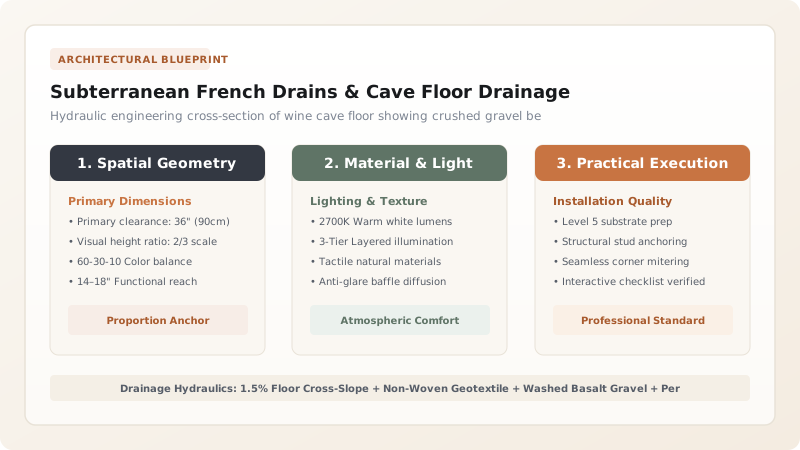
Subterranean French drain trenches and floor percolation gravel beds are specialized subterranean drainage assemblies designed to manage natural groundwater weeping in wine caves. Comprising perimeter cast-in-place concrete trenches sloped at 1.5% minimum grade, wrapped in non-woven needle-punched geotextile filter fabrics and backfilled with washed 20mm basalt gravel surrounding perforated corrugated pipe, they capture water weeping from rock walls and discharge it via gravity daylight outfalls or dual redundant sump stations.
At a Glance: Key Takeaways
- Perimeter Weep Interception: Cast-in-place gutter trenches at cave footing lines capturing wall seepage directly from shotcrete weep wicks.
- Washed Pea Gravel Beds: High-permeability stone bed allowing natural barrel washing water to percolate downward without surface puddling.
- Non-Woven Geotextile Filters: 200 g/m² polypropylene fabric preventing fine rock silt and tufa dust from clogging gravel voids.
- Dual Sump Pump Redundancy: High-capacity submersible vortex pumps on separate electrical circuits with automatic float alternation.
- Natural Humidity Preservation: Open gravel drainage zones naturally evaporatively humidifying the air, sustaining 75%–85% RH for oak barrels.
1. Hydrogeology: Subsurface Seepage Rates & Darcy's Permeability Law
Subterranean wine caves excavated beneath hillsides sit within the unconfined or perched groundwater zone. Even in arid regions, winter rains infiltrate surface soil and migrate through rock fractures toward the cave excavation void.
The steady-state seepage flux \(Q\) into a subterranean tunnel trench is governed by Darcy's Law:
Where \(k\) is the hydraulic conductivity of the surrounding rock (ranging from \(10^{-5}\text{ m/s}\) in fractured sandstone to \(10^{-8}\text{ m/s}\) in dense tufa), \(A\) is seepage surface area, and \(dh/dL\) is the hydraulic gradient. Attempting to completely block this water with waterproof plaster is dangerous—trapped water generates hydrostatic pressure (\(p = \rho g h\)) that cracks concrete linings.
The correct engineering strategy is Controlled Depressurization & Drainage: allow water to seep harmlessly out of the rock through vertical wick drains into a perimeter subfloor trench, keeping structural walls completely stress-free. Review tunnel shoring in our guide to shotcrete arch liners.

2. Trench Engineering: Sizing, Geotextiles & Hydraulic Slopes
The perimeter drainage system runs along both sides of the cave floor directly beneath the wall-footing junction:
- Trench Dimensions: Cast-in-place reinforced concrete trenches measuring \(250\text{ mm}\) wide by \(300\text{ mm}\) deep, sloped at a minimum grade of \(1.5\%\) (1:66) toward the cave portal or collection sump.
- Geotextile Filter Wrap: The trench is lined with a continuous layer of non-woven, needle-punched polypropylene geotextile (apparent opening size \(O_{95} \approx 0.15\text{ mm}\)), preventing migration of fine rock particulates that cause siltation.
- Washed Aggregates: Backfilled with double-washed \(20\text{ to } 25\text{ mm}\) crushed basalt or granite (void ratio \(e \approx 0.40\)), ensuring rapid gravity percolation. Limestone gravel is avoided because acidic cave runoff can slowly dissolve carbonate rock. Connect to architectural portals in our French limestone portals guide.
3. Winery Sanitation & Dual Redundant Sump Stations
In addition to groundwater, cave floors must handle process water from periodic barrel washing, topping, and sanitizing:
- Floor Infiltration Bed vs Solid Slab: In storage galleries, central aisles feature concrete vehicle slabs for forklifts, bordered by 1.5-meter-wide crushed gravel beds where oak barriques sit. Spilled wine or wash water percolates instantly through the gravel, eliminating puddles that harbor fruit flies and acetic bacteria.
- Duplex Sump Stations: If the cave floor is below exterior daylight grade, trenches terminate in a fiberglass sump basin equipped with Duplex Submersible Vortex Impeller Pumps. Controlled by ultrasonic level transducers, the pumps alternate cycles; if water rises above high-water alarm, both pumps activate simultaneously, backed by an uninterruptible battery inverter system. Compare with rill waterway systems in formal rills and waterways.
Subterranean Cave Floor Drainage Options
Use this reference table to calculate exact physical dimensions, ratios, and specifications before purchasing:
| Drainage System | Perimeter French Trench with Grate | Full Permeable Crushed Gravel Bed | Monolithic Sloped Concrete with Central Slot Drain |
|---|---|---|---|
| Groundwater Capture | Excellent (intercepts wall weep directly) | Superior (absorbs from entire floor area) | Poor (water pools on slab surface) |
| Forklift & Equipment Access | Excellent (solid central slab) | Poor (gravel impedes pallet jacks) | Superior (completely flat concrete) |
| Natural Humidity Contribution | High (exposed gravel evaporation) | Very High (natural water reservoir) | Low (water drained immediately) |
| Barrel Sanitation Handling | Good (requires washing bays) | Superior (spills percolate immediately) | Requires frequent squeegee maintenance |
| Maintenance Needs | Annual jetting of cleanouts | Gravel re-raking every 2 years | Daily washing and slot drain clearing |
Cave Hydraulic & Drainage Constraints
Every successful decoration project must account for physical and environmental constraints:
Bacterial Slime (Iron Ochre) Clogging
Groundwater with high dissolved ferrous iron reacts with air in drain trenches, fostering iron bacteria that deposit thick orange ochre sludge. Cleanout access risers must be placed every 20 meters for rotary hydro-jetting.
Sump Pump Electrical Blackout During Storms
Winter storms that generate peak groundwater inflows frequently knock out regional power grids. Sump stations must have an automatic transfer switch connected to an auxiliary standby diesel generator.
Excessive Humidity & Mold Outbreaks
If drainage water is allowed to sit stagnant in flat trenches, relative humidity can spike above 95%, causing black mold to destroy barrel staves. Trenches must maintain continuous positive slope without stagnant pockets.
Subterranean French Drain Trench Installation
Execute this professional sequence to achieve flawless results without backtracking:
Trench Excavation & Laser Bed Grading
Excavate perimeter trenches along cave footings using mini-excavator with rock-ripper tooth; grade trench bed to 1.5% fall using pipe laser.
Forming & Concrete Trench Casting
Erect timber forms and pour 100mm reinforced concrete trench trough to prevent water from undermining the main tunnel footings.
Geotextile Lining & Base Gravel Bedding
Line concrete trough with 200 g/m² non-woven geotextile, leaving 300mm excess flap on each side; place 50mm bedding layer of washed basalt gravel.
Perforated Pipe Placement & Cleanout Risers
Lay 110mm heavy-duty smooth-interior perforated corrugated HDPE drain pipe with perforation holes facing downward; install 90-degree swept cleanout tees every 20m.
Gravel Infill & Geotextile Envelope Lap
Backfill trench with washed 20mm aggregate to within 50mm of top; fold geotextile flaps over gravel with 150mm overlap to seal against silt ingress.
Cast Iron Trench Grates & Outfall Commissioning
Set heavy-duty ductile iron heel-proof trench grates flush with finished floor; verify uninhibited gravity daylight outfall discharge.
Common Mistakes & Countermeasures
Avoid these costly errors that compromise aesthetics, ergonomics, and budget:
Installing Perforations Facing Upward
Using Crushed Recycled Concrete or Limestone Gravel
Omitting Cleanout Access Points
Project Execution Checklist
Track your physical progress. Checkboxes persist automatically on this device:
Frequently Asked Questions
Why is a French drain named 'French'?
The French drain is named after Henry Flagg French (1813–1885) of Concord, Massachusetts, a lawyer and Assistant US Treasury Secretary who popularized the system in his 1859 book 'Farm Drainage'. It is not named after the country of France.
How does water enter the pipe if the holes face downward?
Water seeps downward through the permeable gravel bed until it hits the impermeable trench bottom, creating a localized water table that rises into the pipe perforations from below. This ensures the trench drains completely dry rather than holding stagnant water.
Can wine cave drainage water be reused for vineyard irrigation?
Yes! Because natural subterranean groundwater collected in cave French drains has filtered through hundreds of feet of natural mineral rock strata, it is exceptionally clean and free of biological pathogens. Many Napa and Sonoma wineries pipe cave drainage directly into their vineyard retention ponds for summer irrigation.


