
A vaulted stone wine cave is a subterranean viticultural vault excavated into natural rock strata (typically volcanic tufa, sandstone, or chalk) using roadheaders or continuous mining techniques following the New Austrian Tunnelling Method (NATM). Reinforced with pattern rock bolts and steel-fiber-reinforced shotcrete structural arch liners, and faced with hand-carved limestone ashlar portals, it provides permanent, zero-energy passive climate stability (13°C–15°C and 75%–85% RH) while accommodating hundreds of oak aging barriques.
At a Glance: Key Takeaways
- NATM Tunneling Mechanics: Semi-elliptical or parabolic arch cross-section converting overburden rock lithostatic pressure into pure compressive hoop thrust.
- Tufa & Sedimentary Excavation: Mechanical roadheader cutting into soft volcanic tufa or chalk without damaging seismic shock waves from blasting.
- Rock Bolt & Shotcrete Shoring: 2.5m resin-anchored or swellable rock bolts combined with 100mm silica-fume wet-mix shotcrete liners.
- Hand-Dressed Stone Portals: Reclaimed French limestone (Charentes/Burgundy) masonry voussoirs anchored with stainless steel dowels and lime mortar.
- Passive Percolation Drainage: Sloped perimeter subfloor French drains and washed crushed pea gravel beds capturing natural seepage without ponding.
In-Depth Guides in this Directory
Explore specialized subtopic blueprints, technical dimensions, and execution checklists:
Shotcrete Cave Arch Liners & Rock Bolt Anchoring
Geotechnical engineering guide for wine cave rock stabilization: steel-fiber wet-mix shotcrete mix designs, Swellex hydraulic rock bolts, Q-system rock mass rating, and crown load calculations.
Reclaimed French Limestone Portals: Voussoirs & Arch Thrusts
Stone masonry engineering guide for monumental wine cave portals: reclaimed Charentes limestone cutting, voussoir stereotomy, keystone thrust vectors, and timber centering falsework.
Subterranean French Drains & Cave Floor Drainage
Civil engineering guide for wine cave groundwater management: perimeter French drain trench sizing, washed river gravel beds, sump pump redundancy, and relative humidity equilibria.
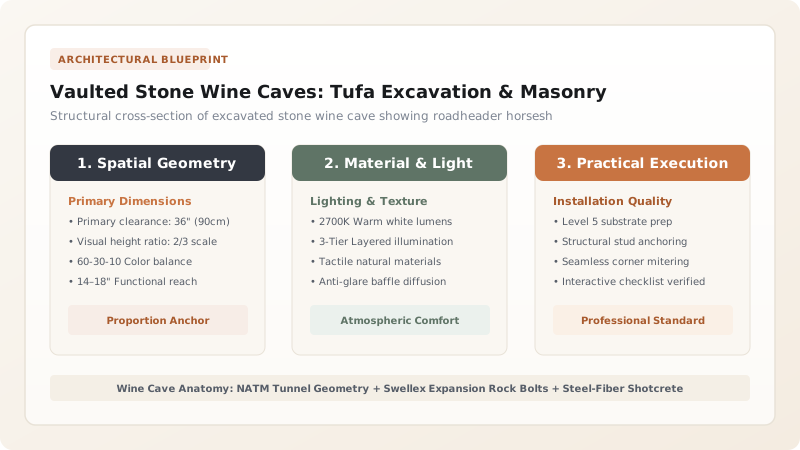
1. Subterranean Excavation: Tufa Stratigraphy & Parabolic Arch Geometry
Excavating an underground wine cave requires selecting suitable geological strata—most famously Volcanic Tufa (tuff), porous chalk, or consolidated sandstone. Tufa possesses the unique property of being easily carved while underground, yet case-hardening upon exposure to atmospheric air as carbonate minerals precipitate.
Excavation is executed using a Boom-Mounted Milling Roadheader. Blasting with explosives is strictly avoided in residential and winery caves because shockwaves shatter natural rock fractures and compromise overburden integrity.
The tunnel profile follows a Parabolic or Modified Horseshoe Arch rather than a flat ceiling. According to subterranean rock mechanics, the vertical overburden lithostatic pressure \(\sigma_v = \gamma \cdot H\) (where \(\gamma\) is rock unit weight and \(H\) is overburden depth) is redirected around the void via compressive arching stress:
Where \(K\) is the lateral earth stress ratio. A parabolic arch keeps tension stresses at zero, ensuring the rock vault remains entirely in compression. Discover structural lining details in our deep dive on shotcrete liners and rock bolts.

2. Structural Shoring: Swellex Rock Bolts & Steel-Fiber Shotcrete
Following excavation, the exposed rock face must be stabilized to prevent spalling or slab fall-in. In accordance with the New Austrian Tunnelling Method (NATM), stabilization is achieved immediately:
- Pattern Rock Bolting: High-tensile steel or hydraulic Swellex Rock Bolts (25mm diameter, 2.4 to 3.0m length) are installed on a 1.2m x 1.2m staggered grid. The bolts pin exterior loose rock wedges back into the unyielding consolidated rock mass.
- Steel-Fiber Reinforced Wet Shotcrete: A \(100\text{ to } 150\text{ mm}\) thick shell of structural wet-mix shotcrete containing silica fume and corrugated steel fibers (dosages \(35\text{ to } 45\text{ kg/m}^3\)) is sprayed at high velocity. The steel fibers impart extreme post-crack flexural toughness (energy absorption >700 Joules under ASTM C1550).
- Architectural Gunite Carving: The final 25mm surface layer is hand-sculpted by master artisans using trowels to replicate ancient hand-chiseled stone or left as rustic rough-hewn stone texture. Connect to precast concrete pod caissons in spiral cellar caissons.
3. Architectural Portals & Percolation Drainage Channels
The transition from exterior sunlight to subterranean darkness is crowned by monumental masonry portals:
- Reclaimed French Limestone Portals: Portals are constructed from massive hand-dressed ashlar blocks of hard limestone (Burgundy or Charentes). Individual voussoirs are wedged into a precision falsework timber center, locked with a central keystone, and bedded in hydraulic lime mortar (NHL 3.5). Learn portal engineering in our guide to reclaimed limestone arch portals.
- Subterranean French Drains & Percolation: Wine caves intentionally maintain high humidity (75%–85%), which leads to natural water weeping from fissure veins. Sloped floor perimeter channels filled with washed river gravel direct seepage to an exterior gravity outfall, preventing floor pooling. Learn drainage design in passive cave drainage channels.
Subterranean Wine Cave Geological & Excavation Matrix
Use this reference table to calculate exact physical dimensions, ratios, and specifications before purchasing:
| Geological Formation | Volcanic Tufa (Tuff) | Chalk / Soft Calcarenite | Solid Sandstone / Siltstone |
|---|---|---|---|
| Excavation Ease | Very High (cuts smoothly with roadheader) | Extremely High (knife-cut consistency) | Moderate (higher pick wear on roadheader) |
| Natural Humidity Regulation | Superior (78% - 85% RH self-balancing) | Superior (80% - 90% RH) | Good (65% - 75% RH) |
| Shotcrete Liner Requirement | 100mm fiber-reinforced shotcrete | 120mm shotcrete + welded wire mesh | 75mm shotcrete or localized rock bolts |
| Case-Hardening Property | Excellent (hardens on air exposure) | Moderate (can remain friable if wet) | Low (rock already dense) |
| Typical World Location | Napa Valley, Loire Valley, Orvieto | Champagne, Loire Valley, Kent | Sonoma, Bordeaux, Rioja |
Subsurface Mining & Environmental Cave Constraints
Every successful decoration project must account for physical and environmental constraints:
Overburden Depth & Crown Collapse Risk
A subterranean wine cave must have a minimum rock overburden (pillar height above crown) equal to 1.5 to 2.0 times the tunnel span. If the crown is too close to the surface, tensile stress creates catastrophic surface sinkholes.
Uncontrolled Water Veins & Hydrostatic Springs
Hitting an active pressurized aquifer during tunneling can flood the excavation at hundreds of liters per minute. Grouting drills must pump polyurethane chemical expanding resins into the rock face ahead of the roadheader.
Radon Gas & Underground Air Quality
Deep rock excavations can release naturally occurring radioactive radon gas and stale CO2 from wine fermentation. Continuous low-volume positive-pressure mechanical ventilation with radon monitoring is mandatory.
Subterranean Wine Cave Mining & Lining Sequence
Execute this professional sequence to achieve flawless results without backtracking:
Geotechnical Drilling & Rock Quality Designation (RQD)
Drill continuous core boreholes along cave alignment; test RQD, unconfined compressive strength (UCS), and groundwater hydrology.
Portal Cut-and-Cover & Soil Stabilization
Excavate hillside portal bench; install soil nails and shotcrete breast wall to secure slope before opening the tunnel heading.
Roadheader Excavation & Progressive Mining
Mine horseshoe tunnel profile in 2-meter advances using crawler-mounted milling roadheader; haul out muck using rubber-tired dumpers.
Rock Bolt Pattern Drilling & Tensioning
Drill 32mm holes in radial pattern; insert resin-grouted or hydraulic expansion rock bolts; torque anchor plates against rock face.
Wet-Mix Steel-Fiber Shotcrete Application
Robotic spray boom applies 100mm wet-mix structural shotcrete containing silica fume and high-tensile hooked steel fibers; finish with damp hand-trowel texture.
Floor Drainage, Slab Pour & Stone Portal Erection
Install dual perimeter French drains and washed gravel trenches; pour fiber-reinforced concrete floor slab; erect reclaimed French limestone portal arch.
Common Mistakes & Countermeasures
Avoid these costly errors that compromise aesthetics, ergonomics, and budget:
Blasting with Explosives in Friable Rock
Completely Sealing Cave Walls with Impervious Resins
Inadequate Tunnel Overburden Thickness
Project Execution Checklist
Track your physical progress. Checkboxes persist automatically on this device:
Frequently Asked Questions
Why are wine caves so energy-efficient compared to surface cellars?
Subterranean wine caves maintain a completely steady year-round temperature between 13°C and 15°C (55°F–59°F) and natural humidity of 75%–85% through the sheer thermal mass of the surrounding mountain. They require zero electricity or mechanical chillers for cooling, reducing energy consumption and carbon emissions by up to 90%.
Can a wine cave collapse during an earthquake?
Underground tunnels are among the safest structures during earthquakes. Because a cave is completely enclosed within the rock mass, it moves uniformly with the ground rather than experiencing the destructive whipping and shear resonance that tears surface buildings apart. During major California earthquakes, Napa wine caves suffered zero structural damage.
What is the typical lifespan of a shotcrete-lined stone wine cave?
Engineered wine caves lined with fiber-reinforced shotcrete and stainless steel rock bolts have an engineered design life of over 100 to 150 years. Ancient natural tufa caves in the Loire Valley and Champagne have been utilized for wine aging for over 500 years.


