
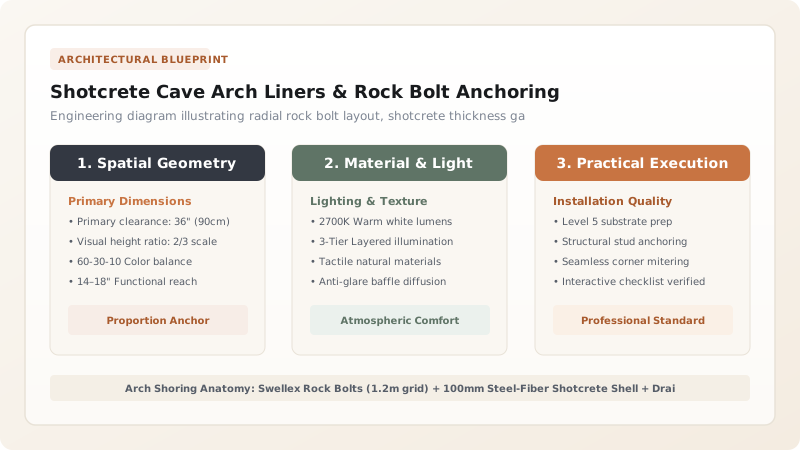
Gunite shotcrete arch liners and rock bolt anchoring form the primary structural support system for subterranean wine caves following the New Austrian Tunnelling Method (NATM). High-tensile steel or hydraulic Swellex rock bolts (2.4m–3.0m length) pin unstable rock strata into deep competent ground, while a 100mm–150mm shell of high-velocity wet-mix shotcrete dosed with hooked steel fibers (40 kg/m³) and silica fume forms a monolithic compressive arch that carries loosening rock loads.
At a Glance: Key Takeaways
- Barton Q-System Classification: Rigorous rock mass rating determining rock bolt spacing, shotcrete thickness, and fiber dosage.
- Swellex Hydraulic Expansion Bolts: High-yield steel tubes expanded with 300 bar water pressure, generating immediate full-length friction anchorage.
- High-Ductility Fiber Shotcrete: Hooked-end steel fibers providing flexural toughness and eliminating the need for slow, cumbersome welded wire mesh.
- Hydrostatic Weep Wick Drainage: Geocomposite drainage strips placed against rock face prior to shotcreting to relieve hydrostatic water head.
- High-Velocity Pneumatic Compaction: Shotcrete sprayed at 30 m/s velocity to achieve dense, void-free bonding to irregular rock surfaces.
1. Rock Mass Mechanics: Barton's Q-System & Overburden Loads
Subterranean cave stability depends on the natural structural integrity of the rock mass. Geotechnical engineers classify the rock using Barton's Rock Mass Quality Index (Q-System):
Where \(RQD\) is Rock Quality Designation, \(J_n\) is joint set number, \(J_r\) is joint roughness, \(J_a\) is joint alteration, \(J_w\) is water reduction factor, and \(SRF\) is Stress Reduction Factor. In typical volcanic tufa or chalk formations, \(Q\) ranges between 1.0 and 10.0 (Fair to Good Rock).
The required support pressure \(P_{\text{arch}}\) to stabilize the cave crown is given by:
This calculated load determines whether plain shotcrete, steel-fiber reinforcement, or heavy steel arches are required. Review overall cave planning in our vaulted stone wine caves hub.

2. Rock Anchoring: Swellex Hydraulic Bolts vs Resin Rebar
Rock bolts mobilize the strength of the rock itself by creating a reinforced compressive rock arch above the tunnel opening:
- Swellex Hydraulic Expansion Bolts: A folded tubular steel bolt (yield strength >450 MPa) is inserted into a 32mm drill hole and inflated with high-pressure water at \(300\text{ bar}\). As it expands, it deforms intimately into rock fissures, creating immediate full-length friction anchorage capable of holding \(120\text{ to } 160\text{ kN}\) within 10 seconds of inflation.
- Resin-Grouted Threaded Rebar: Twin-component polyester or epoxy resin cartridges are inserted into the borehole and spun with a high-tensile steel rebar tendon. The resin cures within 90 seconds, delivering permanent shear transfer across geological fault joints. Contrast with spiral cellar caissons in precast ring sinking.
3. Shotcrete Engineering: Steel Fibers, Silica Fume & Rebound Minimization
Modern wine caves employ Wet-Mix Shotcrete rather than dry-mix gunite due to superior quality control, lower rebound loss (<10%), and higher density:
- Hooked-End Steel Fibers: Dosed at \(35\text{ to } 45\text{ kg/m}^3\), cold-drawn hooked steel fibers (35mm length, aspect ratio 65) act as millions of micro-reinforcements distributed three-dimensionally throughout the matrix, resisting spalling and flexural shear.
- Silica Fume & Liquid Accelerators: Adding 8% silica fume densifies the cement paste, dramatically reducing permeability to water. Non-alkali liquid accelerators injected at the spray nozzle initiate initial set within \(90\text{ seconds}\), allowing thick overhead buildup (up to 120mm in a single pass) without sag. Discover stone portal craft in reclaimed limestone arch portals.
Subterranean Rock Reinforcement Specification Matrix
Use this reference table to calculate exact physical dimensions, ratios, and specifications before purchasing:
| Support Component | Light Rock Support (Q > 10) | Standard Wine Cave (Q 1 - 10) | Heavy Fault Zone (Q < 1) |
|---|---|---|---|
| Rock Bolt Type | Friction Swellex (2.0m) | Swellex or Resin Rebar (2.5m-3.0m) | Self-drilling hollow hollow core grouted bars (4.0m) |
| Bolt Spacing Grid | 2.0m x 2.0m staggered | 1.2m x 1.2m staggered | 0.8m x 0.8m with heavy bearing plates |
| Shotcrete Thickness | 50mm plain or synthetic fiber | 100mm - 120mm steel-fiber | 150mm - 200mm shotcrete + steel lattice girders |
| Fiber Dosage | 25 kg/m³ synthetic or steel | 40 kg/m³ hooked steel fibers | 50 kg/m³ steel fibers + welded rebar mat |
| 28-Day Compressive Strength | 30 MPa (C25/30) | 40 MPa (C35/45) | 50 MPa (C40/50 high strength) |
Geotechnical Tunnel Support Challenges
Every successful decoration project must account for physical and environmental constraints:
Over-Excavation Cavities & Shadowing
If rock spalls into irregular deep voids, shotcrete spraying at an angle can create voids behind reinforcing fibers ('shadowing'). Hand-packing or adjusting spray nozzle angle 90 degrees to face is critical.
Accelerated Shotcrete Shrinkage Cracking
High doses of chemical set accelerators accelerate early strength but increase drying shrinkage cracking. Wet curing with water misting or chemical curing compounds is mandatory for 7 days.
Corrosion of Steel Fibers in Acidic Groundwater
If groundwater contains high sulfates or carbonic acid, surface steel fibers can corrode and cause rust staining on cave walls. Specify stainless steel fibers (Grade 304/316) or high-tenacity polypropylene macro-fibers for architectural finish coats.
Rock Bolting & Shotcrete Application Workflow
Execute this professional sequence to achieve flawless results without backtracking:
Rock Face Scaling & Hydro-Washing
Mechanically scale loose rock wedges using hydraulic excavator scaling pick; wash down face with high-pressure water to remove dust and ensure shotcrete adhesion.
Subterranean Drainage Strip Attachment
Nail vertical geocomposite dimpled drain strips along rock fissures to direct weeping groundwater down to floor footing level.
Radial Borehole Drilling & Rock Bolt Inflation
Drill 32mm boreholes using drill jumbo; insert Swellex steel bolts and inflate to 300 bar water pressure; torque domed bearing plates firmly against rock.
Shotcrete Batching & Fiber Dispersion
Batch ready-mix concrete with 40 kg/m³ steel fibers, ensuring zero fiber clumping (balling); add superplasticizer for 180mm slump.
Robotic Nozzle Spray Application
Spray shotcrete perpendicular to the rock face at 1.0m to 1.5m standoff distance; build 100mm layer from bottom footings upward to the crown.
Thickness Pin Verification & Architectural Troweling
Insert depth measurement pins to verify minimum 100mm cover; finish final architectural surface with rubber sponge or hand-carved stone texture.
Common Mistakes & Countermeasures
Avoid these costly errors that compromise aesthetics, ergonomics, and budget:
Spraying Shotcrete Across Dry, Dusty Rock
Holding the Nozzle at an Angle to the Face
Omitting Drainage Strips Behind Shotcrete
Project Execution Checklist
Track your physical progress. Checkboxes persist automatically on this device:
Frequently Asked Questions
What is the difference between gunite and shotcrete?
Gunite refers to the dry-mix process, where dry cement and sand are pumped through a hose and water is added at the spray nozzle by the operator. Shotcrete typically refers to wet-mix concrete, where the concrete, water, and fibers are fully batched at a plant with exact water-cement ratios before being pumped through the hose. Wet-mix shotcrete provides superior strength consistency, lower rebound, and higher density for underground engineering.
Are steel fibers visible on the finished cave walls?
In structural base coats, fine steel fiber ends may be visible. However, in luxury wine caves, a final 25mm 'flash coat' or architectural finish layer without steel fibers (often blended with natural colored sands or limestone aggregates) is applied and hand-troweled or carved, leaving a smooth, beautiful natural stone aesthetic with zero exposed metal.
How long after mining must shotcrete be applied?
Under NATM principles, the initial flash coat (40–50mm) should be applied within 2 to 4 hours of excavation to seal the newly exposed rock from air slaking and moisture loss, followed by rock bolting and the final structural shotcrete pass within 24 hours.


