
Sculpted sacred pinnacles (pinnacoli) and lime milk (latte di calce) coatings provide the symbolic and environmental climax of trullo architecture. Hand-chiseled from single blocks of soft limestone, pinnacles act as stabilizing ballast keystones over the roof apex, while painted slaked lime roof symbols and annual whitewashed base coatings reflect Mediterranean summer heat and sanitize porous stone walls.
At a Glance: Key Takeaways
- Hand-Carved Pinnacolo Ballast: Sculpted limestone finials weighing 40 to 80 kg that lock the apex capstones under downward gravity compression.
- Four Symbolic Families: Christian crosses, astrological motifs, pagan planetary discs, and maker's guild trademarks.
- Esoteric Lime Roof Symbols: White symbols painted onto dark grey chiancarelle tiles using concentrated slaked lime paste (grassello di calce).
- Latte di Calce (Lime Milk) Whitewash: Pure calcium hydroxide suspended in water applied in 3 thin coats to the circular base walls.
- 85% Solar Reflectance (Albedo): Reflects intense Mediterranean UV radiation, keeping the massive 1.8m stone base cool in summer.
- Natural Antiseptic Properties: High pH (12.5) prevents moss, mold, and bacterial growth on porous limestone surfaces.
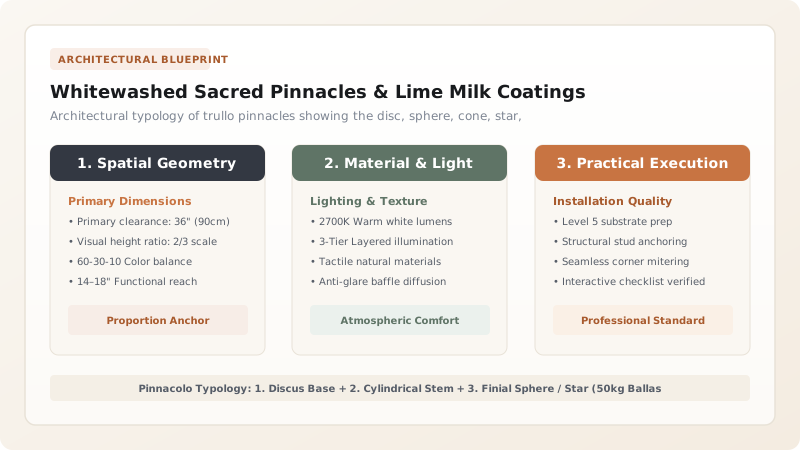
1. The Pinnacolo: Ballast Engineering & Sculptural Typology
The crowning feature of every trullo is its pinnacolo (pinnacle). Far from being a mere decorative finial, the pinnacle performs a vital structural engineering role.
The apex of a dry-stone corbelled cone is its most fragile point. The pinnacle is a monolithic sculpture carved from dense calcareous freestone weighing between \(40\text{ and }80\text{ kg}\). Resting directly on the closing capstone (serracapo), its concentrated dead weight exerts downward compressive force that pre-stresses the upper corbelled rings, preventing strong winter tramontana winds from lifting the topmost shingles.
Pinnacles fall into five historic symbolic archetypes:
- The Disc (Disco): Horizontal circular plate representing the sun god or pagan solar worship.
- The Sphere (Sfera): Universal symbol of the cosmos, perfection, and heavenly protection.
- The Cone / Pyramid (Cono): Ancient symbol of fertility and abundance.
- The Multi-Point Star (Stella): Guiding star and celestial navigation symbol.
- The Cross (Croce): Christian cruciform protection against evil spirits.
2. Sacred Iconography: The Painted Roof Symbols
Painted across the dark gray chiancarelle tiles of the principal cone facing the road are large, striking white symbols. These symbols were painted using pure slaked lime milk applied with coarse bristle brushes.
Scholars categorize these symbols into three distinct traditions:
- Primitive & Pagan: Sun discs, tree of life, animal horns, and fertility triangles dating back to pre-Roman Daunian and Peucetian tribes.
- Christian & Devotional: The Christogram (IHS), the bleeding heart of Mary, the dove of the Holy Spirit, and the Latin cross.
- Astrological & Magic: Signs of the Zodiac, planetary talismans (Jupiter, Mercury), and protective Solomon's knots designed to ward off the evil eye (malocchio).
3. The Science of Latte di Calce: Solar Reflection & Hygiene
Every spring before Easter, Apulian families traditionally re-coat the circular stone base of their trulli with latte di calce (lime milk). This is pure calcium hydroxide putty diluted with water to a creamy consistency (1 part aged lime putty to 3 parts water).
Applied in three thin cross-hatched passes, the coating carbonates upon contact with atmospheric CO2, forming a micro-crystalline film of calcium carbonate:
The resulting brilliant chalk-white surface achieves a solar reflectance index (SRI) over 100, reflecting up to \(85\%\) of incident solar radiation away from the dwelling. Furthermore, its caustic \(\text{pH of }12.5\) acts as a natural broad-spectrum biocide, sanitizing the porous limestone against moss and bacteria without synthetic chemicals.
Pinnacle & Whitewash Specifications
Use this reference table to calculate exact physical dimensions, ratios, and specifications before purchasing:
| Architectural Element | Traditional Apulian Spec | Modern Preservation Standard | Functional / Aesthetic Purpose |
|---|---|---|---|
| Pinnacle Limestone | Dense calcareous Pietra di Trani | Hand-carved local freestone | 40–80 kg ballast weight locking dome capstone |
| Pinnacle Base Mortar | Clay slip or thin hydraulic lime bed | NHL 2.0 breathable lime bedding | Weather seal preventing water penetration at apex |
| Roof Symbol Paint | Thick lime putty (grassello) paste | Pure aged slaked lime + 5% casein | Weather-resistant sacred icon; refreshed every 2 yrs |
| Base Wall Whitewash | Latte di calce (1:3 lime putty to water) | 3 thin cross-brushed coats | 85% solar reflection; natural antibacterial surface |
| Modern Synthetic Paint | Prohibited (Causes stone decay) | Strictly banned by UNESCO | FAILS: Traps moisture and causes limestone spalling |
Application & Environmental Constraints
Every successful decoration project must account for physical and environmental constraints:
Pinnacle Wind Overturn
In high wind zones, pinnacles must be anchored into the capstone with a central 20mm stainless steel or bronze dowel pin bedded in lime grout.
Lime Wash Flaking
Applying lime milk in single thick coats causes immediate crazing and peeling; must be built up in three water-thin transparent passes.
Rainwater Cistern Protection
When whitewashing roofs or symbols, downspout diverters must be disconnected for 48 hours to prevent lime runoff from contaminating the drinking cistern.
Pinnacle Setting & Lime Whitewash Protocol
Execute this professional sequence to achieve flawless results without backtracking:
Pinnacle Carving & Doweling
Carve the monolithic limestone pinnacle from a solid block of Pietra di Trani, drilling a 25mm blind hole in its base for the center anchor pin.
Capstone Dowel Setting
Drill matching hole in the apex closing capstone, setting a 20mm Grade 316 stainless dowel in NHL 2 hydraulic lime grout.
Pinnacle Hoisting & Bedding
Hoist the 50kg pinnacle over the dowel, seating it on a bed of slaked lime mortar mixed with crushed limestone dust.
Base Wall Pre-Wetting
Thoroughly wash down the circular limestone base walls with clean water to remove dust and control wall suction.
Latte di Calce Application
Brush on three thin coats of slaked lime milk using a round horsehair whitewash brush, allowing 12 hours of carbonation between coats.
Roof Iconography Painting
Trace sacred symbols onto the principal cone chiancarelle using chalk, painting with thick slaked lime paste bound with 5% milk casein.
Common Mistakes & Countermeasures
Avoid these costly errors that compromise aesthetics, ergonomics, and budget:
Using modern exterior acrylic or plastic masonry paint on trullo walls
Installing a pinnacle without a structural center dowel pin in high wind zones
Whitewashing the dark grey chiancarelle roof cones completely white
Project Execution Checklist
Track your physical progress. Checkboxes persist automatically on this device:
Frequently Asked Questions
Why do some trulli have multiple pinnacles?
A trullo complex consists of multiple interconnected circular cells, each crowned by its own conical roof. Large family estates can feature five to ten distinct conical domes, each topped with its own hand-carved pinnacle reflecting different symbolic motifs.
Can rainwater collected from a whitewashed trullo roof be consumed?
Yes. Historically, trullo roofs were the sole source of drinking water in water-scarce Puglia. Rainwater filtered through clean, natural limestone chiancarelle tiles into an underground bedrock cistern remains remarkably pure, cool, and rich in natural calcium minerals.
How often does the lime whitewash need to be refreshed?
In traditional Apulian practice, the base walls are whitewashed once a year in spring. The process is quick and inexpensive, maintaining brilliant solar reflection and pristine white aesthetics.


