
Scagliola is an artisanal Italian faux-marble inlay craft dating to the 16th century, created by blending calcined selenite gypsum (specchio d'asino) with animal bone glue and mineral pigments. By hand-kneading contrasting colored doughs into multi-layered 'loaves' and slicing or incising intricate inlays, artisans replicate the complex veining of precious stones, finished through progressive water-honing and linseed oil polishing.
At a Glance: Key Takeaways
- Calcined Selenite Gypsum: Transparent, crystalline variety of gypsum (specchio d'asino) calcined at low heat (120°C–140°C) for maximum purity.
- Animal Bone Glue Retarder: Warm collagen glue acts simultaneously as high-strength binder and setting retarder, extending work time to hours.
- Kneaded Dough Loaf Technique: Individual colored sausage rolls assembled into a composite loaf and sliced to create organic breccia patterns.
- Inlay Sgraffito Intarsia: Incising floral or heraldic patterns into base scagliola and back-filling with contrasting colored mineral doughs.
- Progressive Honing to 3000 Grit: Hand-honed with natural pumice stones, charcoal blocks, and wet diamond papers before flaxseed oil sealing.
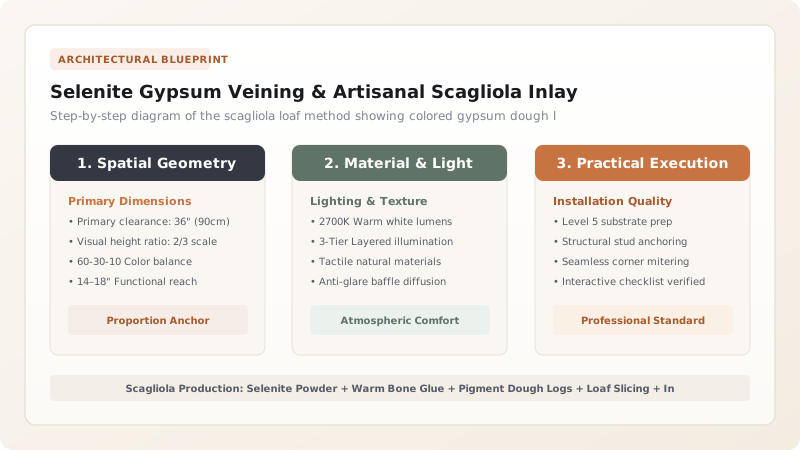
1. Material Foundations: Selenite Gypsum & Bone Glue Retardation
Unlike common plaster of Paris—which sets rock-hard in 15 minutes and yields a chalky white finish—authentic Scagliola uses high-purity crystalline selenite gypsum (historically called lapis specularis or specchio d'asino) sourced from the Apennine mountains of Emilia-Romagna.
The selenite crystals are calcined at \(130^\circ\text{C}\) to form hemihydrate plaster (\(\text{CaSO}_4 \cdot \frac{1}{2}\text{H}_2\text{O}\)). Rather than gauging with pure water, artisans mix the plaster with a warm \(4\%\) solution of animal bone or hide glue. The collagen macromolecules coat the gypsum crystals, drastically retarding the setting time from minutes to 3 to 5 hours while imparting incredible tensile toughness to the cured composite.
2. Vein Generation: The Kneaded Composite Loaf Method
To replicate the chaotic geological breccias of Verde Antico, Brocatelle, or Giallo di Siena, master scagliolisti employ the Loaf Method (Il Pane):
- Gypsum-glue dough is divided into separate bowls and tinted with mineral pigments (raw sienna, Venetian red, bone black, green earth).
- Each colored batch is rolled into elongated snake-like cylinders of varying diameters.
- The colored strands are dusted with dry contrasting gypsum powder and bundled together into a single thick composite loaf.
- The artisan cuts transverse or diagonal slices across the loaf with a wire saw. Each slice reveals stunning organic veins, breccia nodules, and delicate fault lines that are pressed into plaster molds or column armatures.
3. Scagliola Intarsia & Progressive Honing
In addition to marbled fields, scagliola excels at pictorial intarsia. Intricate arabesques, coats of arms, or botanical motifs are incised into a cured black or white base panel using micro-gouges. Contrasting colored doughs are hand-pressed into the recesses.
Once cured, the surface is leveled through progressive water honing using abrasive stones:
- Coarse leveling with rough sandstone and volcanic pumice blocks to flush all seams.
- Intermediate smoothing with fine willow charcoal and slate stones.
- High-polish finishing with wet diamond pads up to 3000 grit, sealed with refined flaxseed oil, gum damar varnish, and carnauba wax.
Scagliola Recipe & Honing Grit Progression
Use this reference table to calculate exact physical dimensions, ratios, and specifications before purchasing:
| Fabrication Stage | Material Formula / Grit Standard | Tooling / Technique | Quality & Aesthetic Target |
|---|---|---|---|
| Gypsum Preparation | Pure calcined selenite (130°C kiln) | Sifted through 120-mesh bronze sieve | Zero uncalcined grains; pure white translucence |
| Liquid Gauge | 3.5% to 5% animal bone glue in water | Heated to 45°C during mixing | Retards set to 4 hours; maximizes paste density |
| Pigment Saturation | 100% natural alkali-stable earth oxides | Hand-kneaded into dough balls | Rich mineral color matching real geological strata |
| Rough Honing (Sbozzatura) | Coarse natural pumice stone + water | Circular wet rubbing with slurry flushing | Removes knife ridges; exposes marble veining |
| Fine Honing (Levigatura) | Willow charcoal + 1200–3000 diamond pads | Constant water wash; mirror-flat tactile check | Zero scratches visible under raking light |
| Sealing & Polishing | Boiled linseed oil + Carnauba-beeswax paste | Heated wool buffing pad | Deep optical clarity; repels wine and water spills |
Craftsmanship & Environmental Constraints
Every successful decoration project must account for physical and environmental constraints:
Water Sensitivity
Unlike lime stucco, cured gypsum-bone glue scagliola is sensitive to standing water. It must never be installed in exterior exposed locations or wet showers.
Glue Concentration Window
If bone glue concentration exceeds 6%, the dough will become rubbery and gummy to hone; if under 2%, the plaster sets too fast before loaves can be rolled.
Substrate Bonding
Base cores (brick columns or marine plywood panels) must be keyed with coarse plaster and sized with warm glue to prevent interfacial delamination.
Scagliola Panel Crafting & Polishing Sequence
Execute this professional sequence to achieve flawless results without backtracking:
Selenite Powder & Glue Preparation
Sift calcined selenite flour and prepare warm 4% bone-glue liquid maintained at 45°C in a water bath.
Colored Dough Kneading
Mix gypsum and glue liquid into stiff doughs, dividing into separate portions tinted with earth pigments.
Loaf Assembly & Slicing
Bundle contrasting colored dough logs into a composite loaf, rolling and slicing with wire into 10mm marbled tiles.
Substrate Pressing & Tamping
Press marbled slices onto a glue-sized baseboard, pounding with wooden tampers to expel all air bubbles and close seams.
Water Honing Progression
After 72 hours of curing, hone the surface under a trickle of water using pumice stones and progressive diamond pads up to 3000 grit.
Flaxseed Oil & Carnauba Buffing
Wipe the dry surface with warm refined linseed oil, allow 48 hours to polymerize, and buff with carnauba paste wax.
Common Mistakes & Countermeasures
Avoid these costly errors that compromise aesthetics, ergonomics, and budget:
Using modern fast-setting Plaster of Paris from a home improvement store
Dry-sanding scagliola with power sanders and dry sandpaper
Installing scagliola tabletop or columns in exterior outdoor spaces
Project Execution Checklist
Track your physical progress. Checkboxes persist automatically on this device:
Frequently Asked Questions
Can scagliola columns bear structural building loads?
No. Scagliola is an ornamental cladding material. Structural columns are constructed from reinforced concrete, brick, or steel, around which wooden or plaster armatures are built and clad with a 15–20mm scagliola shell.
How does scagliola differ from pietra dura?
Pietra dura is an intarsia of real sliced semi-precious hardstones (lapis lazuli, jasper, marble) cut with wire saws and assembled like a jigsaw. Scagliola is a trompe l'œil plastic paste made from gypsum, glue, and pigment that mimics these stones at a fraction of the weight.
What is the lifespan of authentic scagliola furniture and architectural elements?
When kept indoors away from water leaks, scagliola lasts indefinitely. Original 17th-century scagliola altar frontals and chimneypieces across Tuscany and Bavaria remain in museum-perfect condition after more than 350 years.


