
Pietra dura (or commesso fiorentino) is a Florentine lapidary mosaic art form perfected during the Renaissance under the Medici Opificio delle Pietre Dure. Thin 3mm slices of semi-precious hardstones (Mohs hardness 6 to 8: lapis lazuli, agate, chalcedony, and jasper) are cut with iron wire bow saws, beveled to zero-tolerance seams, bedded into carved pockets on black marble slabs using heated beeswax and pine rosin mastic, and polished to a seamless specular gloss.
At a Glance: Key Takeaways
- Commesso Zero-Gap Stereotomy: Slicing and hand-filing stones with inward beveled edges to achieve seamless, hair-tight optical joints.
- Semi-Precious Hardstones (Mohs 6–8): Lapis lazuli, Sicilian jasper, Persian turquoise, chalcedony, and malachite selected for natural mineral shading.
- The Wire Bow Saw (Archetto): Chestnut branch bow armed with soft iron wire lubricated with emery and carborundum abrasive slurry.
- Nero di Belgio Black Marble Ground: Dense, fossil-free black limestone matrix providing high-contrast optical backdrop for colorful stones.
- Colofonia & Beeswax Mastic: Traditional heated thermoplastic mastic formulated from pine rosin, beeswax, and powdered marble dust.
- Progressive Diamond Micron Polishing: Honed with water down to 0.25-micron diamond paste to produce an impervious mirror finish.
In-Depth Guides in this Directory
Explore specialized subtopic blueprints, technical dimensions, and execution checklists:
Wire-Saw Lapidary Slicing: Lapis Lazuli & Jasper
Master lapidary cutting mechanics for commesso: the traditional archetto wire bow saw, carborundum and emery abrasive slurries, and 5-degree inward bevel filing.
Beeswax-Rosin Mastic & Black Marble Bedding
Master Florentine pietra dura bedding: pure pine colophony rosin and beeswax mastic formulation, Belgian black marble mortising, and thermal setting.
Diamond Polishing & Seamless Optical Joints
Master lapidary surface finishing for pietra dura: rigid flat lap leveling, differential mineral hardness control, progressive diamond micron grits, and specular gloss.
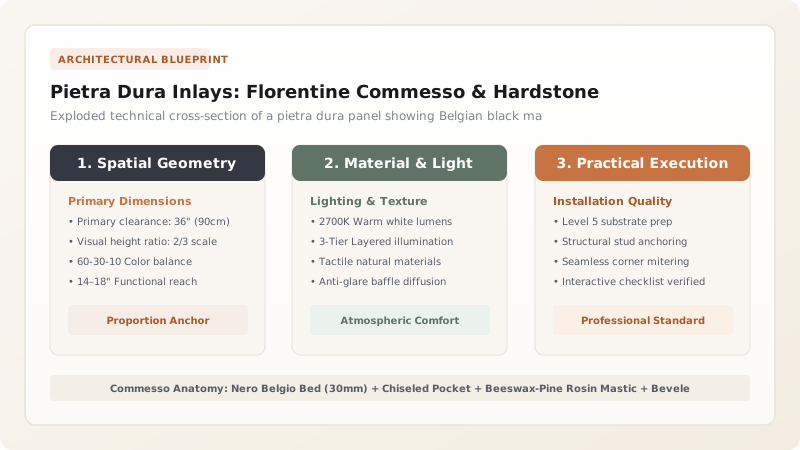
1. Lapidary Heritage: The Medici Opificio & The Commesso Revolution
Founded in 1588 by Grand Duke Ferdinando I de' Medici in Florence, the Opificio delle Pietre Dure transformed Roman marble mosaics (opus sectile) into photorealistic commesso fiorentino (from the Latin committere, meaning to join together seamlessly).
Unlike Roman mosaics which utilized square tesserae with visible mortar joints, commesso uses complex, curvilinear stone pieces cut precisely to match natural botanical shapes (petals, fruit, butterfly wings, feathers). Stones are chosen not merely for color, but for their natural geological banding, dendritic inclusions, and crystalline chatoyance that mimic shadows and highlights without paint. Explore lapidary cutting mechanics in wire-saw slicing of lapis lazuli, agate, and jasper.

2. Cutting Mechanics: The Archetto Wire Saw & Inward Bevels
Diamond saw blades did not exist in the 16th century. Master lapidaries developed the archetto—a curved chestnut branch strung with a soft iron wire (\(0.2\text{ to }0.4\text{ mm}\) diameter).
The wire carries an abrasive slurry of water and emery (corundum powder, \(\text{Al}_2\text{O}_3\)). As the artisan draws the bow back and forth, the hard abrasive particles embed in the soft iron wire and grind through 7-Mohs quartz gems. Crucially, the stone is held at a \(5^\circ\text{ inward bevel angle}\):
This ensures that the top visible faces meet with zero joint tolerance (< 0.05 mm), while leaving a wedge-shaped cavity beneath to receive the warm adhesive mastic.
3. The Adhesive Bed: Beeswax-Pine Rosin Mastic on Black Marble
Modern epoxy adhesives turn yellow under UV light and are brittle. Traditional pietra dura relies on a historic thermoplastic mastic: Mastice Fiorentino.
Equal parts purified pine colophony rosin and pure beeswax are melted and loaded with finely pulverized black marble powder. The mastic is applied molten (\(80^\circ\text{C}\)) into the mortised recesses of a Nero di Belgio black marble bed. The beveled hardstone pieces are pre-heated and pressed into the mastic, which cools and contracts to lock the gem stones permanently in rock-solid adhesion. Read mastic formulation in beeswax-rosin mastic adhesion on black marble.
4. Optical Polishing: Harmonizing Differential Hardness
The supreme challenge in polishing a pietra dura panel is that stones of radically different hardness sit side-by-side (e.g., soft calcite marble at Mohs 3 next to hard jasper at Mohs 7). Traditional polishing pads would hollow out the soft marble, leaving the hard stones proud.
Florentine artisans solved this by using hard, dead-flat iron, pewter, and boxwood laps charged with progressively finer abrasive powders (emery, tin oxide, and sub-micron diamond paste) down to \(0.25\ \mu\text{m}\), producing an unbroken optical mirror across all mineral phases. Explore optical polishing in micro-abrasive diamond polishing and seamless optical joints.
Pietra Dura Mineral Hardness & Lapidary Selection
Use this reference table to calculate exact physical dimensions, ratios, and specifications before purchasing:
| Semi-Precious Gemstone | Mineral Species / Composition | Mohs Hardness Scale | Botanical & Architectural Palette Role |
|---|---|---|---|
| Lapis Lazuli (Badakhshan) | Lazurite / Pyrite silicate complex | Mohs 5.0 to 5.5 | Royal celestial blue petals, morning glories, borders |
| Jasper (Diaspro di Sicilia) | Microcrystalline chalcedony (SiO2) | Mohs 6.5 to 7.0 | Ruby reds, ochres, multi-color autumn leaves, birds |
| Chalcedony / Agate (Volterra) | Cryptocrystalline silica bands | Mohs 6.5 to 7.0 | Translucent grape berries, dew drops, shaded petals |
| Malachite (Ural / Congo) | Basic copper carbonate (Cu2CO3(OH)2) | Mohs 3.5 to 4.0 | Rich banded emerald-green leaves and stems |
| Nero di Belgio (Ground) | Pure carbonaceous microcrystalline limestone | Mohs 3.0 to 3.5 | Flawless mirror-black backdrop for high contrast |
Lapidary Stereotomy & Thermal Constraints
Every successful decoration project must account for physical and environmental constraints:
Differential Thermal Expansion
Gemstones expand at different rates (quartz \(\alpha = 13 \times 10^{-6}\), calcite \(\alpha = 5 \times 10^{-6}\)); exposure to thermal shocks (> 45°C) will shatter delicate lapis veins.
Gemstone Micro-Fracturing
Hardstones like agate and jasper contain internal seismic micro-fissures; all slices must be examined with backlighting before wire-sawing to prevent shattering.
Differential Polish Hollows
Never polish pietra dura with soft felt or foam pads; soft laps erode softer stones, creating unsightly optical ripples.
Florentine Commesso Pietra Dura Creation Sequence
Execute this professional sequence to achieve flawless results without backtracking:
Botanical Watercolor Cartoon
Paint a photorealistic gouache cartoon, tracing each petal onto translucent paper and numbering by mineral species and grain axis.
Gemstone Slicing
Slice raw rough minerals into 3mm-thick slabs using continuous water-cooled lapidary diamond saws or traditional wire saws.
Archetto Wire-Saw Cutting
Saw individual stone pieces along cartoon lines using the archetto bow saw and emery grit, tilting stone 5 degrees for inward bevel.
Carborundum Diamond Filing
Hand-file and hone stone edges with diamond needle files until adjacent stones snap together with zero visible light gap.
Black Marble Bed Mortising
Chisel 3mm-deep mortise pockets into the Belgian black marble substrate slab using carbide pneumatic chisels.
Hot Rosin-Beeswax Bedding & Polish
Flood mortises with 80°C pine rosin mastic, press pre-heated stones firmly into place, and hone to 0.25-micron specular mirror polish.
Common Mistakes & Countermeasures
Avoid these costly errors that compromise aesthetics, ergonomics, and budget:
Using soft foam buffing pads or cloth wheels to polish pietra dura panels
Cutting stone pieces square at 90 degrees without an inward bevel
Using modern fast-curing epoxy resin as the primary bedding mastic
Project Execution Checklist
Track your physical progress. Checkboxes persist automatically on this device:
Frequently Asked Questions
What is the difference between 'pietra dura' and 'pietra tenera'?
Pietra dura (hard stone) specifically refers to siliceous minerals with Mohs hardness 6 to 8 (jasper, agate, chalcedony, quartz) that cannot be scratched with a steel knife. Pietra tenera (soft stone) refers to softer calcareous marbles, alabaster, and limestones (Mohs 3 to 4) that can be easily carved with steel chisels.
How long does it take to create an authentic pietra dura tabletop?
A monumental 1.5-meter commesso in pietra dura tabletop containing thousands of individual hand-cut semi-precious stone pieces typically requires between 2,000 and 5,000 artisan hours (1 to 3 years of full-time lapidary work).
Can pietra dura be used in exterior architectural settings?
While small external medallion inlays exist on Mediterranean palazzi, fine commesso is primarily an interior art. Extreme outdoor freeze-thaw cycles and acidic rain will degrade softer black marble grounds and dissolve delicate lapis lazuli lazurite crystals.


