
Micro-abrasive diamond polishing and optical joint finishing constitute the final triumph of Florentine commesso. Because minerals spanning Mohs 3 (marble) to Mohs 7.5 (jasper) lie adjacent, polishing requires rigid unyielding metal laps (cast iron, pewter, and dense end-grain boxwood) charged with progressively finer diamond paste (from 45 microns down to 0.25 microns) to achieve an optically flat mirror plane without differential surface relief.
At a Glance: Key Takeaways
- Rigid Flat Lap Technology: Solid iron, bronze, or pewter laps that bridge soft and hard stones without dishing soft marble.
- Progressive Diamond Micron Stepping: Honing from 45μm (coarse leveling) through 15μm, 6μm, 3μm, 1μm, down to 0.25μm (optical mirror).
- Zero Differential Relief: Soft Belgian black marble and rock-hard Sicilian jasper leveled to sub-micron optical flatness.
- Water & Glycol Lubrication: Continuous fluid wash carrying away abraded mineral swarf without heating or thermal shock.
- Microcrystalline Wax Seal: Final coat of pure refined microcrystalline wax buffed with silk velvet to seal micro-capillaries.
- Inspection Under Grazing Laser: Surface inspected under low-angle grazing light to verify zero optical distortion across joints.
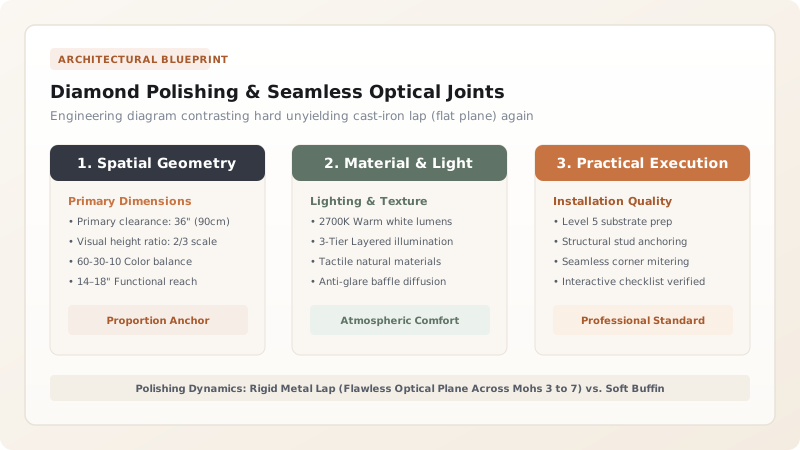
1. Lapidary Physics: Overcoming Differential Hardness (Mohs 3 vs. Mohs 7)
The fundamental physics problem in polishing commesso fiorentino is differential abrasion rates. A single 100mm square floral bouquet can contain:
- Belgian Black Marble (Mohs 3.0, easily ground away)
- Malachite (Mohs 3.8, soft copper carbonate)
- Lapis Lazuli (Mohs 5.5, intermediate)
- Chalcedony, Agate, Jasper (Mohs 6.5–7.0, extremely tough quartz)
If polished with conventional flexible sandpaper or rotary felt wheels, the abrasive will abrade the soft marble five times faster than the jasper, gouging deep trenches (dishing) around the flowers. Master lapidaries prevent this by using unyielding, rigid flat laps (heavy cast-iron and pewter plates) that bear exclusively on high points, cutting hard and soft minerals to an identical optical plane.
2. Micro-Abrasive Diamond Stepping: From 45 Micron to 0.25 Micron
While historic artisans used graded emery and tin oxide powders, modern high-spec restoration combines historic lap geometry with monocrystalline diamond suspensions:
- Leveling Phase (45 to 30 Micron): Cast-iron lap removes excess mastic squeeze-out and planes the assembled gemstones flush with the marble slab.
- Pre-Polishing Phase (15 to 6 Micron): Lead-pewter alloy lap removes rough micro-scratches, bringing all minerals to a uniform satin sheen.
- Optical Luster Phase (3 to 1 Micron): Boxwood lap with water-glycol carrier flattens microscopic mineral facets.
- Specular Mirror Phase (0.25 Micron): High-density tin lap with 0.25-micron diamond paste closes all surface porosities, creating a continuous refractive index mirror.
3. The Vanishing Joint: Optical Continuity Across Seams
When the panel reaches the 0.25-micron polish stage, a visual phenomenon occurs: optical joint vanishing.
Because the stones were cut with 5-degree inward bevels and the top surface has been ground to an unyielding optical plane, the joint line between two contrasting stones narrows to less than \(0.01\text{ mm}\) (10 microns). Under ambient light, the black mastic seam becomes completely invisible to the naked eye. The flowers appear to have grown organically out of the solid black marble slab.
Pietra Dura Diamond Polishing Grit & Lap Progression
Use this reference table to calculate exact physical dimensions, ratios, and specifications before purchasing:
| Polishing Stage | Diamond Particle Size | Lap Plate Metallurgy | Surface Roughness (Ra) Target |
|---|---|---|---|
| Coarse Leveling | 45 micron (325 mesh) | Meehanite cast iron flat lap | Ra < 3.2 μm (Flushes all stones dead flat) |
| Intermediate Hone | 15 micron (1200 mesh) | Soft lead-antimony alloy lap | Ra < 1.0 μm (Removes coarse rotary scratches) |
| Fine Pre-Polish | 6 micron (3000 mesh) | Cast pewter / copper lap | Ra < 0.3 μm (Uniform satin sheen across all minerals) |
| High-Luster Polish | 1 micron (14,000 mesh) | End-grain European boxwood lap | Ra < 0.08 μm (Specular reflection begins) |
| Final Optical Mirror | 0.25 micron (100,000 mesh) | Pure cast tin lap plate | Ra < 0.02 μm (Impervious optical glass mirror) |
Polishing & Environmental Constraints
Every successful decoration project must account for physical and environmental constraints:
Abrasive Cross-Contamination
A single stray grain of 45-micron diamond grit on a 1-micron polishing lap will cut deep swirling scratches across polished lapis lazuli, forcing the artisan to restart the entire sequence from Stage 2.
Lubricant Drainage
Constant flushing with distilled water and propylene glycol is required to sweep away abraded stone swarf; drying swarf forms an abrasive paste that dulls the gloss.
Thermal Expansion from Friction
Machine polishing generates localized friction heat that can soften the underlying pine rosin mastic, causing stone pieces to shift; polishing must be executed at low speeds (< 300 RPM) with generous coolant.
Diamond Micron Polishing Protocol
Execute this professional sequence to achieve flawless results without backtracking:
Cured Panel Inspection
Clean cured panel with mineral spirits to remove excess surface mastic, checking that all stone pieces remain firmly bonded.
Cast-Iron 45-Micron Leveling
Mount panel on a reciprocating lapidary machine or hand-rub with a 45-micron diamond cast-iron lap until all stones are co-planar with the marble.
Ultrasonic Cleaning Wash
Scrub the panel thoroughly with warm water and detergent to remove every trace of 45-micron swarf before progressing to finer grits.
Pewter Lap 15 & 6 Micron Honing
Hone across the panel using a lead-pewter lap charged with 15-micron, then 6-micron diamond paste, working in figure-eight motions.
Boxwood & Tin 1 Micron Polish
Polish with end-grain boxwood and cast tin laps charged with 1-micron diamond paste and glycol lubricant until specular reflections appear.
0.25-Micron Optical Glaze & Wax
Execute final pass with 0.25-micron diamond on a soft tin lap, followed by buffing with microcrystalline Renaissance wax and silk velvet.
Common Mistakes & Countermeasures
Avoid these costly errors that compromise aesthetics, ergonomics, and budget:
Failing to thoroughly wash the panel between abrasive grit stages
Polishing with high-speed rotary buffers (> 1,000 RPM)
Applying polyurethane or lacquer clear coats over finished pietra dura to make it 'shinier'
Project Execution Checklist
Track your physical progress. Checkboxes persist automatically on this device:
Frequently Asked Questions
How do you clean an antique pietra dura tabletop safely?
Clean only with a soft microfiber cloth dampened with demineralized water and a few drops of neutral pH soap. Never use acidic cleaners (vinegar, citrus sprays) or ammonia (Windex), as acids will instantly etch and dull the soft black marble background.
Why is boxwood used as a polishing lap?
European boxwood cut across the end-grain has a unique cellular density: it is hard enough to keep the surface dead-flat without dishing soft minerals, yet porous enough to hold microscopic diamond paste embedded in its grain.
Can scratches on a pietra dura tabletop be repaired in situ?
Minor surface scuffs can be polished out on-site by a master conservator using diamond paste on handheld tin laps. Deeper gouges that cut into the stones require specialized workshop relapping to maintain flat optical planes.


