
The flawless translucence and mirror sheen of Venetian plaster depend entirely on the volumetric ratio of 24-to-36-month aged slaked lime putty (grassello di calce) to micro-pulverized Bianco Carrara marble dust. While base coats utilize a 1:1.5 ratio with 0.4–0.7mm marble grit for compressive strength, finishing coats require a 1:1 or 1:0.8 ratio of aged putty to 0–50 micron marble flour for maximum crystalline packing.
At a Glance: Key Takeaways
- Vat-Aged Grassello di Calce: High-calcium lime (CL-90-S) aged underwater to form nano-scale hexagonal calcium hydroxide crystals.
- Carrara Crystalline Aggregate: White crystalline marble dust with high light refraction index (n = 1.59) delivering optical depth.
- Progressive Particle Stepping: 3-coat gradation stepping down from 700 microns in the base to under 50 microns in the final polish skim.
- Volumetric Blending Precision: 1:1 binder-to-aggregate balance ensuring complete carbonation without shrinkage micro-cracking.
- Inorganic Pigment Compatibility: Alkali-stable mineral oxides, ochres, and lapis lazuli ground into wet putty with zero synthetic binders.
1. The Science of Vat-Aging Grassello di Calce
In classical Italian plastering, lime is not merely an adhesive—it is a live mineral. Freshly slaked lime contains irregular, sharp calcium hydroxide particles. When submerged under standing water in airtight vats for 24 to 36 months, a transformative physical process occurs.
Ostwald ripening causes small crystals to dissolve and recrystallize into micro-scale, flat hexagonal platelets measuring less than \(1\text{ to }2\ \mu\text{m}\) across. These smooth platelets slide across each other with near-zero friction, giving grassello di calce its legendary creamy, butter-like consistency and unmatched plasticity under the trowel.
2. Bianco Carrara Marble Aggregate Sizing
The choice of marble is critical. Bianco Carrara marble is an ultra-pure metamorphic calcium carbonate characterized by interlocking calcite crystals. When ground, its particles possess sharp, multifaceted cleavage angles that interlock tightly under trowel pressure.
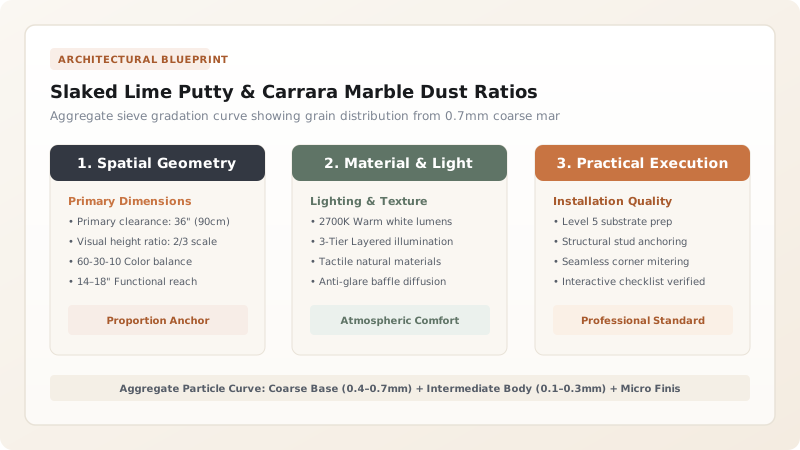
To achieve high structural integrity and specular gloss, the plaster relies on a 3-tier particle gradation curve:
- Intonachino Base: 1 part lime putty to 1.5 parts \(0.4\text{ to }0.7\text{ mm}\) marble grit. Provides tooth and absorbs wall stress.
- Marmorino Intermediate: 1 part lime putty to 1.2 parts \(0.1\text{ to }0.3\text{ mm}\) medium marble dust. Smooths out all substrate grain.
- Stucco Lustro Finishing Skim: 1 part lime putty to 0.8–1.0 part \(0\text{ to }50\ \mu\text{m}\) micro-pulverized marble flour. Enables molecular-level surface compression.
3. Pigment Dispersion & Workability Optimization
Because slaked lime maintains a high alkaline pH of \(12.5\), only alkali-resistant mineral pigments can be used. Organic dyes are quickly bleached by the alkaline lime.
Master artisans pre-disperse natural iron oxides, raw umbers, and genuine lapis lazuli in demineralized water for 24 hours before blending into the putty using low-shear spiral paddle mixers, ensuring streak-free color consistency across large wall expanses.
Venetian Plaster Mix Ratios & Layer Specifications
Use this reference table to calculate exact physical dimensions, ratios, and specifications before purchasing:
| Plaster Coat Layer | Binder (Grassello) Ratio | Marble Dust Size / Type | Application Thickness |
|---|---|---|---|
| Base Coat (Arriccio) | 1 part aged lime putty | 2.5 parts coarse silica sand (0.8–1.2mm) | 6.0 to 10.0 mm |
| Leveling Coat (Intonachino) | 1 part aged lime putty | 1.5 parts Carrara grit (0.4–0.7mm) | 1.5 to 2.0 mm |
| Body Coat (Marmorino) | 1 part aged lime putty | 1.2 parts medium marble dust (0.1–0.3mm) | 0.8 to 1.2 mm |
| Finish Skim 1 (Stucco Lustro) | 1 part 36-mo lime putty | 1.0 part micro marble flour (0–50μm) | 0.3 to 0.5 mm |
| Final Polish Skim (Lustro) | 1 part 36-mo lime putty | 0.8 part ultra-fine flour (0–20μm) | 0.1 to 0.2 mm (knife-edge skim) |
Batching & Atmospheric Constraints
Every successful decoration project must account for physical and environmental constraints:
Water Content Control
Never add excess water to thin lime putty; over-watering increases drying shrinkage, causing microscopic spider-web fissures.
Alkaline Pigment Bleed
Always test pigments in a small sample cup of lime putty; synthetic pigments will fade or turn muddy gray within 48 hours.
Storage Sealing
Slaked lime putty stored in airtight buckets with 25mm of standing water on top will remain usable indefinitely without spoiling.
Lime Putty & Marble Dust Batching Workflow
Execute this professional sequence to achieve flawless results without backtracking:
Lime Putty Inspection
Check aged grassello for buttery consistency, decanting any standing surface water into a clean bucket.
Volumetric Weighing
Weigh lime putty and dry graded Carrara marble flour into clean stainless mixing tubs at precise volumetric ratios.
Pigment Pre-Slurrying
Mix powdered mineral earth pigments with warm distilled water to form a smooth, lump-free color slurry.
Low-Shear Paddle Blending
Blend lime putty, marble flour, and pigment slurry with a variable-speed spiral paddle at under 400 RPM to prevent air entrapment.
Resting & Maturation
Cover the mixed batch with plastic wrap and allow it to rest for at least 2 hours to achieve full thixotropic gel strength.
Trowel Workability Check
Spread a test ribbon on a plaster testing board to confirm that the mix holds its shape on a vertical blade without sagging.
Common Mistakes & Countermeasures
Avoid these costly errors that compromise aesthetics, ergonomics, and budget:
Using industrial sand or silica flour instead of crystalline Carrara marble dust
High-speed mechanical whipping (> 1000 RPM) during plaster mixing
Adding Portland cement to speed up drying time in authentic Venetian stucco
Project Execution Checklist
Track your physical progress. Checkboxes persist automatically on this device:
Frequently Asked Questions
Can I use quicklime powder instead of pre-aged lime putty?
No. Dry hydrated lime powder has not developed the microscopic hexagonal platelet structure of aged putty. It lacks the workability, translucence, and high specular gloss necessary for true stucco lustro.
Why is Bianco Carrara marble preferred over other white marbles like Thassos or Calacatta?
Carrara marble possesses a uniquely fine, homogeneous calcite micro-crystal structure (0.2 to 0.5 mm crystals) that crushes into flat, sharp-edged rhombohedral platelets. These pack tighter under trowel compression than the coarse, sugary crystals of Greek Thassos marble.
How do you achieve deep black or emerald green Venetian plaster?
Deep hues require natural black iron oxide (magnetite) or chromium oxide green ground to sub-micron size. The pigment load must not exceed 8% to 10% of total dry weight, or the binder will be starved, leading to chalking.


