
Hot-iron burnishing (ferro caldo) paired with authentic olive-oil Castile soap (sapone marsigliese) is the historic Venetian technique for achieving a glass-like specular finish and water repellency on stucco lustro. Passing a 65°C–75°C heated trowel over a soap-treated lime plaster triggers saponification, precipitating an insoluble calcium oleate hydrophobic barrier while preserving vapor permeability.
At a Glance: Key Takeaways
- Chemical Saponification: Reaction between potassium oleate in pure olive soap and calcium ions in lime putty producing insoluble calcium oleate.
- Ferro Caldo Heating: Iron trowels heated to 65°C–75°C to accelerate chemical bonding and melt protective natural lipids into pores.
- Specular Mirror Finish: Pressure and thermal heat flatten micro-scale marble dust crystals into an optically flat reflective plane.
- Vapor-Permeable Water Barrier: Repels liquid water droplets on contact while allowing moisture vapor to escape freely from the substrate.
- Non-Yellowing Natural Finish: Free from synthetic acrylics and polyurethane resins, preventing UV discoloration or plastic film peeling.
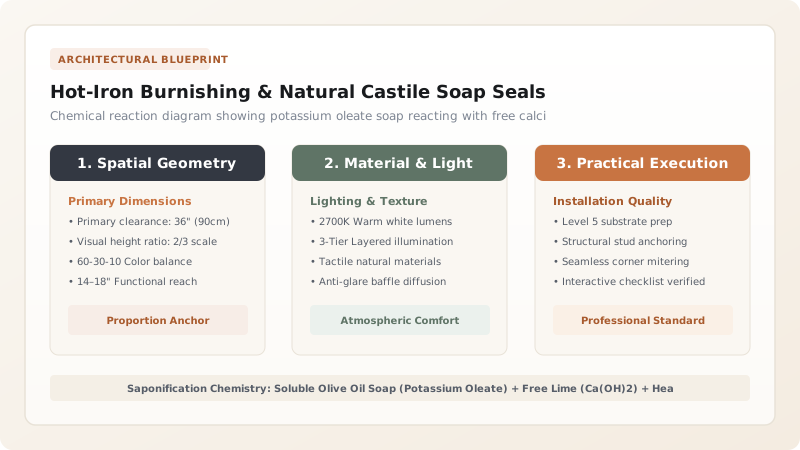
1. Saponification Chemistry: The Calcium Oleate Barrier
Modern decorators often mistakenly apply petroleum wax or synthetic acrylic clear coats to make Venetian plaster shiny. Historic Venetian master artisans relied on an elegant chemical synthesis: in situ saponification.
Authentic Castile soap (made from cold-pressed olive oil and potash) is rich in potassium oleate (\(\text{C}_{17}\text{H}_{33}\text{COOK}\)). When brushed onto a leather-hard lime wall, the oleate ions react instantly with free calcium hydroxide in the uncarbonated lime putty:
The resulting calcium oleate is a waxy, insoluble salt that precipitates directly inside the capillary pore openings of the plaster. It creates a robust hydrophobic barrier that sheds surface water while leaving the micro-porous matrix open to water vapor diffusion.
2. The Ferro Caldo Technique: Thermal Compression
The catalytic agent that transforms saponified plaster into an illuminated mirror is heat and mechanical pressure. Artisans use a heavy, radiused-edge stainless steel trowel known as the ferro caldo.
The iron is gently heated over a clean gas flame or electric heating plate to exactly \(65^\circ\text{C to }75^\circ\text{C}\). As the heated blade glides across the soaped wall in overlapping circular sweeps, three physical events occur simultaneously:
- The heat accelerates the saponification reaction rate by over \(400\%\).
- The natural vegetable lipids melt, flowing into microscopic surface voids.
- High mechanical shear flattens the hexagonal calcium carbonate crystals parallel to the wall face, creating perfect specular optical reflectivity.
3. Long-Term Maintenance & Natural Wax Finishing
Once burnished and cooled, a stucco lustro wall can receive an optional final treatment with refined Venetian beeswax paste thinned with pure gum turpentine. This adds a velvety tactile warmth and increases stain resistance in dining salons and bathrooms.
Unlike polyurethane, which requires complete stripping when scratched, a saponified stucco lustro wall can be cleaned and maintained for decades with nothing more than diluted Castile soap and a soft lamb's wool buffing pad.
Burnishing & Saponification Operational Parameters
Use this reference table to calculate exact physical dimensions, ratios, and specifications before purchasing:
| Operational Factor | Recommended Parameter | Critical Tolerance | Significance in Execution |
|---|---|---|---|
| Soap Solution Concentration | 8% to 10% pure Castile soap in soft water | Demineralized water only | Hard water calcium creates premature curdling in bucket |
| Plaster Timing for Soap | Leather-hard state (approx 4–6 hrs) | Surface damp, no wet sheen | Too wet causes plaster erosion; too dry prevents reaction |
| Iron Trowel Temperature | 65°C to 75°C (150°F to 167°F) | Maximum allowable 80°C | Excess heat scorches soap, leaving permanent brown stains |
| Trowel Blade Pressure | Moderate to firm (15–25 kPa contact) | Uniform sweeping strokes | Uneven point pressure causes blade chatter lines |
| Surface Hydrophobicity | Contact angle > 110° for water droplets | Beads water instantly | Protects against bathroom condensation & splashes |
| Vapor Permeance | Permeable (SD < 0.05 meters) | Class I vapor permeable | Substrate breathes; zero risk of trapped moisture blistering |
Application & Thermal Safety Constraints
Every successful decoration project must account for physical and environmental constraints:
Temperature Uniformity
A blowtorch should never be applied directly to the trowel while touching the wall; heat the iron on a bench plate and monitor with an infrared thermometer.
Pure Olive Oil Specification
Synthetic soaps containing sodium lauryl sulfate or animal tallow will fail to saponify properly and leave sticky, dust-attracting films.
Ventilation Safety
When applying optional beeswax thinned in gum turpentine, ensure continuous fresh airflow to prevent solvent vapor buildup.
Hot-Iron Saponification & Burnishing Sequence
Execute this professional sequence to achieve flawless results without backtracking:
Castile Soap Dissolution
Grate authentic olive-oil Castile soap into hot demineralized water (80g per liter) and stir until completely dissolved into a clear liquid gel.
Plaster Dryness Assessment
Inspect the final stucco lustro skim coat; it must be firm to finger touch (leather-hard) with uniform color across the entire bay.
Soap Gel Application
Apply a thin, uniform coat of soap solution using a wide badger-hair brush, working in gentle overlapping vertical strokes.
Trowel Pre-Heating
Heat the stainless steel burnishing spatola on an electric warming plate until its face registers 70°C on a digital infrared thermometer.
Sweeping Ferro Caldo Passes
Glide the heated trowel across the soaped wall in tight overlapping arcs at a 15-degree blade angle, listening for the smooth hiss of steam.
Final Wool Buffing
Allow the surface to cool for 12 hours, then buff lightly with a dry lamb's wool or micro-velvet mitt to remove trace soap haze.
Common Mistakes & Countermeasures
Avoid these costly errors that compromise aesthetics, ergonomics, and budget:
Applying Castile soap to completely dry, fully carbonated lime plaster (days later)
Overheating the burnishing trowel past 85°C
Using carbon steel or rusty iron trowels for hot burnishing
Project Execution Checklist
Track your physical progress. Checkboxes persist automatically on this device:
Frequently Asked Questions
Can I achieve a mirror finish without heating the iron?
Cold burnishing with a polished stainless trowel will produce a pleasant satin-to-semi-gloss sheen. However, the true high-specular glass mirror finish and the deep hydrophobic calcium oleate barrier require the thermal activation of the ferro caldo.
Is stucco lustro sealed with Castile soap washable?
Yes. Once fully cured (28 days), the calcium oleate surface can be cleaned using lukewarm water and a mild dilute Castile soap solution. Abrasive cleaners and acidic chemicals (vinegar, bleach) must never be used.
What is the origin of the term 'stucco lustro'?
Stucco lustro translates from Italian as 'shining or polished stucco.' Perfected in Venice during the 15th and 16th centuries (frequently documented by Andrea Palladio), it was developed to replicate heavy marble revetments on unstable canal foundations without adding excessive weight.


