
Venetian stucco lustro is a masterclass in mineral plastering that transforms aged slaked lime putty (grassello di calce) and micro-fine Carrara marble dust into a mirror-gloss stone finish without chemical varnishes. Paired with scagliola—an intricate inlay technique using calcined selenite gypsum and bone glue to replicate precious marbles—these Venetian arts deliver radiant depth, complete breathability, and natural hydrophobic resilience.
At a Glance: Key Takeaways
- Aged Grassello di Calce: Lime putty slaked and matured in vats for a minimum of 24 to 36 months to form micro-crystalline calcium hydroxide platelets.
- Carrara Marble Dust Gradation: Micro-pulverized Bianco Carrara marble powders (0 to 100 microns) providing crystalline translucence and hardness.
- Hot-Iron Saponification (Ferro Caldo): Passing a heated stainless steel trowel over pure olive-oil Castile soap to create hydrophobic calcium oleate.
- Scagliola Selenite Gypsum: High-purity crystallized gypsum dough mixed with animal protein hide glue and earth pigments to mimic lapis lazuli and breccia.
- Breathable Moisture Regulation: Highly vapor-permeable mineral matrix that absorbs ambient humidity and naturally inhibits mold via high alkalinity (pH 12.5).
In-Depth Guides in this Directory
Explore specialized subtopic blueprints, technical dimensions, and execution checklists:
Slaked Lime Putty & Carrara Marble Dust Ratios
Master authentic Venetian plaster formulations: grassello di calce aging, Carrara marble grit sizing (0-100μm), and volumetric blending ratios.
Hot-Iron Burnishing & Natural Castile Soap Seals
Master authentic stucco lustro finishing: ferro caldo heated iron burnishing (70°C), olive-oil Castile soap saponification, and hydrophobic calcium oleate seals.
Selenite Gypsum Veining & Artisanal Scagliola Inlays
Architectural guide to artisanal scagliola: calcined selenite gypsum dough, pigmented bone-glue veining, loaf kneading, and pumice polishing.
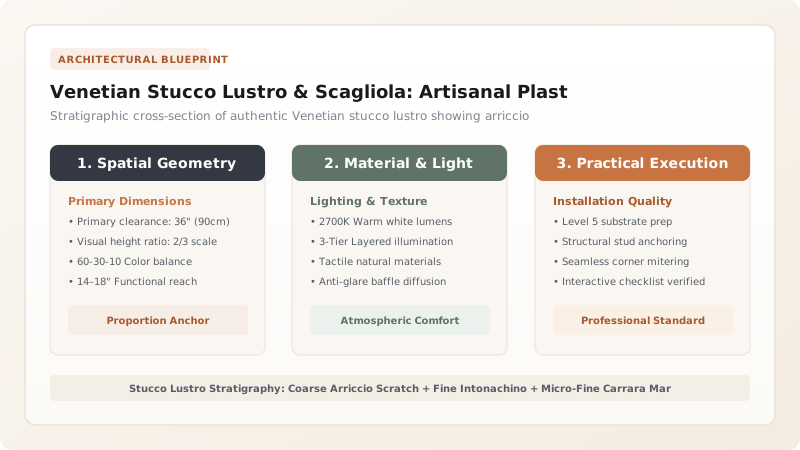
1. Mineral Chemistry: Matured Grassello di Calce & Carrara Marble
Unlike modern synthetic 'Venetian' acrylic plasters—which dry simply through water evaporation and form a rubbery plastic film—authentic Stucco Lustro is a purely mineral, self-petrifying finish.
The foundation is grassello di calce, non-hydraulic lime produced by calcining pure calcium carbonate (limestone) in wood-fired kilns at \(900^\circ\text{C}\), followed by slaking in excess water. When aged in subterranean vats for 24 to 36 months, the calcium hydroxide crystals fracture into microscopic flat platelets:
As the stucco is applied in gossamer layers, it absorbs atmospheric carbon dioxide, chemically reverting back into solid calcium carbonate (recrystallized marble). Mixed with graded Bianco Carrara marble flour, the plaster develops internal crystalline refractive facets that bounce light from deep within the wall. Read material ratios in our guide on slaked lime putty and Carrara marble dust ratios.

2. Hot-Iron Burnishing & Castile Soap Saponification
The legendary mirror finish and water repellency of authentic stucco lustro are achieved without synthetic polyurethanes. The secret lies in saponification.
While the final skim coat is still damp (leather-hard), pure olive-oil Castile soap (savon de Marseille) is applied. Plasterers then run a specially heated iron trowel (ferro caldo, heated to approximately \(70^\circ\text{C}\)) across the surface. The heat and pressure drive a chemical reaction between the free calcium ions of the lime and the potassium oleate fatty acids of the soap:
This precipitates calcium oleate—an insoluble, hydrophobic mineral soap that seals the pore structure while preserving total vapor permeability. Explore execution in hot-iron burnishing and natural Castile soap seals.
3. The Art of Scagliola: Selenite Gypsum & Faux Marble Inlays
First perfected by Renaissance master Guido Fassi in Carpi, Italy, Scagliola (from the Italian scaglia, meaning flakes or chips) is the ultimate trompe l'œil marble technique.
Artisans calcine high-grade selenite gypsum, pulverize it into flour, and knead it into dough with warm rabbit-skin bone glue and natural mineral earth pigments (ochres, umbers, terra verde, lapis lazuli). By kneading multiple colored doughs together into a loaf and slicing thin cut sections, artisans replicate intricate breccia, porphyry, and sienna marble veins that are honed, oiled, and polished with pumice. Master scagliola fabrication in our deep dive on selenite gypsum veining and scagliola inlays.
Stucco Lustro vs. Scagliola Material & Technical Specifications
Use this reference table to calculate exact physical dimensions, ratios, and specifications before purchasing:
| Technical Criterion | Authentic Venetian Stucco Lustro | Artisanal Scagliola Inlay | Modern Synthetic Plaster (Comparison) |
|---|---|---|---|
| Binder Base | 36-month aged grassello di calce (Ca(OH)2) | Calcined selenite gypsum (CaSO4·½H2O) | Acrylic copolymer / vinyl resin emulsion |
| Aggregate Matrix | Bianco Carrara marble dust (0–100 μm) | Pulverized selenite flour + mineral pigments | Calcium carbonate / silica sand with plasticizers |
| Gloss Mechanism | Trowel compression + carbonation + iron heat | Progressive hone (to 3000 grit) + linseed oil | High-gloss synthetic acrylic sealer / wax |
| Waterproofing Layer | Calcium oleate from pure Castile soap | Spirits of turpentine + refined linseed oil / beeswax | Non-breathable polyurethane / acrylic film |
| Vapor Permeability | High (μ < 10); completely breathable | Moderate; suitable for dry luxury interiors | Low (μ > 150); risks moisture trapping behind wall |
| Surface Longevity | Centuries (petrifies into solid limestone) | Centuries (museum-grade palace columns/tables) | 10–15 years before UV yellowing / peeling |
Substrate & Environmental Constraints
Every successful decoration project must account for physical and environmental constraints:
Substrate Rigidity
Stucco lustro and scagliola have zero tensile flexural elasticity. Any deflection in drywall framing will cause hairline spider-web cracking.
Substrate Alkalinity
Base coats must be cured lime-sand plaster or non-deflecting masonry. Applying over drywall requires bonding primers and fiberglass mesh reinforcement.
Humidity and Carbonation
Stucco lustro requires ambient humidity between 50% and 70% during application to allow gradual, complete carbonation without desiccating.
Authentic Stucco Lustro Application Sequence
Execute this professional sequence to achieve flawless results without backtracking:
Substrate Preparation
Apply coarse arriccio base coat (1:3 lime-sand) over masonry or fiberglass-reinforced drywall; scratch to create a mechanical key.
Intonachino Base Layer
Trowel on an intermediate marmorino coat composed of 1:1 aged lime putty and 0.4–0.7mm graded Carrara marble grit; level flat.
First Finishing Skim
Apply an ultra-thin coat of lime putty mixed with micro-fine (0–100 micron) Carrara flour using a rounded Venetian spatula.
Second Skim & Trowel Compression
Apply a second razor-thin skim while the first is damp, holding the blade at a 30-degree angle to compact crystalline platelets.
Castile Soap Saponification
Brush warm olive-oil Castile soap solution over the leather-hard plaster, initiating the calcium oleate precipitation reaction.
Hot-Iron Burnishing (Ferro Caldo)
Glide a heated stainless steel trowel across the soaped surface in continuous overlapping arcs to produce a deep glass-like mirror sheen.
Common Mistakes & Countermeasures
Avoid these costly errors that compromise aesthetics, ergonomics, and budget:
Using modern acrylic 'Venetian plaster' from a bucket and expecting mineral breathability
Over-heating the iron trowel during ferro caldo burnishing (> 90°C)
Using square-edged plastering trowels instead of mirror-polished rounded spatulas
Project Execution Checklist
Track your physical progress. Checkboxes persist automatically on this device:
Frequently Asked Questions
Can Venetian stucco lustro be used in luxury shower stalls and wet rooms?
Yes, but it requires thorough saponification with Castile soap and multiple applications of natural Carnauba wax. While water-resistant and breathable, it is best suited for splash zones rather than submerged pool basins.
Why does aged lime putty perform better than fresh bagged hydrated lime?
Fresh dry hydrated lime powder consists of clumped agglomerates. Aging lime putty underwater for 24+ months allows water to break down particles into nano-sized flat hexagonal calcium hydroxide crystals, providing incredible lubricity, workability, and high-specular gloss.
How do you repair a scratched stucco lustro surface?
Minor surface scuffs can be buffed out using warm Castile soap and a soft microfiber cloth or heated spatola. Deeper gouges require spot-filling with color-matched marble paste, light wet-sanding with 2000-grit paper, and re-burnishing.


