
Chip-carved timber inscriptions (Kerbschnitt), solar rosettes, and natural larch resin finishes represent the decorative and protective crown of Swiss chalet woodwork. Centered on the horizontal tie-beams (Gurtbalken) and window friezes of the Bernese Simmental and Oberland, master carvers layout geometric solar rosettes, Gothic arches, and sweeping Fraktur-script house blessings using compasses and marking knives. Using specialized V-gouges and skew knives, artisans excise triangular and diamond-shaped chips of wood to create dramatic, shadow-casting intaglio relief. The raw wood is protected naturally without synthetic paint: high-altitude conifer heartwood is seasoned with natural larch turpentine (Venice turpentine) blended with cold-pressed linseed oil and beeswax, which cures under Alpine UV radiation into an insoluble, amber-toned, weather-resistant natural resin enamel.
At a Glance: Key Takeaways
- Kerbschnitt (Chip-Carving) Geometry: Triangular, diamond, and curved chip excavations producing high-contrast light and shadow.
- Fraktur House Inscriptions: Poetic German verses, Psalms, and builder signatures carved in flowing Gothic blackletter calligraphy.
- Solar Rosette Symbolism (Wirbelrosette): Rotating geometric sunburst medallions carved on gable peaks as ancient life symbols.
- Specialized Carving Knives: Double-beveled skew knives and 60° V-parting gouges hand-sharpened on waterstones to razor edges.
- Larch Resin (Venice Turpentine): Natural oleoresin tapped from Larix decidua heartwood providing permanent rot resistance.
- UV Photo-Oxidation Patina: Sun-curing turning pale spruce and larch into rich, glowing honey-amber and chocolate brown.
- Zero Toxic Synthetic Strippers: Completely renewable finish maintained with occasional brushings of hot boiled linseed oil.
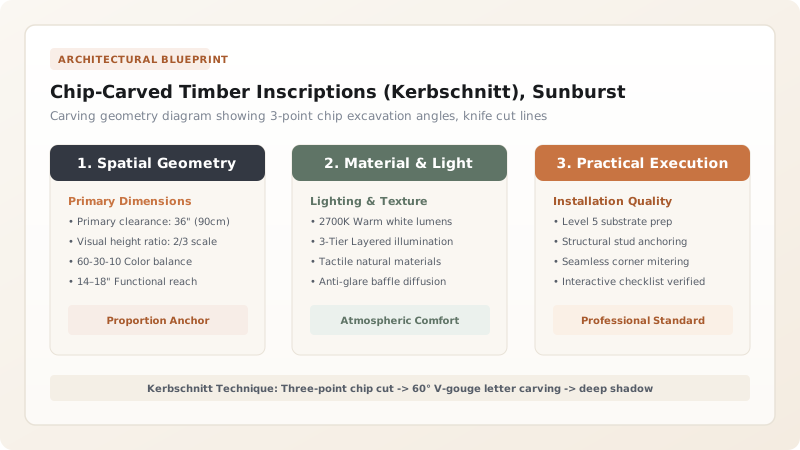
1. Kerbschnitt Geometry: The Art of Three-Point Chip Excavation
Chip carving (German: Kerbschnitt) is an ancient intaglio woodcarving discipline that relies entirely on geometric precision and light refraction. Rather than sculpting raised three-dimensional figures, the artisan excises small, geometrically regular chips of wood from a flat timber beam.
The basic building block is the three-cornered chip (Dreischnitt). The carver uses a short, rigid, razor-sharp skew knife (Kerbschnitzmesser). Three precise angled cuts are made from the three outer corners toward a single central apex at an angle of 50° to 60°. As the third cut is completed, a neat triangular pyramid of wood pops cleanly out of the timber, leaving pristine, glassy-smooth facet walls. When thousands of these faceted indentations are arranged across a building facade, they catch low-angle morning and evening Alpine sunlight, producing dazzling geometric tapestries of bright highlights and deep velvet shadows.
2. Fraktur Inscriptions, Solar Rosettes, and Calligraphic Layout
The horizontal tie-beams spanning the main facade were reserved for calligraphic and symbolic decoration:
- Fraktur Inscriptions: Master carvers drafted magnificent German blackletter calligraphy (Frakturschrift). The verses—known as Hausinschriften—recorded the construction year, the names and crests of the husband and wife who commissioned the house, the master carpenter (Werkmeister), and poetic rhyming prayers asking God to protect the dwelling from lightning, avalanches, and fire. Letters were outlined with marking knives and carved with deep V-grooves.
- Solar Rosettes (Wirbelrosetten): Positioned at the apex of the gable and above entrance doors, multi-petal swirling sunburst medallions were drafted using Euclidean compass geometry. These rosettes symbolized the sun, fertility, and renewal—crucial psychological totems in mountain valleys where the sun disappeared behind high peaks for months in winter.
3. Larch Resin (Venice Turpentine) and Photo-Oxidizing Finishes
Authentic Swiss chalets were never covered with modern colored paints or polyurethane sealers. The protective coating was derived entirely from the Alpine forest itself:
Carvers formulated traditional finishes by blending Venice Turpentine (the viscous, balsamic natural oleoresin tapped from European larch trees, Larix decidua) with boiled flaxseed oil and melted pure beeswax. The high concentration of abietic and pinic acids in the larch resin acts as a potent natural fungicide, completely repelling wood-destroying fungi and woodworm beetles.
Brushed hot onto the dry timber, the resin-oil mixture penetrates 3mm into the wood grain. When exposed to high-altitude solar radiation, the ultraviolet light catalyzes the oxidation of natural lignin and resin molecules. Over the course of 5 to 10 years, the pale spruce and larch wood transforms into a glorious, deep, translucent caramel-amber and glowing chocolate patina that never flakes, blisters, or peels.
Natural Alpine Timber Finishes and Resin Formulations
Use this reference table to calculate exact physical dimensions, ratios, and specifications before purchasing:
| Finishing Medium | Ingredients Formulation | Application Method | Drying / Oxidation Profile | Weather Resistance Factor |
|---|---|---|---|---|
| Larch Resin Balm (Balsam) | 40% Larch Resin + 40% Boiled Linseed + 20% Turpentine | Brushed hot (60°C) with natural bristle | Oxidizes over 14 days in sun | Superb; natural biocide repelling rot and beetles |
| Linseed-Beeswax Polish | 60% Boiled Linseed Oil + 30% Beeswax + 10% Rosin | Hand-rubbed with wool rags | Sets to satin sheen in 48 hours | High; hydrophobic barrier on carved friezes |
| Natural Wood Sun-Bake (Roh) | 100% Raw untreated slow-grown timber | Zero coating applied | Natural photo-oxidation over 5–10 yrs | High; heartwood develops natural weathered skin |
| Swedish Pine Tar Blend | 33% Wood Tar + 33% Raw Linseed + 33% Turpentine | Brushed warm in direct sunlight | Tack-free in 5 to 7 days | Maximum; used on storm-exposed weather gables |
| Lye Pre-Treatment (Seifenlauge) | Hot water + potassium soft soap (Schmierseife) | Scrubbed with stiff union fiber brush | Air dries; leaves silver-grey patina | Moderate; keeps interior timber pale and clean |
Practical Constraints
Every successful decoration project must account for physical and environmental constraints:
Meticulous Tool Sharpening Discipline
Authentic Calligraphic Skill Requirements
Layout, Carving, and Resinating Sequence for a Chalet Inscription Beam
Execute this professional sequence to achieve flawless results without backtracking:
Beam Surface Planing and Smoothing
Plane straight-grained larch or spruce beam mirror-flat using wooden jointer plane; sand lightly with 150-grit paper to remove machine ridges.
Fraktur Calligraphy Layout
Draft parallel horizontal chalk guidelines; draw Fraktur letters and solar rosettes using drafting compasses, triangles, and soft graphite pencil.
Contour Scribing with Marking Knife
Score all outer edges of letters and rosettes with razor-sharp marking knife, severing surface wood fibers to prevent splintering during gouging.
Excavating Three-Cornered Chips (Dreischnitt)
Carve geometric border rosettes using skew knife, making three 50° angled cuts toward the center until the wood chip pops out cleanly.
V-Gouge Letter Carving
Carve Fraktur script lines using 60° V-parting gouge, maintaining consistent 6mm depth to create uniform, bold shadow relief.
Compounding Larch Resin Balm
Melt raw Venice turpentine, boiled linseed oil, and pure beeswax in double-boiler to 60°C; stir until completely liquified and translucent.
Hot Resin Application and Burnishing
Brush hot resin solution generously across carved beam; allow 30 minutes penetration; buff excess oil from surface with coarse linen cloths.
Common Mistakes & Countermeasures
Avoid these costly errors that compromise aesthetics, ergonomics, and budget:
Carving chip patterns across curly, wild, or interlocked wood grain
Painting over historic carved inscriptions with modern acrylic or latex exterior house paint
Using a dull carving knife and forcing cuts with heavy hand pressure
Project Execution Checklist
Track your physical progress. Checkboxes persist automatically on this device:
Frequently Asked Questions
What is the difference between relief carving and chip carving (Kerbschnitt)?
In relief carving, the background wood is hollowed away, leaving the figures standing proud of the surface. In chip carving (Kerbschnitt), the original wood surface remains intact: geometric chips and letters are carved *into* the wood surface in deep V-grooves, creating dramatic negative shadow lines without removing the structural background plane.
Where does Venice Turpentine come from?
Venice Turpentine is the historical trade name for the natural resin tapped from European larch trees (*Larix decidua*) in the Alpine forests of Switzerland, Austria, and northern Italy. Historically, it was traded through the port of Venice. It is renowned for its thick, honey-like consistency, pleasant balsamic aroma, and extraordinary durability.
Why are some letters in Swiss chalet inscriptions colored red and black?
Historically, master carvers occasionally highlighted the deep V-grooves of Fraktur letters with natural mineral pigments (such as bone black and cinnabar or iron red) mixed with egg tempera or linseed oil, making the house blessings readable from the village road below.


