
Terminal gable dragon-head carvings (dragehoder) and boiling pine tar coatings are the twin guardians of Norwegian stave church architecture. Mounted high on soaring, stepped roof gables, the fierce, hand-carved serpentine dragon heads—direct descendants of Viking longship prow sculptures—serve an apotropaic function to ward off evil mountain spirits while functionally terminating bargeboards to deflect gale-force driving rain away from the roof ridge. Beneath these mythic beasts, the entire exterior of the stave church—hundreds of thousands of hand-split pine shingles (spon) and vertical wall planks—is saturated in thick, hot, kiln-burned Scots pine tar (tjære). This natural resinous biocide penetrates deep into the wood cellular matrix, creating an impermeable, water-shedding black armor that resists arctic freeze-thaw cycles and fungal decay for centuries.
At a Glance: Key Takeaways
- Apotropaic Dragon Heads (Dragehoder): Serpentine Norse beast carvings with flared nostrils and snouts mounted on ridge peaks.
- Bargeboard Wind Deflection: Functional terminal anchors deflecting gale-force fjord winds from lifting ridge shingles.
- Urnes Animal Style Carving: Sinuous, interlocking ribbons, stylized quadrupeds, and openwork biting beasts in deep relief.
- Boiled Scots Pine Tar (Tjære): Natural dark biocide distilled from kiln-burned resinous pine stumps (tyrived).
- Hot Saturation Protocol: Applied at 60°C on hot summer days so liquid resins penetrate deep into open wood pores.
- Enduring Black Silhouettes: Regular re-tarring every 3–5 years producing the iconic obsidian-black church facade.
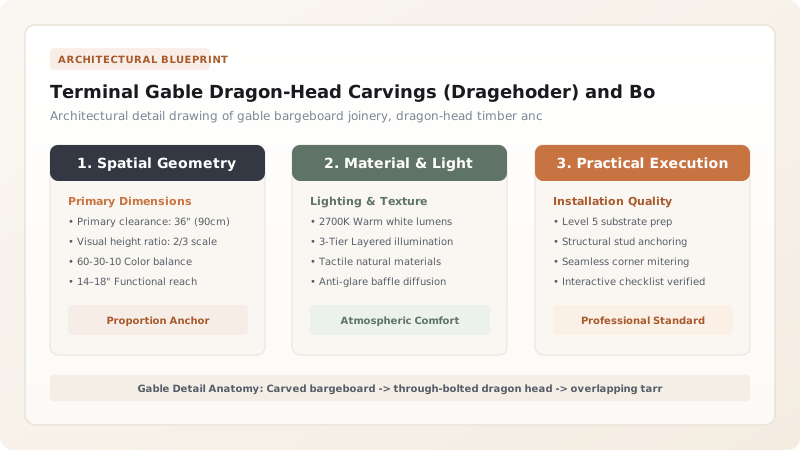
1. Dragehoder Iconography: Viking Warship Proser Continuity on Christian Roofs
The most arresting visual hallmark of traditional stave churches like Borgund, Gol, and Hopperstad is the presence of monstrous dragon heads (dragehoder) projecting from the highest roof gables. These carvings represent an astonishing cultural continuity: they are identical in form to the menacing dragon figureheads (drekahöfuð) mounted on the prows of 9th-century Viking longships.
While the interior of the church was consecrated to Christ and the saints, the exterior roofscape inhabited the wild, perilous mountain world. In the mind of the 12th-century Norse Christian, the sky was filled with pagan spirits, trolls, and destructive storms. The fierce open-mouthed dragon, with its protruding tongue, flaring nostrils, and scrolled ears, acted as an apotropaic guardian, frightening away malevolent forces before they could breach the sacred sanctuary.
2. Bargeboard Joinery and Aerodynamic Water-Shedding Mechanics
Beyond their mythological symbolism, the dragon heads serve critical architectural and aerodynamic purposes:
- Ridge Cap Anchoring: The dragon head is carved from a solid, heavy baulk of slow-grown pine heartwood, measuring up to 1.8 meters in length. Its extended neck forms the terminal anchor for the bargeboards (vindskier) that frame the verge of the steep 60° roof.
- Wind-Vortex Disruption: As violent gale-force winds hit the steep roof gables, the projecting curved snout of the dragon breaks up laminar airflow into harmless turbulent micro-vortices, preventing high-velocity wind uplift from tearing shingles away from the ridge cap.
- Rainwater Deflection: The dragon’s neck is carved with deep drip grooves (vannese) that channel driving mountain rain away from the vulnerable end-grain joints of the wall plates below.
3. The Chemistry of Boiled Pine Tar (Tjære) and Hot Saturation Application
The longevity of stave church timbers is fundamentally a triumph of organic wood preservation. Exposed to Norway's relentless moisture, un-treated pine shingles rot within 15 years. Stave churches survive because they are saturated with Tjære—authentic Scandinavian wood-tar produced by destructive distillation of resinous Scots pine stumps (tyri) in earth-covered tar kilns (tjæremiler).
True pine tar is not a film-forming paint; it is an unrefined liquid resin packed with natural turpentine, resin acids (abietic acid), and phenols. When heated to 60°C and brushed onto dry shingles on warm summer days, the volatile turpentine thins the liquid, pulling the resin acids deep into the tracheid cells of the pine heartwood. The tar hardens into a breathable, flexible barrier that repels liquid water while allowing internal moisture vapor to escape. It is naturally antiseptic, toxic to wood-decaying fungi (Coniophora puteana), and repels wood-boring beetles, imparting the deep, lustrous black-brown patina that defines the stave church aesthetic.
Stave Church Exterior Carvings and Weatherproofing Specifications
Use this reference table to calculate exact physical dimensions, ratios, and specifications before purchasing:
| Exterior Component | Material Specification | Dimensional Standard | Functional Purpose | Maintenance Lifecycle |
|---|---|---|---|---|
| Dragon Head (Dragehoder) | Dense Scots pine heartwood log | 1400–1800mm length, 200mm thick | Apotropaic defense & wind baffle | Re-tarred every 3 years; lasts 500+ yrs |
| Roof Shingles (Spon) | Split heartwood pine (not sawn) | 120 x 280mm, 15mm thickness | Multi-layered water-shedding scale | Steep-slope shingling; 50-year service |
| Bargeboards (Vindskier) | Heavy pine planks with carved knotwork | 40 x 250mm, up to 6m length | Protects roof verge against gale uplift | Through-bolted with birch trunnels |
| Boiled Pine Tar (Miletjære) | 100% kiln-burned pine root tar | Heated to 60°C for application | Natural biocide, fungicide & moisture seal | Re-applied every 3 to 5 years |
| Ridge Crest Finials | Carved openwork dragon cresting | 300mm height along entire ridge | Breaks wind turbulence at ridge cap | Impregnated continuously with tar |
Practical Constraints
Every successful decoration project must account for physical and environmental constraints:
High Flammability During Tarring
Extremely Demanding Scaffolding Access
Master Craft Protocol for Carving Dragon Heads and Applying Pine Tar
Execute this professional sequence to achieve flawless results without backtracking:
Tyri Pine Heartwood Selection
Select resin-saturated pine heartwood from mature mountain trees, checking for tight annual growth rings and high natural resin content.
Dragon Profile Scribing and Rough Hewing
Draft traditional Urnes-style serpentine dragon profile on timber baulk; rough out shape using Scandinavian adzes and hewing axes.
Deep Relief Gouge Carving
Carve gaping jaws, flared nostrils, and curled ears using curved spoon-gouges; undercut decorative interlacing knotwork by 40mm.
Terminal Tenon and Bargeboard Notching
Cut heavy tenon at the base of the dragon neck to slot securely between the roof bargeboards at the gable apex.
Kiln-Burned Pine Tar Heating
Heat pure kiln-burned pine tar in iron cauldrons to 60°C; stir continuously to blend natural turpentine solvents and resin acids.
Hot Tar Saturation Application
Apply hot tar generously with stiff horsehair brushes across dry dragon carvings and roof shingles during warm summer sun.
Ridge Apex Hoisting and Pinning
Hoist the heavy carved dragon head to the gable peak; pin through bargeboard horns with seasoned oak trunnels, sealing seams with tar.
Common Mistakes & Countermeasures
Avoid these costly errors that compromise aesthetics, ergonomics, and budget:
Applying cold, unheated pine tar on damp or frozen shingles
Carving dragon heads from flat-sawn pine sapwood
Coating shingles with modern petroleum bitumen or asphalt tar
Project Execution Checklist
Track your physical progress. Checkboxes persist automatically on this device:
Frequently Asked Questions
How often do Norwegian stave churches need to be coated with pine tar?
In Norway's wet western fjords, sunny and wind-exposed south and west roof facades are re-tarred every 3 to 5 years. More sheltered north and east facades may go 7 to 10 years between treatments. Conservators monitor the wood closely: as soon as the tar weathers from rich black to matte charcoal-grey, fresh hot tar is applied.
Why are stave church roof shingles split with an axe rather than sawn?
Split shingles (spon) are cleaved along the natural longitudinal wood grain with a froe and wooden mallet. This leaves the cell walls intact and smooth, so water runs off naturally. Sawn shingles cut across millions of wood fibers, leaving open porous end-grain straws that absorb water like a sponge and rot quickly.
What does a freshly tarred stave church smell like?
A freshly tarred stave church has a powerful, deeply evocative aroma of sweet wood smoke, pine resin, campfires, and turpentine. The scent carries on the mountain breeze for hundreds of meters and lingers inside the church for years, creating an unforgettable sensory connection to medieval Scandinavia.


