
Persian Plaster and Terracotta Arch Template Moulding is the precise workshop methodology that allowed master builders to construct complex stereotomic vaults with zero wooden formwork. On a smoothed gypsum floor, masons drafted full-scale geometric layouts and cast curved plaster rib templates called moqavva. These rigid, featherweight gypsum molds were hoisted into position on vertical piers to guide the laying of custom-molded curved terracotta bricks, ensuring millimeter accuracy across multi-ton vault spans.
At a Glance: Key Takeaways
- Full-Scale Gypsum Tracing Floor (Zamin-Tarhi): The physical drafting floor where complex 3D geometry is mapped 1:1.
- Moqavva Plaster Templates: Rigid curved gypsum battens cast directly on the floor to serve as reusable arch profiles.
- Custom Curved Terracotta Bricks: Lightweight porous clay bricks molded with matching parabolic curvatures.
- Centering-Free Brick Adhesion: Sticking bricks in mid-air using fast-setting gach mortar without wooden shoring.
- Aesthetic Plaster Moulding: Covering rough structural brick ribs with crisp, hand-run gypsum cornices and floral lace.
- Zero-Waste Construction: Every mold, scrap brick, and leftover plaster slurry is crushed and recycled on site.
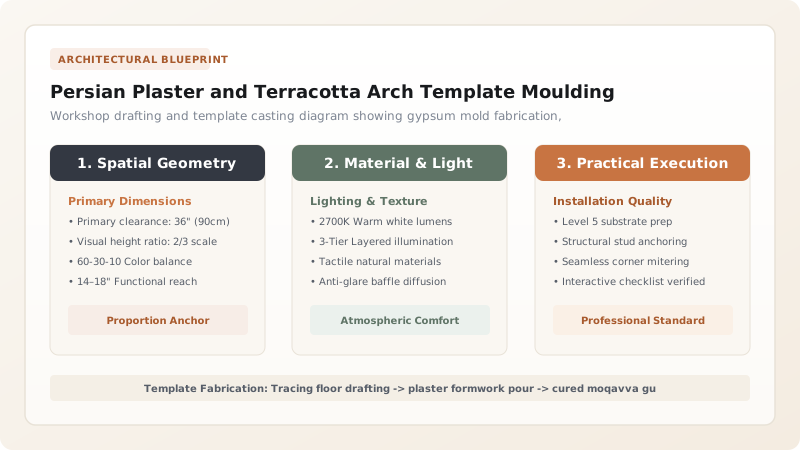
1. The Zamin-Tarhi: Full-Scale 1:1 Drafting Floor
Before any vaulting commenced on the building site, the master me'mar established the zamin-tarhi (tracing floor). A level room on site was coated with a 10mm layer of dead-flat gypsum plaster.
Using a steel-tipped wooden beam compass, string trammels, and dyed chalk lines, the me'mar scribed the entire vault plan at full scale (1:1). The radial divisions of the Karbandi and the true profiles of the parabolic arches were scratched deeply into the plaster floor, serving as the master geometric legal contract for the entire masonry team.
2. Casting Moqavva Templates: The Plaster Centering Revolution
To transfer the drafted arch curve from the horizontal floor up to the overhead vertical space without heavy timber centering, Persians invented the moqavva (plaster template).
Artisans placed flexible reed splints along the scribed arch lines on the floor, forming a shallow trench. Rapid-setting gach plaster reinforced with animal hair or straw fibers was poured into the trench. Within 15 minutes, the plaster cured into a rigid, lightweight curved batten measuring 50mm x 100mm. Two workers easily lifted this featherweight plaster arch up to the scaffolding, anchoring it between the pa-bar springers to serve as an exact physical guide for bricklaying.
3. Curved Terracotta Molding and Freehand Adhesion
Standard flat rectangular bricks create jagged, clumsy curves in tight vaults. Persian kilns fired specialized curved terracotta bricks (ajor-e qousi) molded with subtle radiused faces and tapered wedge cross-sections.
The mason buttered the edge of each damp terracotta brick with a 5mm coat of fresh gach paste, pressed it firmly against the previous brick and the moqavva guide, and held it with light hand pressure for 45 to 60 seconds. The rapid chemical suction of the gypsum held the brick suspended in mid-air against gravity, advancing the arch rib toward the apex at speeds exceeding 20 bricks per hour.
Persian Vaulting Materials & Setting Kinetics
Use this reference table to calculate exact physical dimensions, ratios, and specifications before purchasing:
| Material Component | Local Persian Term | Setting / Cure Time | Compressive Strength | Workshop / Site Role |
|---|---|---|---|---|
| Fast-Setting Calcined Gypsum | Gach-e Tiz | 3 - 5 Minutes (Flash set) | 12 - 15 MPa | Freehand brick adhesion in mid-air |
| Slow-Setting Lime-Gypsum | Gach-o-Khak | 20 - 30 Minutes | 8 - 10 MPa | Underbedding & template casting |
| Curved Terracotta Arch Brick | Ajor-e Qousi | Kiln fired (950°C) | 20 - 25 MPa | Structural arch ribs (togh) |
| Hollow Infill Clay Tile | Toukh-e Sofali | Kiln fired (850°C) | 10 - 14 MPa | Lightweight shaparak ceiling webs |
| Reinforced Plaster Template | Moqavva | 15 Minutes to full rig | 15 MPa (with hair) | Reusable vertical arch alignment guide |
Operational & Material Constraints
Every successful decoration project must account for physical and environmental constraints:
Extreme Flash-Setting Window
Gach plaster cannot be retempered with water once setting begins; any mortar left in the bucket after 5 minutes must be discarded.
Scaffolding Stability Without Timber
Masons work from narrow, modular brick and earthen towers erected inside the room, requiring steady balance.
Protocol for Drafting, Casting, and Setting Moqavva Arch Templates
Execute this professional sequence to achieve flawless results without backtracking:
Plaster Tracing Floor Leveling
Pour 10mm smooth gypsum screed over workshop floor; trowel to mirror flatness; cure for 24 hours.
Full-Scale Arch Drafting
Draft parabolic arch curve using string trammel and iron scriber; verify span and apex rise against architectural specifications.
Reed Edge Moulding & Release Wax
Pin flexible willow reed strips along scribed lines to form 50mm wide channel; brush floor with tallow grease release agent.
Fiber-Reinforced Gach Pouring
Mix gach plaster with goat hair fibers; pour into reed channel; screed flat; allow 20 minutes for exothermic crystal set.
Moqavva Hoisting & Alignment
Pry cured moqavva template off floor; carry up scaffolding; bed ends in pa-bar springer pockets; verify plumb with plumb-bob.
Freehand Bricklaying Along Guide
Lay curved terracotta bricks edge-to-edge along moqavva using 3-minute gach mortar; strike moqavva template once arch is keyed.
Common Mistakes & Countermeasures
Avoid these costly errors that compromise aesthetics, ergonomics, and budget:
Using ungreased gypsum floors when casting moqavva templates
Laying dry, dusty terracotta bricks into fast-setting gach mortar
Project Execution Checklist
Track your physical progress. Checkboxes persist automatically on this device:
Frequently Asked Questions
How many times can a single moqavva plaster template be reused?
When cast with goat-hair fiber reinforcement and handled carefully by experienced masons, a single moqavva template can be used to lay between 12 and 16 identical arch ribs before edge wear requires re-casting.
Why did Persian masons prefer goat hair over hemp fibers in plaster?
Goat hair has natural keratin oils and microscopic surface scales that provide superior tensile bonding in gypsum matrices without absorbing excessive water, preventing the plaster from becoming limp or soggy.


