
Persian Vault Acoustic Resonance and Passive Bazaar Cooling represent the environmental engineering genius of Karbandi architecture. In desert cities where summer temperatures exceed 45°C, monumental vaulted market halls (timchehs) operated without mechanical energy. By pairing soaring Karbandi ceiling vaults with central oculus lanterns (hur-no), subterranean water canals (qanats), and evaporative courtyard pools, vaults induced continuous passive stack-effect ventilation. Acoustically, thousands of concave plaster niches scattered chaotic commercial market noise while amplifying sacred musical calls.
At a Glance: Key Takeaways
- Solar-Induced Thermal Stack Effect: Hot air venting through apex lanterns creating low-pressure upward air currents.
- Qanat Evaporative Cooling Connection: Drawing cool 18°C air from subterranean canals through bazaar floor vents.
- Acoustic Sound Diffusion: Intersecting plaster facets eliminating harsh flutter echoes and reducing bazaar ambient noise by 10-15 dB.
- Central Oculus (Hur-No): Aerodynamic roof dome opening exhausting stale air while admitting diffuse natural daylight.
- Thermal Flywheel Inertia: Multi-ton terracotta and brick mass buffering desert day-night temperature swings by up to 20°C.
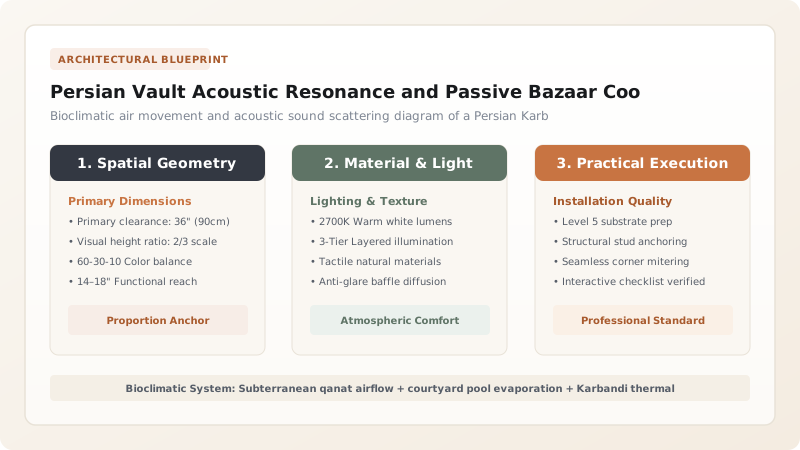
1. Bioclimatic Physics: The Stack Effect and Bazaar Chimneys
Persian bazaar vaults are solar-powered thermal chimneys. In desert cities like Kashan and Yazd, the exterior dome surface is heated by intense solar radiation, warming the air directly beneath the high apex of the vault.
As hot air expands and rises, it exhausts through the central oculus (hur-no) or perimeter lantern clerestories. This creates a continuous low-pressure zone at floor level, which draws cool, humidified air upward across central marble fountains (hooz) and from subterranean qanat aqueduct tunnels, maintaining an interior temperature 12°C to 18°C cooler than the desert exterior without a single moving part.
2. Acoustic Engineering: Diffusing Market Noise
In a standard flat-ceiling or barrel-vaulted stone hall, hundreds of shouting merchants and customers generate deafening reverberant noise, creating a chaotic acoustic din. The multi-faceted geometry of a Karbandi vault acts as a mathematical acoustic diffuser.
Sound waves rising from the bazaar floor strike the thousands of angled plaster facets (shaparak and lapa) at varied incident angles. Rather than reflecting back down as harsh flutter echoes, the sound waves are scattered isotropically in all directions, attenuating high-frequency speech noise and maintaining an atmosphere of dignified, murmuring acoustic calm.
3. The Music Rooms of Safavid Palaces (Ali Qapu)
In royal palaces such as the Ali Qapu Music Hall in Isfahan, this acoustic science was pushed to the absolute extreme. Master builders hollowed out the decorative Karbandi plaster facets into delicate shapes of vases, ewers, and flutes (chogh).
These hollow plaster cavities functioned as Helmholtz acoustic resonators. When court musicians played traditional Ney flutes and Tar lutes, the hollow niches absorbed harsh reverberation while amplifying the subtle harmonic overtones of vocal poetry, creating a sublime acoustic sanctuary celebrated as one of the wonders of the Islamic world.
Bioclimatic Performance Metrics of Persian Karbandi Vaults
Use this reference table to calculate exact physical dimensions, ratios, and specifications before purchasing:
| Architectural Element | Thermodynamic Function | Summer Exterior / Interior Temp | Air Change Rate (ACH) | Acoustic Impact |
|---|---|---|---|---|
| Apex Hur-No Oculus | Thermal chimney exhaust vent | Exterior: 44°C / Interior: 27°C | 4 - 8 Air Changes / Hour | Vents high-frequency vocal flutter |
| Subterranean Qanat Air Inlet | Deep earth geothermal intake | Air cooled from 40°C down to 20°C | Continuous 1.2 m/s draft | Zero mechanical fan background noise |
| Central Hooz Water Basin | Evaporative micro-cooling pool | Increases relative humidity by 25% | Local radiant cooling zone | Gentle water splashing white noise mask |
| Faceted Shaparak Plaster Niches | Isotropic acoustic scattering | Thermal flywheel insulation | Static air boundary layer | Reverberation time reduced to 1.4s |
Urban & Environmental Constraints
Every successful decoration project must account for physical and environmental constraints:
Urban Pollution Ingress
Desert dust storms (sandstorms) enter through open apex oculi, requiring regular cleaning of bazaar floor basins.
Water Table Depletion
Modern industrial over-pumping has dried up many ancient qanat systems, requiring closed-loop recirculation pumps for central cooling pools.
Protocol for Commissioning and Tuning a Karbandi Passive Cooling Vault
Execute this professional sequence to achieve flawless results without backtracking:
Thermal Stack Airway Verification
Inspect underground air supply shafts connected to qanat canals; clear flues of debris to ensure unimpeded laminar airflow.
Central Hooz Basin Water Level Setting
Fill central marble pool from gravity-fed qanat; adjust fountain jet to maintain continuous surface ripple for evaporative cooling.
Hur-No Aerodynamic Chimney Calibration
Open adjustable louvers at the apex hur-no lantern; measure upward convective draft velocity using smoke tracer tests.
Acoustic Reverberation Sweep
Perform acoustic frequency sweep across the hall; inspect plaster niches for sound absorption and absence of focused echoes.
Gypsum Plaster Porosity Maintenance
Clean interior plaster surfaces with soft horsehair brushes to maintain open micro-pores for moisture absorption and release.
Seasonal Louver Adjustment
In winter, close apex hur-no dampers to trap warm air generated by human occupancy; in summer, open fully to exhaust heat.
Common Mistakes & Countermeasures
Avoid these costly errors that compromise aesthetics, ergonomics, and budget:
Glazing over the apex hur-no oculus with airtight modern glass panels
Applying glossy oil-based paints or synthetic lacquers over the interior plaster niches
Project Execution Checklist
Track your physical progress. Checkboxes persist automatically on this device:
Frequently Asked Questions
How did Persian merchants prevent bird ingress through the open hur-no oculus?
They installed delicate brass wire screens or suspended polished mirrored glass balls (kureh) directly beneath the opening; the flashing reflections of daylight off the spinning mirrored balls frightened birds away from flying into the hall.
Why did the music rooms of Ali Qapu have hollow cutouts shaped like vases?
The vase cutouts in the double-skinned plaster ceiling acted as tuned acoustic resonators (Helmholtz absorbers). The volume of air inside each hollow plaster bottle vibrated in sympathy with specific musical frequencies, selectively absorbing harsh echoes and creating a crystal-clear recording-studio acoustic quality.


