
Geometric interlocking turned-wood mashrabiya screens are fabricated by precision lathe-turning individual hardwood bobbins and junction nodes. Spindles feature turned cylindrical tenons that seat into four-way or six-way radial mortises bored into connection beads. Assembled dry without metallic fasteners or adhesives, the friction-fitted matrix absorbs seasonal hygroscopic swelling while forming an acoustically dampening, glare-diffusing architectural diaphragm.
At a Glance: Key Takeaways
- Precision Lathe Turning: Lathe-turned bobbins produced to ±0.2mm dimensional tolerance across thousands of identical units.
- Radial Node Boring: Junction beads bored with orthogonal 90° or diagonal 60° multi-axis radial mortises.
- Dry-Friction Interlock: Non-glued mechanical joinery allowing micro-expansion across moisture cycles.
- Subtractive Geometry: Profile contours optimized to maximize curved surface area for diffused light reflection.
- Hardwood Selection: Seasoned fine-grained timbers (walnut, boxwood, cedar) selected for zero end-grain tear-out.
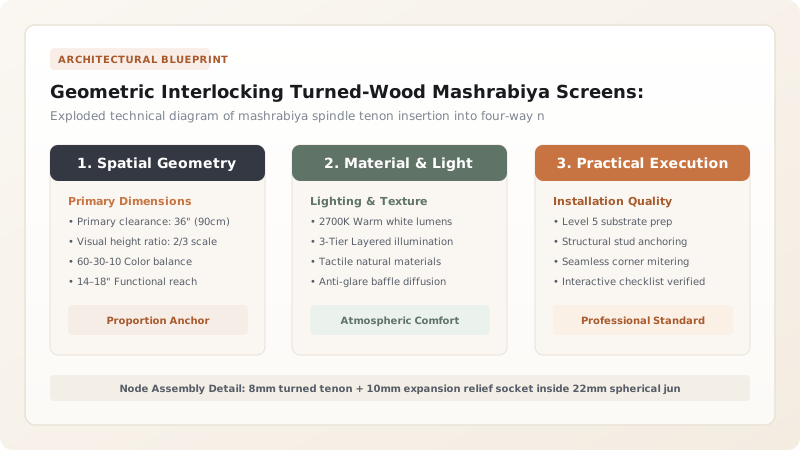
1. Turning Mechanics: Lathe Tooling & Spindle Contours
The fabrication of mashrabiya screens represents high-precision repetitive woodturning. Historically produced on a foot-powered bow lathe (torna) and in modern workshops on variable-speed wood lathes, square hardwood blanks are rounded and contoured using high-speed steel gouges and skew chisels.
The contour consists of an alternating sequence of beads, coves, and fillets. Spindle shafts are turned to a baseline diameter of 10mm to 14mm, swelling to 20mm to 28mm at the decorative node. Consistency within ±0.2mm is mandatory to ensure identical insertion depths and uniform aperture spacing across the screen matrix.
2. Multi-Way Junction Nodes & Radial Mortise Boring
The junction node (boğum) acts as the multi-directional mechanical connector:
- Orthogonal 4-Way Grids: Four radial mortises bored at exact 90° intervals around the node equator, creating square or rectangular ventilation apertures.
- Hexagonal 6-Way Grids: Six radial mortises bored at 60° azimuths, producing rigid triangulated geometries that resist diagonal shear distortion.
Mortise depth is calibrated to exactly one-third of the node diameter, bored with brad-point bits to eliminate internal tear-out and maintain crisp perimeter rims.
3. Hygroscopic Expansion Relief Engineering
Because timber expands significantly across its grain when atmospheric relative humidity rises, rigid joinery would cause immediate splitting of the junction beads. Ottoman craftsmen engineered an intentional 0.5mm to 1.0mm axial expansion clearance at the bottom of every mortise socket.
When humidity increases, the tenon swells radially, gripping the mortise walls tighter through friction, while longitudinal expansion is accommodated within the end void without pushing the node apart.
Mashrabiya Joinery Geometry & Structural Attributes
Use this reference table to calculate exact physical dimensions, ratios, and specifications before purchasing:
| Joinery System | Intersection Geometry | Aperture Porosity (%) | Lateral Shear Resistance |
|---|---|---|---|
| Orthogonal 4-Way (Bilezikli) | 90° perpendicular cross | 45% - 55% | Moderate (Requires rigid perimeter frame) |
| Diagonal 4-Way (Baklava) | 45° diamond cross | 35% - 45% | High (Self-bracing diagonal shear resistance) |
| Hexagonal 6-Way (Yıldızlı) | 60° triangulated star | 25% - 35% | Very High (Triangulated truss diaphragm action) |
| Continuous Rod Sleeve | Through-bore continuous dowel | 40% - 50% | High (Rapid mechanical disassembly) |
Craftsmanship & Tooling Constraints
Every successful decoration project must account for physical and environmental constraints:
Tolerancing Demands
A standard 1.2m x 1.8m window panel requires over 800 turned pieces; a 0.2mm error per piece creates a 20mm cumulative frame error.
Timber Grain Uniformity
Wild or figured grain will twist during turning; use only straight-grained quartersawn heartwood.
Protocol for Assembling a Historic Friction-Fit Lattice Panel
Execute this professional sequence to achieve flawless results without backtracking:
Blank Sizing & Moisture Equilibration
Rip kiln-dried cedar or walnut stock into 25mm square blanks; equilibrate in workshop at 45% relative humidity for 14 days.
Lathe Spindle Turning
Turn spindles to target profile using master template calipers; polish on lathe with 400-grit abrasive paper.
Radial Mortise Indexing
Mount junction beads in a rotary dividing indexing chuck; bore radial sockets at designated angles to precision depth.
Sequential Corner Assembly
Commence assembly from bottom corner inside a 3-sided assembly jig, tapping spindles into sockets with a rawhide mallet.
Perimeter Stile Clamping
Install the fourth perimeter stile, applying uniform screw-clamp pressure to preload the friction-fit lattice matrix.
Hot Oil Impregnation
Submerge or brush panel with warm linseed oil and pine rosin blend; allow deep capillary absorption.
Common Mistakes & Countermeasures
Avoid these costly errors that compromise aesthetics, ergonomics, and budget:
Using PVA or aliphatic wood glue during spindle assembly
Boring junction mortises off-center or without indexing jigs
Project Execution Checklist
Track your physical progress. Checkboxes persist automatically on this device:
Frequently Asked Questions
How are damaged individual spindles replaced in an existing mashrabiya panel?
Conservators carefully remove the outer perimeter beading strip, slide the assembly loose within its rebate, and extract the damaged spindle. If the frame cannot be opened, a skilled joiner splits the broken spindle, bores an internal dowel core, and grafts an exact replica using a concealed brass or hardwood sleeve.
Why is walnut preferred for interior lattice shutters while cedar is used for exteriors?
Walnut has an extremely dense, fine texture that allows razor-sharp lathe details and polishes to a lustrous interior finish, whereas Lebanese cedar contains natural antimicrobial thujaplicin oils that provide superior rot resistance against exterior rain.


