
Build authentic Japanese Shoji sliding screens by joinery-crafting frames from clear, straight-grain Japanese Hinoki cypress or Western red cedar. Infill with intricate interlocking Kumiko wood lattices (such as Asanoha hemp leaf or Kikyo bellflower), stretch handmade mulberry Washi paper using water-mist shrink tension, and suspend on smooth sliding tracks.
At a Glance: Key Takeaways
- Hinoki Cypress & Akita Cedar: Clear, aromatic, straight-grain softwoods that resist warping and machine with razor-sharp tolerances.
- Kumiko Wood Lattice Joinery: Precision hand-chiseled geometric grids assembled with friction-fit half-lap joints without metal nails.
- Handmade Mulberry Washi Paper (*Kozo*): Natural plant fiber paper diffuses harsh sunlight into a tranquil, velvety ambient glow.
- Water-Shrink Paper Stretching: Mist-wetting Washi paper after pasting pulls the sheet drum-tight as it dries without wrinkles.
- Top-Hung Ball-Bearing Sliding Tracks: Concealed overhead tracks provide whisper-quiet gliding with zero trip hazards on floor tatami.
In-Depth Guides in this Directory
Explore specialized subtopic blueprints, technical dimensions, and execution checklists:
Kumiko Geometry: Asanoha vs Kikyo Lattice Joinery
Master traditional Japanese Kumiko woodworking geometry: Asanoha (hemp leaf) hexagonal trigonometry, Kikyo (bellflower) star patterns, guide block angle bevels, and friction-fit joinery.
Washi Paper: Mulberry Fiber Physics & Water-Stretching
Master authentic Japanese Washi paper installation: handmade Kozo mulberry long-fiber physics, natural rice starch paste (Nori) recipes, water-mist tension shrinking, and drum-tight stretching.
Shoji Sliding Tracks: Top-Hung Rails & Mortise Guides
Master Japanese Shoji sliding track carpentry: traditional wooden Kamoi (top) and Shikii (bottom) grooved tracks, top-hung concealed ball-bearing rollers (Sugatsune), and wax lubrication.
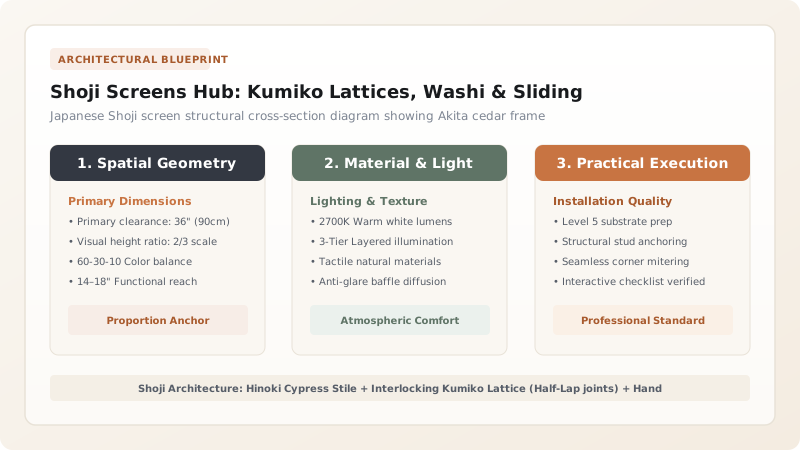
1. Japanese Aesthetics: In Praise of Shadows & Light Diffusion
In traditional Japanese architecture (as celebrated in Jun'ichirō Tanizaki's In Praise of Shadows), windows and partitions are not transparent barriers, but Luminous Diffusers of Gentle Light.
Unlike Western glass that casts harsh glare, authentic Shoji Screens (*障子*) filter direct sunlight through handmade Mulberry Washi Paper (*Kozo*), eliminating harsh shadows and bathing the room in a soft, ethereal glow. Learn lattice patterns in Kumiko lattice patterns (Asanoha vs Kikyo) and coordinate with Wabi-Sabi organic design principles.

2. Washi Paper Water-Tensioning & Concealed Sliding Hardware
Applying paper to wood frames requires a specialized historic craft: the paper must be stretched drum-tight without tearing or sagging under seasonal humidity.
Artisans paste paper using Natural Nori (Rice Starch Paste) and mist the sheet with distilled water; as the fibers dry, they contract into a drum-tight, wrinkle-free translucent membrane. The lightweight screens glide on concealed top-hung cedar sliding tracks. Learn paper stretching in Washi paper water-shrink stretching physics.
Shoji Screen Framing Woods Comparison
Use this reference table to calculate exact physical dimensions, ratios, and specifications before purchasing:
| Wood Species | Grain & Color Tone | Aromatic Quality | Workability & Stability |
|---|---|---|---|
| Japanese Hinoki Cypress (*Chamaecyparis*) | Silky pale cream with pink undertones | Intoxicating citrus-cedar aroma | Maximum (Silky planed surface / Zero warp) |
| Akita Sugi / Western Red Cedar | Warm amber cinnamon brown | Rich spicy cedar fragrance | Excellent (Lightweight & dimensionally stable) |
| Sitka Spruce / Alaskan Yellow Cedar | Pale creamy white | Mild resin scent | Very High (Crisp pencil-line Kumiko lattices) |
| Pine / Poplar (Hardware store) | Yellow with knots / Wild grain | Faint resin | FAILS: Warps and twists screens out of track |
Paper Puncturing Pet & Child Constraints
Every successful decoration project must account for physical and environmental constraints:
Traditional Washi Paper Tearing or Puncturing from Pets and Children
Pure mulberry paper tears if poked; for modern family homes, specify 'Laminated Washi' (Washi paper thermo-bonded between two microscopic sheets of transparent acrylic or polyester film), which is 100% puncture-proof, washable, and looks identical to authentic paper.
How to Build and Mount a Japanese Shoji Screen
Execute this professional sequence to achieve flawless results without backtracking:
Mill Hinoki Cypress Stiles and Rails
Plane clear straight-grain cypress into 1-3/8" thick stiles with haunched mortise-and-tenon joints.
Cut and Notch Kumiko Lattice Strips
Rip 1/8" × 3/8" lattice strips; notch half-lap half-depth joints on a Kumiko sled spaced 2.5" OC.
Interlock Kumiko Grid and Inset in Frame
Friction-fit the lattice grid without glue, anchoring outer ends into stile mortise pockets.
Brush Natural Rice Starch Paste (Nori) on Grid
Apply boiled rice starch paste along all wood lattice faces using a horsehair pastry brush.
Roll and Press Mulberry Washi Paper
Unroll Washi paper roll from top to bottom, smoothing flat across glued lattice with a dry cloth.
Mist Water to Tension and Dry Drum-Tight
Spray fine mist of clean water over paper back; let dry 4 hours to shrink drum-tight.
Hang on Top-Hung Concealed Sliding Track
Mount overhead ball-bearing sliding track into header and adjust screen plumb and square.
Common Mistakes & Countermeasures
Avoid these costly errors that compromise aesthetics, ergonomics, and budget:
Using Synthetic White PVA Glue to Adhere Washi Paper
Project Execution Checklist
Track your physical progress. Checkboxes persist automatically on this device:
Frequently Asked Questions
How often does traditional Washi paper need to be replaced on Shoji screens?
In traditional Japanese homes, Shoji paper is replaced every 1 to 2 years during New Year celebrations (*Ōsōji*). In modern homes using laminated acrylic Washi, the paper lasts 15+ years with zero maintenance.


