
Install traditional Japanese Washi paper on Shoji screens by applying natural rice starch paste (Nori) along the wood lattice grid. Roll the dry paper roll from top to bottom, smoothing flat. Once the paste dries, spray a fine, uniform mist of distilled water over the entire back of the paper; as the water evaporates, the paper shrinks drum-tight.
At a Glance: Key Takeaways
- Kozo Mulberry Long-Fiber Physics: Entangled 10mm plant fibers provide extreme tensile strength that contracts without tearing.
- Natural Rice Starch Paste (Nori): Reversible, water-soluble starch adhesive allows future re-papering without damaging wood.
- Water-Mist Tensioning Technique: Dampening relaxes hydrogen bonds in cellulose; drying contracts the sheet into a drum-tight skin.
- Light Diffusion Optics: Transmits 50% to 60% of natural sunlight while scattering light rays into a velvety, shadow-free glow.
- Natural Room Humidity Buffering: Washi paper breathes, absorbing excess room moisture in summer and releasing it in winter.
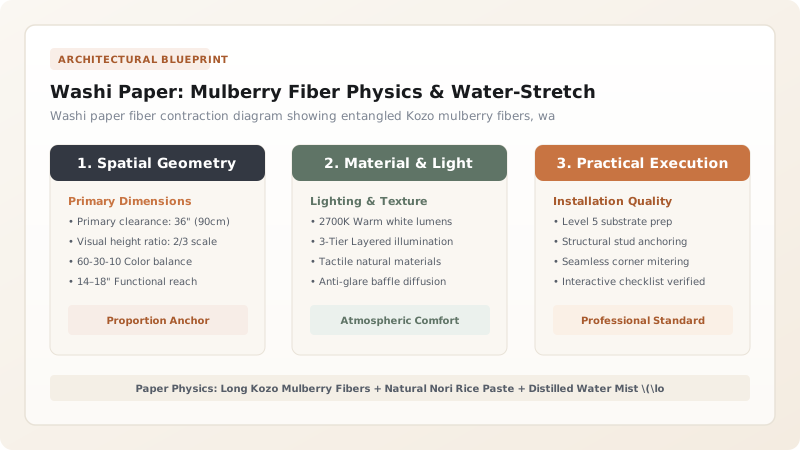
1. Material Science: Kozo Mulberry Long-Fiber Tensile Physics
Unlike Western wood pulp paper made from short 1mm chopped wood fibers, authentic Japanese Washi Paper (*和紙*) is handmade from the inner bark of the Kozo (Paper Mulberry - 楮) shrub.
Kozo fibers measure over 10mm to 15mm in length. During the traditional hand-papermaking process (*Nagashi-zuki*), these long fibers interlock into a dense, felted web. This gives Washi paper extraordinary tensile strength and tear resistance, allowing it to withstand high shrinking tension. Learn frame joinery in Shoji screen architecture.

2. The Water-Shrink Tensioning Protocol: Drum-Tight Execution
If you try to stretch dry paper manually across a frame, it will inevitably develop loose wrinkles and sag during humid summer days. Japanese artisans rely on Hygroscopic Evaporative Contraction.
After pasting the paper with Nori (boiled rice starch paste) and trimming the edges, the back of the paper is sprayed with a fine mist of distilled water. As the water molecules evaporate over 4 hours, hydrogen bonds pull the Kozo fibers tight, leaving the paper as taut and resonant as a drum skin. Review Kumiko patterns in Kumiko lattice geometry.
Shoji Paper Types Comparison
Use this reference table to calculate exact physical dimensions, ratios, and specifications before purchasing:
| Shoji Paper Formulation | Fiber Composition | Tear Resistance | Aesthetic Character |
|---|---|---|---|
| Handmade Pure Kozo Washi (Optimal) | 100% Japanese Mulberry Bark | High (Traditional long fiber) | Sublime, natural warm translucent glow |
| Laminated Acrylic Washi (*Tough-Top*) | Washi thermo-bonded to acrylic film | Maximum (Puncture & tear proof) | Modern luxury / Family & pet safe |
| Rayon / Polyester Blended Washi | 60% Kozo + 40% Synthetic fibers | Very High | Clean bright white / High moisture resistance |
| Western Wood Pulp Paper (DANGER) | Short wood pulp fibers | FAILS: Rips during water shrinking | FORBIDDEN for Shoji screens |
Tap Water Mineral Staining Constraints
Every successful decoration project must account for physical and environmental constraints:
Spraying Hard Tap Water Leaving Yellow Water Rings on White Washi Paper
Tap water contains minerals and chlorine that leave yellow stains as water evaporates; strictly use 100% Distilled or Deionized Water in an ultra-fine atomizing spray bottle when misting Shoji paper.
How to Paste, Trim, and Water-Tension Washi Paper
Execute this professional sequence to achieve flawless results without backtracking:
Mix Pure Rice Starch Paste (Nori)
Cook 1 part sweet rice flour with 4 parts water over low heat until translucent; thin to honey consistency.
Brush Paste Across All Lattice Ribs
Use a wide horsehair brush to apply a thin, uniform ribbon of rice paste along all wood lattice faces.
Unroll Washi Paper from Top Rail
Align paper roll at top; unroll smoothly down the frame, smoothing lightly with a clean dry towel.
Trim Excess Edge Paper with Knife and Guide
Use a razor-sharp Shoji cutting guide rule and snap-blade knife to trim paper 1/16" inside outer frame edge.
Allow Rice Paste to Dry for 1 Hour
Let the starch paste cure fully along the wood grid before applying any water mist.
Spray Fine Mist of Distilled Water
Spray a light, uniform mist of distilled water over the entire paper face from 18 inches away.
Let Dry 4 Hours to Shrink Drum-Tight
Allow moisture to evaporate naturally in a dust-free room until the paper contracts dead-flat.
Common Mistakes & Countermeasures
Avoid these costly errors that compromise aesthetics, ergonomics, and budget:
Spraying Water Before the Edge Paste is Fully Dry
Project Execution Checklist
Track your physical progress. Checkboxes persist automatically on this device:
Frequently Asked Questions
How do you patch a small hole in a Shoji screen?
Cut small decorative shapes (such as cherry blossom petals, autumn leaves, or squares) from spare Washi paper, apply a dab of rice paste, and adhere over the hole. In Japan, these decorative patches (*Wabi-Sabi repairs*) are celebrated as poetic marks of time.


