
Mount Japanese Shoji sliding screens using traditional grooved solid cypress beams: the top header (*Kamoi*) features 15mm deep grooves, while the bottom floor threshold (*Shikii*) features 3mm shallow grooves, allowing screens to be lifted and removed instantly. For modern barrier-free floors, suspend screens on concealed top-hung ball-bearing roller tracks.
At a Glance: Key Takeaways
- The Kamoi (Top) & Shikii (Bottom) Traditional System: 15mm deep top groove allows screens to push upward to lift out of the 3mm bottom track.
- Top-Hung Concealed Roller Tracks (Sugatsune): Overhead aluminum track with nylon ball-bearing wheels eliminates floor tracks entirely.
- Carnauba & Ibota Wax Lubrication: Natural insect wax (*Ibota-rō*) rubbed into wood grooves provides glass-smooth gliding without grease.
- 12mm Symmetrical Bypass Overlap: Adjacent sliding screens overlap by 12mm to seal light leaks between door frames.
- Solid Hinoki Cypress or Hard Maple Rails: Dense, wear-resistant hardwoods prevent track grooving after decades of sliding.
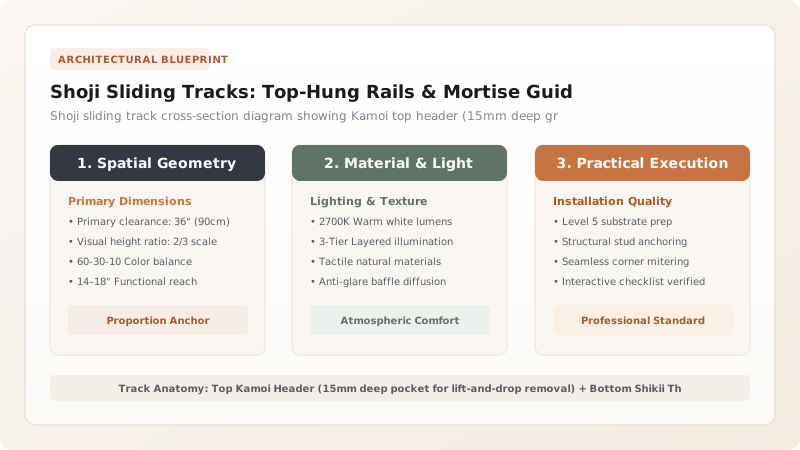
1. Traditional Carpentry: The Lift-and-Remove Kamoi/Shikii System
For over a millennium, Japanese homes used no metal hardware for sliding doors. The system relies on precision joinery in two horizontal beams:
- Kamoi (Top Header Beam - 鴨居): Plowed with twin 15mm (5/8") deep grooves.
- Shikii (Bottom Threshold - 敷居): Plowed with twin 3mm (1/8") shallow grooves.
To install or remove a screen, you push the top of the door up into the deep 15mm Kamoi pocket, clear the bottom threshold, and lift the screen out in seconds. Grooves are lubricated with natural Ibota insect wax (*Ibota-rō*). Learn paper finishing in Washi paper stretching.

2. Modern Barrier-Free Engineering: Top-Hung Ball-Bearing Suspension
In modern luxury homes with heated hardwood floors or tatami mats, bottom floor grooves collect dust and create tripping thresholds. Architects specify Top-Hung Concealed Sliding Hardware (such as Sugatsune FD Series).
Precision overhead aluminum tracks with quad nylon ball-bearing rollers are mortised flush inside the ceiling header beam. A concealed pin guide mortised into the bottom of the door keeps the screen tracking dead-straight. Review overall layouts in Shoji screen architecture.
Shoji Sliding Hardware Systems Comparison
Use this reference table to calculate exact physical dimensions, ratios, and specifications before purchasing:
| Hardware System | Floor Threshold Requirement | Gliding Resistance | Aesthetic Character |
|---|---|---|---|
| Top-Hung Concealed Track (Sugatsune) | 100% Flush Floor (Zero threshold) | < 1 lb (Effortless 1-finger glide) | Ultra-clean modern barrier-free |
| Traditional Wood Kamoi/Shikii (Optimal) | 3mm Shallow wood groove in floor | Smooth (When waxed with Ibota wax) | 100% Authentic traditional Japanese |
| Bottom Roller Wheel in Floor Track | Exposed metal floor track (Trip hazard) | Low | Commercial / Western sliding door |
| Surface-Mounted Barn Door Rail (Avoid) | Exposed black iron rail on wall face | Moderate | FAILS: Clashes with Japanese minimalism |
Header Sag Door Binding Constraints
Every successful decoration project must account for physical and environmental constraints:
Ceiling Header Sagging 3mm Pinching Shoji Doors Tight in Track
Wood framing headers deflect over wide 8-foot openings, crushing the top of Shoji screens; frame ceiling headers with rigid steel flitch plates or doubled LVL beams, leaving a 5mm clearance gap above the top door tenon in the Kamoi groove.
How to Rout and Install Traditional Shoji Sliding Tracks
Execute this professional sequence to achieve flawless results without backtracking:
Dimension Solid Hinoki Cypress Kamoi and Shikii
Mill top header (Kamoi) to 3.5" wide × 2" thick; mill bottom threshold (Shikii) to 3.5" wide × 1" thick.
Rout Dual 15mm Deep Grooves in Top Kamoi
Use plunge router with 21mm wide straight bit to cut two parallel 15mm deep grooves spaced 12mm apart.
Rout Dual 3mm Shallow Grooves in Bottom Shikii
Cut matching parallel 21mm wide × 3mm deep grooves in bottom threshold beam.
Rub Natural Ibota Wax into Grooves
Rub solid block of Ibota tree wax or paraffin wax into bottom grooves and buff with horsehair brush.
Machine Matching 12mm Top Tenon on Shoji Door
Cut 12mm long tenon on top stile ends and 2mm guide tongue on bottom door edge.
Lift and Drop Door into Tracks
Insert top tenon up into 15mm Kamoi groove, swing bottom inward, and drop down into 3mm Shikii groove.
Common Mistakes & Countermeasures
Avoid these costly errors that compromise aesthetics, ergonomics, and budget:
Using Petroleum-Based Lubricants (WD-40 / Grease) in Wood Grooves
Project Execution Checklist
Track your physical progress. Checkboxes persist automatically on this device:
Frequently Asked Questions
What is Ibota wax?
Ibota wax (*Ibota-rō*) is a natural hard crystalline wax harvested from the secretions of the *Ericerus pela* scale insect on Japanese privet trees. It has been used for centuries by Japanese woodworkers to create frictionless sliding tracks.


