
Execute traditional Japanese Kumiko lattice joinery by creating a mortised outer grid (*Jigaku*). Shape hundreds of microscopic infill pieces (1/8" thick cedar) by planing precise 22.5°, 45°, 30°, and 60° bevels using specialized wooden guide blocks (*Kanna Jigs*), assembling friction-fit Asanoha (hemp leaf) or Kikyo (bellflower) patterns.
At a Glance: Key Takeaways
- Asanoha (Hemp Leaf) Pattern: Sacred hexagonal 6-pointed star geometry symbolizing rapid growth and protection.
- Kikyo (Bellflower) Pattern: 4-fold or 8-fold diamond star geometry representing honesty and elegance.
- Guide Block Planing Jigs (*Kumiko Kanna*): Precision hardwood blocks hold micro-strips at exact compound angles for hand planing.
- Zero-Tolerance Friction Fit: Every piece locks under compressive friction tension without a single drop of glue.
- Clear Straight-Grain Softwoods: Alaska yellow cedar, Hinoki cypress, or Japanese cedar machined to 0.001" thickness tolerances.
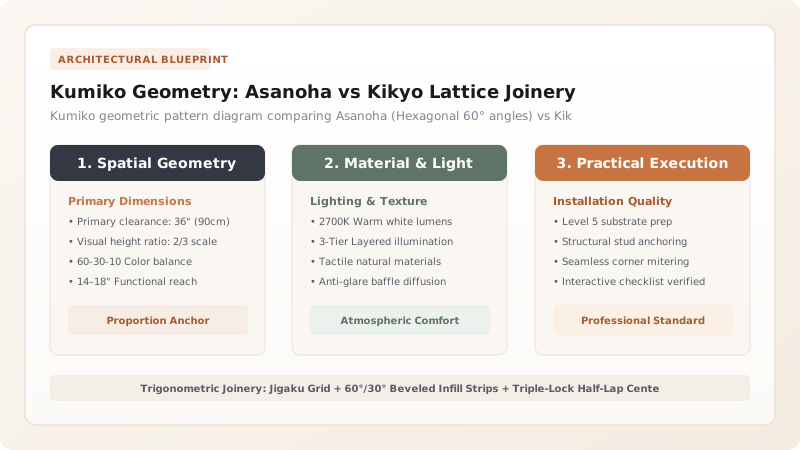
1. Sacred Geometry: The 60°/30° Asanoha vs 45° Kikyo Trigonometry
Kumiko (*組子*) is a traditional Japanese woodworking technique dating back to the Asuka period (600 AD). It constructs complex geometric lattice patterns by interlocking hundreds of tiny wooden parts without fasteners.
The two most celebrated patterns are:
1. Asanoha (Hemp Leaf - 麻の葉): Built on a triangular/hexagonal grid with \(60^{\circ}\) and \(30^{\circ}\) angled infill pieces.
2. Kikyo (Japanese Bellflower - 桔梗): Built on a square grid with \(45^{\circ}\) and \(22.5^{\circ}\) diamond infill stars. Learn paper backing in Washi paper water-shrink stretching.

2. Friction-Fit Joinery Physics: The Jigaku Frame Armature
The foundation of every Kumiko panel is the Jigaku (*地組*) Outer Matrix Grid: slotted horizontal and diagonal cedar ribs half-lapped together at 2-inch intervals.
Each delicate infill leaf is planed 0.1mm longer than its theoretical space. When pressed into the grid with fingers, the wood fibers compress slightly, creating permanent friction-lock tension that never shakes loose. Review sliding tracks in cypress top-hung sliding tracks.
Traditional Kumiko Pattern Geometry Comparison
Use this reference table to calculate exact physical dimensions, ratios, and specifications before purchasing:
| Kumiko Pattern Name | Base Grid Matrix | Planing Bevel Angles | Symbolic Meaning |
|---|---|---|---|
| Asanoha (Hemp Leaf - Optimal) | Hexagonal / Triangular (60°) | 30° and 60° Compound Bevels | Health, resilience & rapid growth |
| Kikyo (Bellflower Star) | Square Grid (90°) | 45° and 22.5° Diamond Bevels | Elegance, honesty & devotion |
| Goma-Gara (Sesame Seed) | Hexagonal Grid (60°) | 30° Central Y-Lock | Longevity & prosperity |
| Izutsu (Water Well Criss-Cross) | Square Grid (90°) | Half-Lap straight cuts | Purity & good fortune |
Micro-Thickness Variation Loose Joint Constraints
Every successful decoration project must account for physical and environmental constraints:
Lattice Strips Varying by 0.2mm Causing Kumiko Patterns to Fall Out
Kumiko relies on friction fit; a 0.2mm thickness variation causes infill pieces to fall out or buckle the frame; pass all ripped lattice strips through a precision drum sander or thickness planer bed calibrated to within ±0.05mm (0.002").
How to Plan, Plane, and Assemble an Asanoha Kumiko Panel
Execute this professional sequence to achieve flawless results without backtracking:
Mill Clear Cedar Strips to 1/8" × 3/8"
Dimension straight-grain Alaska yellow cedar into uniform 3.0mm × 10.0mm micro-strips.
Notch Jigaku Grid on Kumiko Table Saw Sled
Cut 60° triangular half-lap notches spaced exactly 50mm apart across all primary grid ribs.
Interlock Triangular Jigaku Frame
Press grid ribs together to form a rigid matrix of equilateral triangles.
Plane 60° and 30° Infill Bevels in Guide Blocks
Insert infill strips into hardwood angle jigs; plane bevels with razor-sharp Japanese Kanna plane.
Notch Center Y-Lock Joints on Locking Stems
Cut tiny 1.5mm locking notches on center infill struts to interlock with the three leaf petals.
Press Infill Pieces into Triangular Cells
Push three beveled petals into each cell by hand until they click into rigid friction lock.
Final Surface Planing
Take whisper-thin smoothing plane passes across the assembled panel face to level all joints flush.
Common Mistakes & Countermeasures
Avoid these costly errors that compromise aesthetics, ergonomics, and budget:
Using Wood Glue on Kumiko Infill Pieces
Project Execution Checklist
Track your physical progress. Checkboxes persist automatically on this device:
Frequently Asked Questions
What is the best wood for carving Kumiko lattices?
Alaska Yellow Cedar (*Cupressus nootkatensis*), Japanese Hinoki Cypress, or Basswood. These species have tight, straight grain, zero resin pockets, and cut cleanly with razor hand planes without splintering.


