
Aged Grassello di Calce and pozzolanic Cocciopesto constitute the structural substrate system that guarantees the crack-free longevity of Venetian Pastellone. Non-hydraulic fat lime putty (Grassello) derived from pure calcined limestone is slaked in excess water and matured in storage vats for a minimum of 24 to 36 months, breaking down calcium hydroxide crystals into nano-scale hexagonal platelets. When blended with Cocciopesto—finely crushed, low-fired Roman brick dust—the reactive amorphous aluminosilicates in the terracotta react chemically with the lime, triggering a hydraulic set that hardens throughout the 20mm to 25mm thick screed bed without requiring atmospheric carbon dioxide. This pozzolanic matrix exhibits high vapor permeability, exceptional flexural elasticity over timber joists, and near-zero drying shrinkage.
At a Glance: Key Takeaways
- Grassello Maturation Kinetics: Aging 24–36 months transforming Ca(OH)2 into sub-micron hexagonal crystal platelets.
- Pozzolanic Reactivity: Low-fired terracotta (750°C–850°C) releasing reactive amorphous SiO2 and Al2O3 into the lime matrix.
- Hydraulic Setting Mechanism: Formation of calcium silicate hydrates (C-S-H) hardening in deep unventilated screeds.
- Grain Size Gradation: Multi-sieved brick dust (0.1–0.5mm, 0.5–1.5mm, 1.5–3.0mm) achieving maximum particle packing density.
- Crack-Free Flexural Modulus: Low elastic modulus ($E \approx 4 - 6\,\text{GPa}$) accommodating timber palazzo deflections.
- Breathable Moisture Permeability: Permeability coefficient allowing continuous vapor transpiration in humid tidal environments.
1. The Science of Grassello Aging: Crystal Morphological Evolution
Freshly slaked lime putty contains large, irregular prismatic crystals of calcium hydroxide ($\text{Ca(OH)}_2$). If used immediately in flooring, it shrinks severely and lacks binding power. Venetian artisans solved this through lime aging (invecchiamento).
Submerged under water in limestone-lined pits for two to three years, the lime crystals undergo continuous dissolution and re-precipitation. The large prisms fragment into millions of microscopic hexagonal crystal platelets ($< 1\,\mu\text{m}$ in diameter). This astronomical increase in specific surface area ($> 30\,\text{m}^2/\text{g}$) confers extraordinary rheological properties: the putty becomes as smooth and buttery as whipped cream, develops immense water retention, and carbonizes with high tensile density when exposed to air.
2. Cocciopesto Pozzolanic Reaction and Grain Gradation
Pure Grassello lime is non-hydraulic: it requires atmospheric carbon dioxide ($\text{CO}_2$) to cure. In a thick 25mm floor screed, air cannot penetrate beyond the top 3mm, meaning a pure lime screed would remain wet mud underneath for decades. Master builders added Cocciopesto (pulverized terracotta) to initiate hydraulic setting:
Clay fired between 700°C and 850°C loses its crystalline structure, leaving disordered, highly reactive amorphous silica ($\text{SiO}_2$) and alumina ($\text{Al}_2\text{O}_3$). When blended with damp Grassello, an exothermic pozzolanic reaction occurs, precipitating insoluble calcium silicate hydrates (C-S-H) and calcium aluminate hydrates:
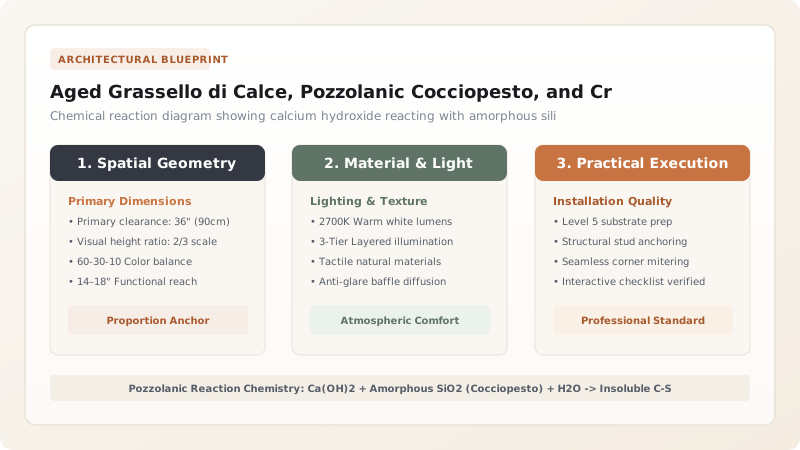
$$\text{Ca(OH)}_2 + \text{SiO}_2 + \text{H}_2\text{O} \longrightarrow \text{C-S-H (Hydraulic Gel)}$$
This reaction binds the screed throughout its entire thickness within 48 to 72 hours, completely independent of atmospheric carbon dioxide.
3. Engineering Crack-Free Screeds Over Flexible Timber Joists
In Venetian palazzi, subfloors consist of wooden floor joists spanned by rough larch or fir planks (tavolato). To prevent floor cracking from joist deflection, the screed must be decoupled:
Masons lay an uncoupling layer of oiled paper or breathable linen scrim over the timber decking, followed by an alkali-resistant fiberglass or bronze reinforcing mesh. The 20mm Cocciopesto screed is compacted using heavy wooden rollers (frattazzo pesante). Because the cured screed has a low elastic modulus ($E = 5\,\text{GPa}$, compared to $30\,\text{GPa}$ for Portland concrete), it flexes elastically under live floor loads without brittle fracture.
Cocciopesto Screed Aggregate Sizing and Hydraulic Mix Ratios
Use this reference table to calculate exact physical dimensions, ratios, and specifications before purchasing:
| Screed Component | Binder / Aggregate Material | Particle Size Fraction | Volumetric Proportion | Structural Curing Role |
|---|---|---|---|---|
| Aged Lime Binder | Grassello di Calce (min 24 mo.) | Colloidal (< 1 micron) | 1.0 Part | Supplies active Ca(OH)2 for hydraulic reaction |
| Coarse Brick Pozzolan | Crushed low-fired cotto tile | 1.5 – 3.0 mm | 1.2 Parts | Compressive structural aggregate skeleton |
| Medium Brick Flour | Crushed terracotta roof tile | 0.5 – 1.5 mm | 0.8 Parts | Fills voids between coarse aggregates |
| Fine Reactive Pozzolan | Micro-pulverized brick dust | 0.1 – 0.5 mm | 0.5 Parts | Immediate rapid pozzolanic chemical reaction |
| Washed River Sand | Silica quartz river sand | 0.2 – 1.0 mm | 0.5 Parts | Eliminates excessive binder paste shrinkage |
Practical Constraints
Every successful decoration project must account for physical and environmental constraints:
Long Hydraulic Curing Time
Authentic Brick Sourcing
Field Mixing and Laying Protocol for Cocciopesto Base Screed
Execute this professional sequence to achieve flawless results without backtracking:
Substrate Reinforcement and Decoupling
Fasten loose timber subfloor planks; lay breathable decoupling paper; lay continuous bronze or fiberglass reinforcement mesh across entire room.
Cocciopesto Aggregate Sifting and Grading
Screen low-fired terracotta brick dust into three distinct particle fractions (0-0.5mm, 0.5-1.5mm, 1.5-3mm) using brass sieves.
Mortar Blending in Mechanical Pan Mixer
Charge mixer with aged Grassello lime putty and graded cocciopesto aggregates (1:2.5 ratio); mix dry for 3 minutes, adding minimal water to reach damp-earth consistency.
Establishing Screed Rails and Level Datum
Set temporary aluminum or timber leveling screed rails across room using precision laser level, setting screed thickness to 22mm.
Spreading and Screed Bar Striking
Shovel cocciopesto mortar between rails; strike level with straightedge screed bar in sawing motion, compacting the damp matrix.
Mechanical Wooden Float Compaction
Beat surface vigorously with heavy rectangular wooden tamper plates (batacchi), forcing aggregate particles into maximum interlocking density.
Sponge Float Keying and Moist Curing
Rub surface with damp coarse sponge float to create fine keying texture for Pastellone finish; cover with damp burlap for 7 days of moist hydration.
Common Mistakes & Countermeasures
Avoid these costly errors that compromise aesthetics, ergonomics, and budget:
Using high-fired vitreous porcelain or ceramic tile dust instead of low-fired terracotta for cocciopesto
Adding excessive water to the cocciopesto mix to make it self-leveling
Laying the screed directly over raw timber floorboards without a decoupling membrane
Project Execution Checklist
Track your physical progress. Checkboxes persist automatically on this device:
Frequently Asked Questions
Why is aged Grassello lime so much better than bagged hydrated lime powder?
Bagged hydrated lime (Type S or N) is factory-dried powder that has partially carbonated in the bag and contains large, splintered crystal agglomerations. Aged Grassello lime putty has matured underwater for years: its crystals have dissolved into sub-micron hexagonal platelets with 10 times higher surface area, providing peerless plasticity, bonding, and crack resistance.
Can Cocciopesto screeds be used with underfloor hydronic heating pipes?
Yes, exceptionally well. Cocciopesto has excellent thermal conductivity and volumetric heat capacity. Because of its low elastic modulus, it expands and contracts gently with thermal heating cycles without cracking, unlike brittle Portland cement screeds.
What is the historical origin of Cocciopesto?
Cocciopesto was invented by the ancient Phoenicians and perfected by the Romans (who called it *opus signinum*). The Romans used it to waterproof aqueducts, cisterns, and public thermal baths because they discovered that mixing crushed burnt pottery with lime created a mortar that hardened underwater.


