
Venetian Pastellone is one of history's most sophisticated continuous mineral plaster floors. Dating back to the Roman Opus Signinum and elevated to royal luxury during the Venetian Renaissance, Pastellone is a seamless, self-leveling lime screed applied at a total thickness of only 8 to 12mm. It is formulated from aged non-hydraulic slaked lime putty (grassello di calce) combined with finely pulverized terracotta brick dust (cocciopesto). The reactive aluminosilicates in the brick dust transform the soft lime into a hydraulic binder that cures completely in damp lagoon air. Colored throughout its mass with mineral earth pigments (hematite red, raw sienna, and burnt umber) and reinforced with open-weave linen scrim, Pastellone creates an elastic, monolithic floor that withstands building movement without cracking.
At a Glance: Key Takeaways
- Binding Matrix: 12-month aged slaked lime putty (grassello) + reactive cocciopesto brick dust.
- Hydraulic Pozzolanic Set: Amorphous silica in crushed brick reacting with lime to form calcium silicate hydrates.
- Total Layer Thickness: Ultra-slender 8–12mm profile adding only 18–22 kg/m² to structural floor joists.
- Mineral Pigment Saturation: Naturally tinted with Italian earth pigments: Rosso Veneziano, Terra d'Ombra, and Ochre.
- Crack-Bridging Armature: Embedded woven flax linen or alkali-resistant fiberglass scrim bridging timber joist flexure.
- Steel Trowel Compaction: Progressive high-pressure burnishing closing surface capillaries to a marble-smooth sheen.
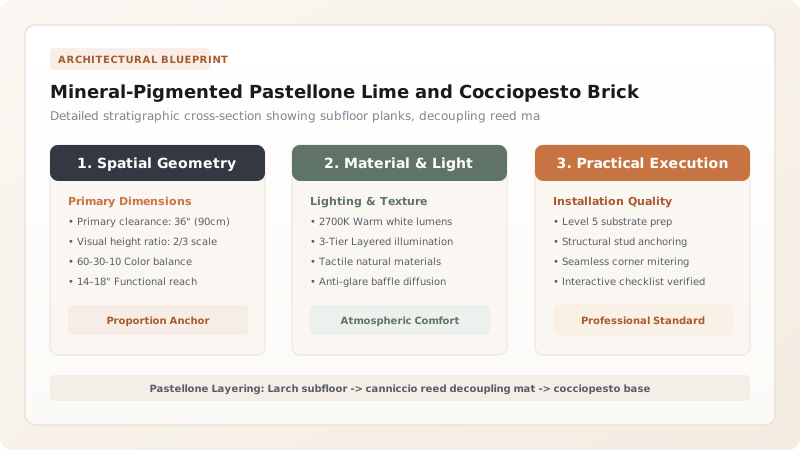
1. Pozzolanic Chemistry: Why Crushed Terracotta Makes Lime Hard as Stone
Standard lime plaster hardens purely through carbonation—absorbing atmospheric carbon dioxide ($CO_2$). However, in a floor screed 10mm thick covered with oils and waxes, air cannot penetrate to the bottom layers. Without a secondary chemical mechanism, the floor would remain soft and powdery.
Venetian builders solved this through cocciopesto (crushed low-fired terracotta brick and tile dust). Clay fired at moderate temperatures (600°C–800°C) contains dehydroxylated amorphous aluminosilicates ($Al_2O_3 \cdot 2SiO_2$). When mixed with wet calcium hydroxide ($Ca(OH)_2$), a powerful pozzolanic reaction occurs, synthesizing insoluble calcium silicate hydrates and calcium aluminate hydrates ($C-S-H$ and $C-A-H$). This reaction occurs throughout the entire depth of the floor without air, transforming the lime into an extremely tough, water-resistant stone matrix.
2. Substrate Decoupling: Canniccio Reed Mats and Woven Linen Scrim
Applying a rigid plaster floor over flexible timber joists that bounce under foot traffic is an engineering contradiction. If applied directly to wood, the plaster shears off and cracks within weeks. Venetian masters developed a two-tier decoupling strategy:
- Canniccio Reed Decoupling: Over the structural wooden floorboards, artisans lay a dense mat of dried marsh reeds (cannucce di palude) bound with galvanized wire. The reed mat creates a physical decoupling slip-sheet: the timber joists can flex horizontally below without transferring shear stresses into the plaster above.
- Embedded Linen Scrim: Within the wet base screed, artisans embed an open-weave mesh of natural unbleached flax linen (or modern alkali-resistant fiberglass scrim). This tensile reinforcement absorbs horizontal shear movements, allowing the pastellone to act as an unyielding structural diaphragm.
3. Mass Pigmentation with Earth Oxides and Progressive Trowel Burnishing
Pastellone is never painted on top; the color is integral throughout its entire mass. Master craftsmen blend pure mineral earth pigments directly into the wet lime paste:
- Rosso Veneziano (Venetian Red): Natural anhydrous ferric oxide ($Fe_2O_3$) quarried near Verona, yielding the iconic rich, warm rust-red of Venetian palazzi.
- Giallo di Verona: Hydrated iron oxide ochre producing luminous warm honey and golden tones.
- Terra di Siena: Natural raw and burnt earths providing deep tobacco and amber nuances.
The finish coat (3mm thick) is troweled with stainless steel Venetian trowels. As the lime begins its initial set, the artisan exerts powerful, rhythmic circular pressure with the trowel blade. This burnishing action collapses microscopic capillaries, flattens calcite crystals parallel to the floor, and brings a silky lime cream to the surface, creating an exquisite, mirror-smooth stone finish.
Pastellone Layer Formulation and Particle Granulometry
Use this reference table to calculate exact physical dimensions, ratios, and specifications before purchasing:
| Mortar Layer | Binder : Aggregate Ratio | Aggregate Sieve Size | Pigment Load (% of Lime) | Working / Setting Window |
|---|---|---|---|---|
| Decoupling Base Bed | 1.0 Grassello : 2.0 Cocciopesto | Medium crushed brick (1.0–3.0 mm) | 0% (natural brick red) | 24 hours to initial foot traffic |
| Intermediate Leveling Coat | 1.0 Grassello : 1.5 Cocciopesto | Fine crushed brick (0.5–1.2 mm) | 2% – 4% earth pigment | 12 hours open working time |
| Fine Pastellone Finish | 1.0 Grassello : 1.0 Marble Flour | Micro-fine marble + brick (<0.2 mm) | 6% – 10% mineral oxide | 6–8 hours active burnishing window |
Practical Constraints
Every successful decoration project must account for physical and environmental constraints:
Long Carbonation Window Before Heavy Use
Continuous Seamless Pour Requirement
Application Protocol for a Mineral-Pigmented Venetian Pastellone Floor
Execute this professional sequence to achieve flawless results without backtracking:
Substrate Rigidity Verification
Inspect timber floor joists; secure loose subfloor planks with countersunk screws; verify deflection meets L/600 structural criteria.
Decoupling Reed Mat Installation
Staple a continuous layer of marsh reed matting (canniccio) across the timber subfloor, staggering seams to decouple joist deflection.
Cocciopesto Base Screed Spreading
Trowel a 12mm leveling bed of coarse lime-cocciopesto mortar across the reed matting; embed alkali-resistant linen scrim into wet paste.
Surface Scratch Keying
Lightly cross-hatch the green base screed with a plastic comb; allow to cure for 48 hours until firm and pale pink.
Pigmented Finish Pastellone Mixing
Knead aged grassello lime putty with micro-fine cocciopesto, Carrara marble flour, and mineral red hematite in a planetary mixer.
Two-Pass Finish Troweling
Apply two tight, successive skim coats totaling 3mm thickness wet-on-wet using flexible rounded stainless steel trowels.
Progressive Steel Blade Burnishing
Burnish the surface as the lime stiffens, increasing hand pressure over 4 hours until the floor achieves a glass-smooth marble luster.
Common Mistakes & Countermeasures
Avoid these costly errors that compromise aesthetics, ergonomics, and budget:
Adding modern gypsum plaster or Portland cement to speed up drying
Using industrial chemical dyes or liquid paint colorants
Burnishing with an ordinary carbon steel masonry trowel
Project Execution Checklist
Track your physical progress. Checkboxes persist automatically on this device:
Frequently Asked Questions
Can Pastellone be installed over modern radiant underfloor heating?
Yes. Pastellone performs exceptionally well over low-temperature hydronic radiant underfloor heating. Because it is a dense, continuous mineral stone screed only 10mm thick, it has high thermal conductivity and zero insulating air voids, transferring radiant heat into the room far faster than thick wood or carpet.
How does Pastellone flex without cracking when timber floors bounce?
Pastellone's flexibility comes from its unique composite structure: (1) The underlying reed mat decouples it from direct joist shear; (2) The non-hydraulic slaked lime matrix has a low modulus of elasticity, allowing microscopic ductile deformation; (3) The embedded linen scrim acts as high-tensile reinforcement that distributes bending stresses across the entire room.
What is the difference between Marmorino on walls and Pastellone on floors?
Marmorino is formulated primarily with lime putty and crushed Carrara marble dust, designed for vertical walls where compressive wear is minimal. Pastellone is formulated with crushed terracotta brick (cocciopesto), which imparts hydraulic strength, high abrasion resistance, and tensile toughness required to withstand heavy foot traffic.


