
Venetian Marmorino and Calce Rasata are the definitive luxury polished mineral wall finishes of the Venetian Renaissance, immortalized by Andrea Palladio and Carlo Scarpa across Venetian palazzi. Formulated from pure high-calcium Istrian lime putty (Grassello) aged underwater for years and combined with graded Carrara marble flour and crystalline granules, Marmorino produces a translucent, depth-filled stone finish resembling solid marble slab. Burnished using stainless steel spatulas or traditional hot irons (ferro caldo) and sealed with pure olive-oil Marseille soap, Marmorino creates a breathable, self-cleaning wall capable of surviving humid lagoon environments.
At a Glance: Key Takeaways
- Aggregate Matrix: Select Carrara White Marble Dust (0.1mm to 0.7mm grains)
- Burnishing Tools: Beveled stainless steel spatulas & hand-heated smoothing irons (Ferro Caldo)
- Lime Binder: Grassello di Calce (Pure CL90-S lime putty aged 24–36 months)
- Protective Sealer: Pure potassium olive-oil Marseille soap (Sapone di Marsiglia)
In-Depth Guides in this Directory
Explore specialized subtopic blueprints, technical dimensions, and execution checklists:
Istrian Slaked Grassello Lime Putty and Carrara Marble Dust Grading Ratios
Technical manual on Istrian high-calcium Grassello lime putty maturation, Carrara marble aggregate grading curves, and stoichiometric mixing ratios for Marmorino.
Hot-Iron (Ferro Caldo) Burnishing and Stainless Steel Spatula Finishing of Grassello Plaster
Master artisan manual on hot-iron (ferro caldo) burnishing techniques, surgical stainless steel spatulas, and mirror-finish Grassello polishing.
Marseille Olive-Oil Soap Sealing and Salt-Efflorescence Mitigation in Venetian Palazzi
Comprehensive conservation guide to Marseille olive-oil soap saponification, hydrophobic calcium oleate formation, and marine salt mitigation in Venetian Marmorino.
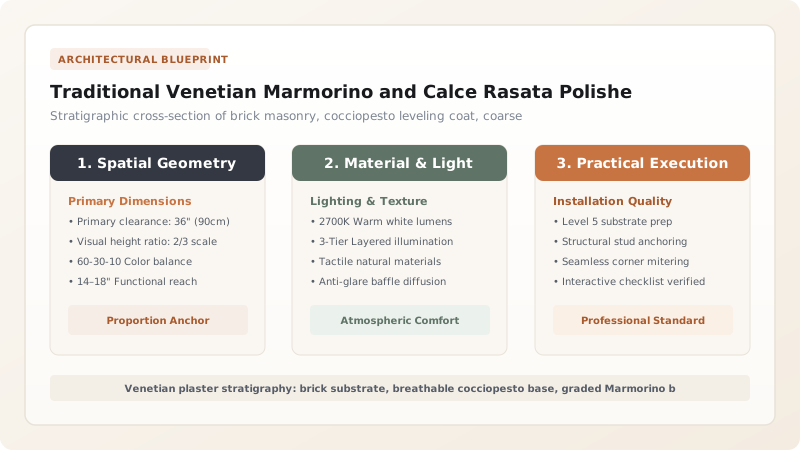
The Architectural Imperative of Marmorino in the Venetian Lagoon
In Venice, building engineering has always been constrained by water. Constructing grand palatial interiors with solid marble wall cladding was impossible: solid marble slabs would add thousands of tons of deadweight to the fragile timber pile foundations driven into lagoon mud, causing the buildings to sink.
Venetian architects (including Andrea Palladio, Michele Sanmicheli, and Jacopo Sansovino) perfected Marmorino ('little marble') as a lightweight, flexible stone surrogate. A 3mm Marmorino application provided the optical grandeur, tactile cool smoothness, and light reflectivity of solid marble slabs while weighing less than 1% of solid stone, flexing harmlessly as historic foundations settled.
Material Science: Istrian Grassello Lime and Carrara Marble Powders
True Venetian plaster is 100% mineral. The binder is Grassello di Calce, produced from pure Istrian high-calcium limestone calcined at 950°C and slaked in water pits for a minimum of 24 to 36 months. Over this extended aging, the calcium hydroxide crystals transform into microscopic hexagonal colloidal platelets that impart extreme plasticity and high refractive index.
The aggregate consists exclusively of crushed metamorphic marble from Carrara. By combining graded angular granules (0.3mm–0.7mm) in the base coats with impalpable marble flour (0.05mm–0.1mm) in the finish coat, the plaster achieves maximum crystalline packing density, producing deep optical translucency (profondità) rather than a flat, superficial gloss.
Application Mastery: Multi-Coat Troweling and Hot-Iron Burnishing
Marmorino is applied in three tightly timed passes. The first leveling coat sets the suction plane; the second coat beds the marble grains; and the third whisper-thin skim (rasatura) fills all microscopic valleys. The artisan applies the plaster using rounded-corner, mirror-polished flexible stainless steel spatulas (spatole veneziane).
To achieve the ultimate glass-smooth finish, master artisans employ Ferro Caldo (the hot smoothing iron). A heavy brass or steel iron heated over coals to 70°C–90°C is pressed firmly across the setting plaster. The heat accelerates surface carbonation, drives moisture into the wall, and fuses the marble platelets into an impenetrable, mirror-reflective crystalline stone skin.
Hydrophobic Saponification (Sapone di Marsiglia) and Salt Resistance
Venetian interiors endure humid, salt-saturated marine air. If raw plaster is exposed, lagoon salts (chlorides and sulfates) penetrate and cause crumbling efflorescence. The historic Venetian defense is saponification.
While the burnished plaster is still warm, the artisan works a lather of pure olive-oil Marseille soap (Sapone di Marsiglia) into the surface with a trowel. The oleic acid and potassium salts in the soap react chemically with the free calcium hydroxide in the lime, precipitating an insoluble, hydrophobic calcium oleate soap. This creates a breathable, water-shedding shield that allows moisture vapor to breathe out while preventing liquid water and marine salt ingress.
Venetian Polished Plaster Typology & Aggregate Specifications
Use this reference table to calculate exact physical dimensions, ratios, and specifications before purchasing:
| Plaster Variety | Visual Texture | Marble Aggregate Size | Troweling Protocol | Final Surface Sheen |
|---|---|---|---|---|
| Classic Marmorino (Marmorino Classico) | Natural stone texture with visible crystalline depth | 0.3mm to 0.7mm Carrara granules | Two coats + steel float burnish | Satin to semi-gloss stone sheen |
| Calce Rasata (Spatula Stucco) | Ultra-smooth, cloud-like chromatic mottling | 0.1mm to 0.2mm fine marble flour | Three thin coats + tight spatula compression | High mirror-reflective gloss |
| Grassello di Calce (Venetian Stucco) | Glass-like mirror finish with deep translucency | Sub-50 micron micro-pulverized marble | Multiple overlapping razor-thin passes | High mirror gloss with 3D depth |
| Marmorino con Cocciopesto | Warm terracotta-pink hue with porous breathing | 0.5mm to 1.2mm crushed fired brick grog | Coarse wooden float + steel consolidation | Matte satin, high humidity resistance |
Practical Constraints
Every successful decoration project must account for physical and environmental constraints:
Venetian High-Tide Humidity (Acqua Alta Microclimates)
Atmospheric relative humidity exceeding 85% significantly slows carbonation, requiring dehumidification during application in Venice.
Skill Intensity and Rapid Trowel Work Window
The critical burnishing window lasts only 30 to 60 minutes as the finish skim transitions from wet to firm; requires coordinated two-artisan teams.
Execution Blueprint & Craftsmanship Sequence
Execute this professional sequence to achieve flawless results without backtracking:
Substrate Evaluation and Cocciopesto Base
Ensure brick or masonry substrate is flat and cured; apply a 10mm breathable cocciopesto hydraulic lime scratch coat, leveling to an even suction plane.
First Marmorino Body Coat (Fondo)
Trowel the first coat of Marmorino containing 0.5mm Carrara marble grit across the dampened wall; allow to set for 24 hours to a uniform matte plane.
Second Intermediate Coat Application
Apply the second coat with a stainless steel spatula, scraping tightly to fill voids while maintaining consistent grain distribution across the surface.
Third Finish Skim (Rasatura)
Apply a razor-thin skim of fine Grassello marble plaster; work in overlapping multi-directional strokes, wiping spatula edges constantly to avoid ridges.
Hot-Iron Burnishing (Ferro Caldo)
Heat a heavy smoothing iron to 80°C; press firmly across the setting plaster in circular motions, compressing the surface into a mirror-smooth stone sheen.
Marseille Soap Hydrophobic Treatment
Trowel pure olive-oil Marseille soap lather over the warm plaster; burnish vigorously with a clean microfiber cloth, converting the lime into waterproof calcium oleate.
Common Mistakes & Countermeasures
Avoid these costly errors that compromise aesthetics, ergonomics, and budget:
Using Synthetic Acrylic 'Venetian Plaster' from Hardware Stores
Burnishing with Low-Grade Carbon Steel Trowels
Applying Plaster Over Dry, Thirsty Substrates Without Pre-Wetting
Project Execution Checklist
Track your physical progress. Checkboxes persist automatically on this device:
Frequently Asked Questions
Can authentic Venetian Marmorino be applied in shower enclosures or bathrooms?
Yes. When properly burnished and treated with traditional Marseille olive-oil soap (or pure beeswax), the resulting calcium oleate reaction creates a water-repellent, mold-resistant surface ideally suited to high-humidity bathrooms and spa environments.
Why does authentic Marmorino feel cold like real marble stone?
Because it is composed of over 95% pure calcium carbonate (slaked lime and crushed Carrara marble). Its high mineral density gives it the exact thermal conductivity and specific heat capacity of natural metamorphic marble.
How do you maintain and clean a historic Marmorino wall?
Historic Marmorino walls should be cleaned using only warm water and dilute Marseille soap with a soft microfiber cloth. Never use acidic, bleach, or ammonia cleaners, as acids instantly dissolve calcium carbonate, ruining the polished shine.


