
The finishing treatment of traditional Venetian cotto and Pastellone is a masterclass in organic lipid polymer chemistry. Rather than sealing the floor beneath an impermeable synthetic polyurethane coat (which traps moisture and peels in damp lagoon climates), Venetian artisans saturate the cured, bone-dry lime and clay with hot boiled linseed oil (olio di lino cotto). The low-viscosity oil penetrates 4 to 6mm deep into the open capillaries, where it oxidizes and cross-links into a flexible, insoluble natural linoxyn polymer. Once cured, the floor is treated with melted virgin beeswax blended with hard carnauba palm wax and hand-buffed with friction pads. This creates an organic, breathable, water-repellent satin patina that deepens in amber warmth with age and resists lagoon wine, oil, and moisture spills.
At a Glance: Key Takeaways
- Deep Capillary Permeation: Hot boiled linseed oil penetrating 4–6mm into open clay and lime pores.
- Linoxyn Polymerization: Natural oxidative cross-linking of linolenic fatty acids forming an elastic water barrier.
- Virgin Beeswax Body: Natural cera alba providing elasticity, satin sheen, and micro-pore surface sealing.
- Carnauba Hardness: High-melting-point Brazilian palm wax (82°C–86°C) providing abrasion and scratch resistance.
- Vapor-Permeable Breathability: Impervious to liquid water spills while allowing rising subfloor moisture vapor to escape.
- Warm Amber Tone Deepening: Enhances mineral pigments, shifting dry pastel pinks into rich, glowing leather tones.
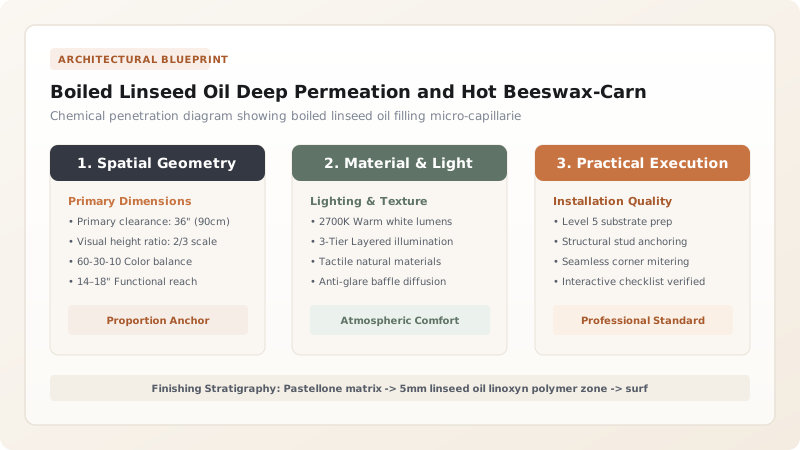
1. Lipid Chemistry: Linolenic Acid Polymerization and Linoxyn Formation
Unlike mineral oils or paraffin that stay liquid and greasy forever, linseed oil (pressed from flax seeds, Linum usitatissimum) is a true drying oil. It contains extraordinarily high concentrations of polyunsaturated fatty acids, particularly alpha-linolenic acid ($>50\%$).
When raw linseed oil is pre-heated ('boiled') to approximately 150°C in the presence of natural mineral catalysts, it begins initial molecular polymerization. When applied hot to porous cotto or pastellone, the oil wicks deep into the stone capillaries through capillary suction. Over the next 48 hours, the oil absorbs atmospheric oxygen ($O_2$), triggering oxidative cross-linking between double carbon bonds. The liquid oil transforms into linoxyn—a solid, resilient, rubbery polymer matrix that permanently lines every pore, preventing water, wine, and olive oil from soaking into the floor.
2. Application Protocol: Heated Saturation, Wiping, and Curing Time
Proper oiling requires strict technical discipline to avoid leaving a sticky, gummy surface:
- Moisture Content Assessment: The cotto or pastellone floor must be bone-dry (moisture content $<3\%$). If applied over damp lime, the oil turns milky, fails to penetrate, and rots.
- First Saturation Pass (Heated Oil): Boiled linseed oil is heated in water-jacketed cauldrons to 50°C–60°C to reduce its viscosity. It is flooded across the floor with wide floor brushes. The porous floor drinks the oil voraciously.
- Excess Wiping (The Critical Step): After 30 to 45 minutes of soaking, any oil remaining pooled on the surface must be vigorously wiped dry with clean, lint-free cotton towels. If excess oil is left to dry on the surface, it forms a soft, wrinkly, sticky skin that ruins the finish.
- Second Light Pass: After 48 hours, a second light coat (often blended 1:1 with natural gum turpentine) is buffed in to complete saturation.
3. The Hot Beeswax-Carnauba Wax Seal and Routine Floor Care
Once the linseed oil has cured for 7 to 10 days, the floor receives its crowning protective layer: a hot blend of pure virgin beeswax (cera alba) and carnauba palm wax.
Pure beeswax is soft and silky, melting at 62°C, while carnauba wax (derived from the leaves of the Brazilian Copernicia prunifera palm) melts at 85°C and is one of the hardest natural waxes known. The two waxes are melted together with natural orange-terpene or pine-turpentine solvents into a rich paste. When spread across the floor and hand-buffed with heavy felt pads or sheepskin buffers, the friction heat melts the wax into the surface micro-pores. The result is an astonishing, satiny liquid luster that is non-slip underfoot, repels dirt, and can be maintained for generations with simple periodic buffing and gentle vegetable-oil soap washes.
Linseed Oil and Wax Application Schedule for Venetian Floors
Use this reference table to calculate exact physical dimensions, ratios, and specifications before purchasing:
| Finishing Phase | Material Formulation | Application Temp / Method | Reaction / Dwell Time | Surface Objective |
|---|---|---|---|---|
| Primary Oil Saturation | 100% boiled linseed oil (pure) | 50°C–60°C; wide floor brush | Dwell 45 min; wipe 100% dry | Deep 5mm capillary penetration & amber tone |
| Secondary Sealing Pass | 70% boiled oil : 30% pine turpentine | Ambient temp; lamb's wool mop | Dwell 20 min; wipe dry | Seals near-surface pores; rapid drying |
| Polymerization Rest | Zero traffic / no coatings | Ambient ventilated room (20°C) | 7 to 10 days cure | Complete linoxyn cross-linking |
| Hot Wax Buffing | 70% beeswax : 30% carnauba wax | Paste wax; high-speed felt buffer | Friction buff to immediate shine | Silky satin sheen & liquid water beading |
| Routine Cleaning | Dilute Marseille olive soap (1:20) | Damp cotton mop (well wrung) | Air dry | Cleans dirt without stripping wax film |
Practical Constraints
Every successful decoration project must account for physical and environmental constraints:
Fire Safety Protocol for Oil Rags
Strong Linseed Oil Aroma
Application Protocol for Boiled Linseed Oil and Beeswax Burnishing
Execute this professional sequence to achieve flawless results without backtracking:
Substrate Dryness Testing
Test floor moisture using calcium carbide or pin moisture meters; confirm relative humidity within floor is below 3% before oiling.
Surface Cleaning and Vacuuming
Vacuum floor thoroughly; wipe with a microfiber cloth slightly moistened with mineral spirits to remove all airborne dust.
Heated Linseed Oil Flooding
Warm boiled linseed oil to 55°C in indirect heating pots; apply generously across floor tiles or pastellone with broad floor brushes.
Mandatory Excess Wipe-Down
After 40 minutes, vigorously wipe every trace of standing surface oil using dry cotton rags until the floor feels matte and non-greasy.
Secondary Dilute Oil Pass
Allow 48 hours for initial polymerization; apply a light second coat thinned 20% with natural gum turpentine; buff dry immediately.
Carnauba-Beeswax Paste Application
After 7 days of oil curing, spread a micro-thin layer of melted beeswax and carnauba paste using cotton applicator pads.
High-Speed Mechanical Felt Buffing
Buff floor vigorously with natural wool or felt polishing pads until friction heat melts the wax into a radiant, silky satin finish.
Common Mistakes & Countermeasures
Avoid these costly errors that compromise aesthetics, ergonomics, and budget:
Leaving wet pools of linseed oil to dry on the surface without wiping
Disposing of oil-soaked cotton rags in open trash cans
Applying beeswax before the linseed oil has completely polymerized
Project Execution Checklist
Track your physical progress. Checkboxes persist automatically on this device:
Frequently Asked Questions
Can I use food-grade raw flaxseed oil from the grocery store?
No. Culinary raw flaxseed oil contains high levels of moisture, proteins, and free fatty acids, and lacks pre-oxidized polymerization catalysts. It will take months to dry, will remain perpetually sticky, will spoil rancid, and will attract mold inside damp floor capillaries.
How do you clean an oiled and waxed Venetian floor everyday?
Daily maintenance requires only sweeping or vacuuming with a soft brush attachment. For damp cleaning, use a well-wrung cotton mop dampened with clean lukewarm water containing a capful of pure vegetable oil soap (such as Marseille or Castile olive soap). Never use ammonia, bleach, vinegar, or steam mops.
Why does linseed oil make the floor color look darker and richer?
Linseed oil has a refractive index ($n \approx 1.48$) very close to that of calcite crystals in lime and quartz in clay. When the oil fills the air-filled pores of the stone, it drastically reduces surface light scattering, allowing light to penetrate deeper into the mineral pigments before reflecting, producing deep, saturated, gem-like colors.


