
Traditional Moroccan Tadelakt is an ancient, luxurious, and completely waterproof seamless lime plastering craft originating in the High Atlas Mountains and the historic imperial city of Marrakech. Derived from the Arabic verb *dalaka* (to rub, massage, or burnish), Tadelakt transforms indigenous limestone naturally containing silica and clay into a living, seamless stone skin. The artisan applies the coarse lime paste onto lime-rendered masonry, compresses and polishes it meticulously using hard, semi-precious river stones (such as basalt or agate), and treats the damp surface with an organic black olive oil soap (savon noir). The oleic acids in the soap react chemically with the free calcium hydroxide in the lime (saponification), forming an insoluble calcium oleate hydrophobic membrane that is smooth as silk, hard as marble, and fully waterproof without synthetic chemical sealers.
At a Glance: Key Takeaways
- Indigenous Geological Origin: Sourced exclusively from wood-fired kilns quarrying the Plateau of Marrakech.
- Natural Hydraulic Properties: Unique raw limestone containing natural silica and alumina, setting both hydraulically and by carbonation.
- River Stone Burnishing: Hand polishing with hard, rounded river stones (hardness 6–7 Mohs) to mechanically close surface pores.
- Chemical Saponification: Olive oil black soap (savon noir) reacting with lime to synthesize an insoluble calcium oleate waterproof shield.
- Seamless Monolithic Form: Flawless concave and convex curves spanning baths, basins, floors, and hammam dome ceilings without grout lines.
- Tactile Natural Luxury: Silky, stone-cool touch with subtle marble-like undulating color gradations and zero VOC emissions.
In-Depth Guides in this Directory
Explore specialized subtopic blueprints, technical dimensions, and execution checklists:
Marrakech Plateau Limestone Calcination and Aged Slaked Putty Chemistry
Technical guide to authentic Tadelakt lime mineralogy: Marrakech plateau limestone calcination in wood kilns, unburned grog particle dynamics, and slaking fermentation.
Semi-Precious Agate and River Stone Burnishing and Mechanical Densification
Master guide to Moroccan Tadelakt stone burnishing: selecting hard river stones, timing compaction phases, closing capillary pores, and creating undulating luster.
Black Olive Soap Saponification, Oleic Acid Hydrophobicity, and Hammam Curing
Technical guide to Tadelakt waterproofing chemistry: Moroccan black olive soap (savon noir), oleic acid reaction, calcium oleate synthesis, and hammam curing.
1. Berber Origins and the Architectural Physics of the Hammam
For over a thousand years, Berber master plasterers (maâlems) have guarded the secret techniques of Tadelakt. Originally developed to seal water cisterns (matfias) against subterranean seepage in the arid plains surrounding Marrakech, the material soon became the defining luxury surface of royal Moroccan riads, palaces, and communal steam baths (hammams).
In a saturated, steamy hammam where relative humidity reaches 100% and ambient heat exceeds 45°C, standard plaster softens and paints blister and mold. Tadelakt thrives in this environment. Because it is an alkaline, breathable stone matrix ($pH > 12$), it is naturally antimicrobial, antifungal, and completely impervious to standing water. Furthermore, its ability to wrap continuously around curved steps, domed ceilings, and sunken soaking tubs eliminates mold-collecting grout seams entirely.
2. The Unique Chemistry of Marrakech Limestone and Kiln Calcination
Authentic Tadelakt cannot be produced using standard commercial hydrated lime from industrial hardware stores. It relies on a unique geological anomaly found only in the quarries of Marrakech:
- Natural Hydraulic Limestone: The local limestone contains natural impurities of reactive silica ($SiO_2$), alumina, and clay minerals intimately interstratified with calcium carbonate ($CaCO_3$).
- Wood-Fired Kiln Calcination: Quarried blocks are fired in traditional olive-wood and palm-frond kilns for several days at approximately 900°C–1,000°C. This uneven, low-temperature firing leaves micro-particles of unburned limestone (grog) alongside quicklime and hydraulic calcium silicates.
- Coarse Particle Distribution: When slaked with water on site, the resulting lime putty contains coarse, hard unslaked limestone aggregates (0.5 to 2mm) that act as built-in structural sand, eliminating the need for added aggregate while creating immense compressive density under burnishing.
3. The Dual Finishing Mechanics: Stone Burnishing and Saponification
The transformation of rough lime paste into a waterproof gemstone surface is achieved through a two-fold physical and chemical ritual:
First, as the applied 5mm plaster layer begins to stiffen, the maâlem rubs the surface in tight, circular motions with a flat, polished river stone (agathe or basalt, Mohs hardness 7). This intense mechanical pressure compresses the lime platelets, collapsing capillary pores and driving moisture out. Microscopic grog particles are pushed flush into the surface, creating an ultra-dense, glass-smooth plane.
Second, the artisan brushes the damp, stone-polished surface with diluted savon noir—a traditional Moroccan black soap made from crushed black olives and potassium hydroxide. The oleic and palmitic fatty acids in the soap undergo an immediate chemical reaction with the free calcium hydroxide ($Ca(OH)_2$) in the fresh lime. This saponification reaction synthesizes calcium oleate—an insoluble, hydrophobic waxy soap that locks deep into the lime capillaries. Water droplets falling on cured Tadelakt bead up and roll off like mercury on glass.
Moroccan Tadelakt Stratigraphy and Application Parameters
Use this reference table to calculate exact physical dimensions, ratios, and specifications before purchasing:
| Application Layer | Material Component | Thickness / Depth | Functional Purpose | Critical Execution Tool |
|---|---|---|---|---|
| Substrate Masonry | Terracotta brick, stone, or lime block | 150–300mm structural wall | Stable, non-flexing structural base | Raked joints; thoroughly soaked |
| Scratch Undercoat (Gobertis) | 1 part hydraulic lime : 2 parts sharp sand | 10–15mm thickness | Levels substrate & controls suction | Notched trowel; combed keying |
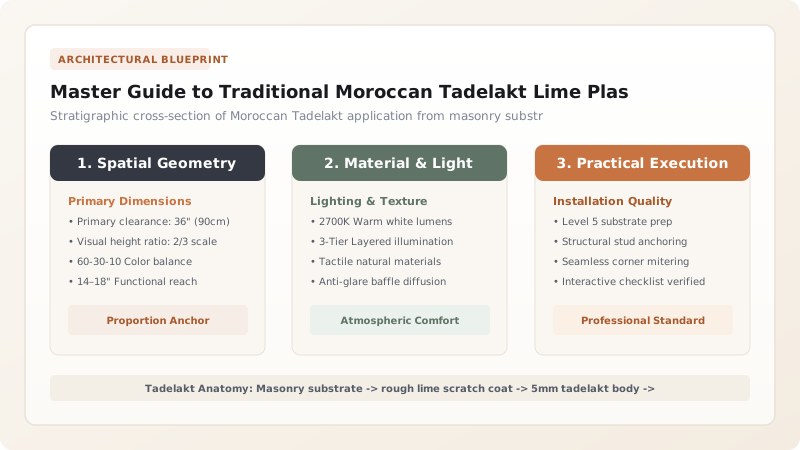
| Tadelakt Body Coat | Pure Marrakech tadelakt lime putty | 4–6mm applied thickness | Primary stone mass & color field | Plastic or stainless steel trowel |
| Mechanical Compression | Densified lime matrix | Compressed to 3–4mm | Collapses capillaries & flattens grog | Hard basalt river stone (Mohs 7) |
| Saponification Treatment | Diluted olive oil black soap (savon noir) | 1:5 soap to water dilution | Forms waterproof calcium oleate film | Soft paintbrush & continuous stone rubbing |
| Maintenance Waxing | Natural carnauba or beeswax paste | Microscopic buffed film | Protects against hard water limescale | Woolen cloth burnishing (annual) |
Practical Constraints
Every successful decoration project must account for physical and environmental constraints:
Labor-Intensive Manual Burnishing
Strict Substrate Rigidity Requirements
Master Craft Protocol for Authentic Moroccan Tadelakt Installation
Execute this professional sequence to achieve flawless results without backtracking:
Substrate Wetting and Suction Control
Saturate the cured lime-rendered wall copiously with water for 24 hours to prevent the dry wall from sucking water out of the tadelakt.
Tadelakt Slaking and Pigment Kneading
Mix dry Marrakech tadelakt lime with water and alkali-stable mineral pigments; allow putty to slake and ferment in sealed drums for 48 hours.
Uniform Trowel Application
Apply tadelakt paste in two continuous passes totaling 5mm thickness using flexible plastic trowels, maintaining tight planar curves.
Initial Plastic Float Flattening
Allow plaster to stiffen for 30–60 minutes; gently float the surface with a flexible plastic trowel to eliminate trowel ridges and bring lime cream to surface.
Primary River Stone Burnishing
Begin circular polishing with a flat river agate or basalt stone, applying firm pressure to crush unslaked grains and seal microscopic surface voids.
Savon Noir Soap Infusion
Brush diluted olive oil black soap across the stone-rubbed plaster; the soap reacts instantly with free lime, creating a milky saponification foam.
Final Stone Hydrophobic Burnishing
Polish the soapy surface vigorously with the river stone until the foam vanishes and the wall achieves an ultra-glossy, stone-hard waterproof luster.
Gradual Carbonation Curing
Protect the finished room from moving air and direct heat; allow lime to carbonate slowly for 30 days before exposing to pressurized running shower water.
Common Mistakes & Countermeasures
Avoid these costly errors that compromise aesthetics, ergonomics, and budget:
Using modern drywall or flexible timber studwork as a substrate
Replacing authentic Marrakech lime with synthetic 'tadelakt style' acrylic plasters
Cleaning tadelakt surfaces with modern acidic household bathroom cleaners (vinegar, bleach, or descalers)
Project Execution Checklist
Track your physical progress. Checkboxes persist automatically on this device:
Frequently Asked Questions
Is Tadelakt truly 100% waterproof for showers and bathtubs?
Yes. When executed authentically with genuine Marrakech lime, proper stone burnishing, and complete olive soap saponification, Tadelakt forms a dense calcium oleate barrier that is completely impervious to standing water. It has been used for centuries inside Moroccan royal hammams and public bathhouses.
How do you clean and maintain a Tadelakt bathroom?
Tadelakt must be cleaned exclusively with clean warm water and a soft cloth, or re-washed periodically with dilute Moroccan black olive soap. Never use acidic limescale removers, bleach, or abrasive sponges, which dissolve the protective calcite and calcium oleate layer.
Why does Tadelakt require a special river stone instead of a metal trowel?
Metal trowels drag across the surface and can leave grey metallic burn marks on pale lime plaster. A smooth, rounded river stone (such as hard agate or basalt) glides with minimal friction, allowing the artisan to exert heavy concentrated point pressure that crushes unburned limestone grains flush into the surface without scratching.


