
Black soap saponification is the transformative chemical reaction that converts breathable, water-absorbing Moroccan lime plaster into an impermeable, hydrophobic stone membrane. When authentic Moroccan black soap (*savon noir*—derived from saponified black olives and rich in potassium oleate) is brushed onto setting, stone-burnished Tadelakt, the oleic and palmitic fatty acids instantly react with the free calcium hydroxide ($Ca(OH)_2$) in the lime. This in situ reaction synthesizes **calcium oleate**, an insoluble, natural waxy soap salt that precipitates within the microscopic capillary pores of the plaster. As the stone burnishing continues, this hydrophobic barrier is compacted deep into the surface, creating an enduring waterproof finish that breathes vapor while causing liquid water to bead and roll off effortlessly.
At a Glance: Key Takeaways
- Chemical Reaction: $Ca(OH)_2 + 2 CH_3(CH_2)_7CH=CH(CH_2)_7COOK \rightarrow (C_{17}H_{33}COO)_2Ca + 2 KOH$.
- Formulation of Savon Noir: Traditional Moroccan soft paste soap made from black olive oil and potassium hydroxide (potash).
- Synthesized Molecule: Insoluble calcium oleate (a dense, natural waxy soap salt resistant to water dissolution).
- Dilution Ratio: 1 part pure black soap paste to 4–6 parts warm water, brushed onto warm setting plaster.
- Hydrophobic Performance: Contact angle $>90^\circ$, causing standing water to bead up into mercury-like droplets.
- Curing Environment: 30-day gentle carbonation in humid conditions; absolute prohibition of acidic cleaners.
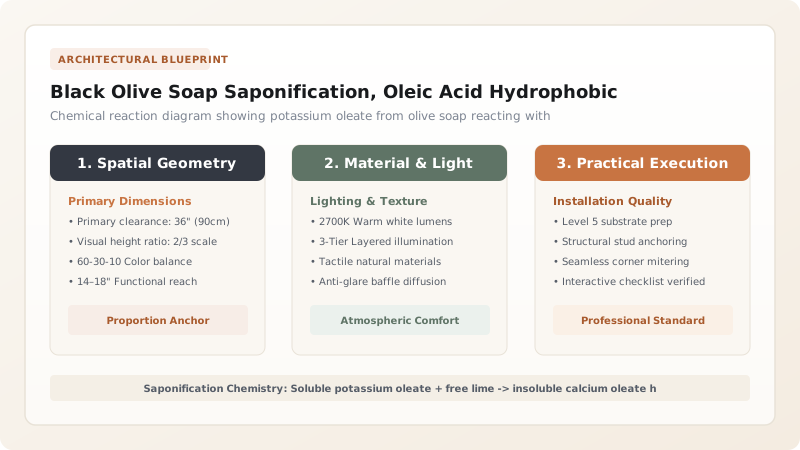
1. Chemical Kinetics: From Soluble Potassium Oleate to Insoluble Calcium Oleate
Unlike modern waterproof coatings that form a synthetic plastic film on top of a wall, Tadelakt waterproofing occurs through an integrated chemical transformation within the substrate itself. The agent of this transformation is Savon Noir, an ancient Moroccan olive soap made by saponifying crushed ripe black olives with wood-ash lye (potassium hydroxide).
Savon noir is rich in potassium oleate ($C_{17}H_{33}COOK$). When brushed onto the fresh, alkaline lime plaster, it penetrates several millimeters into the porous capillary network. It immediately encounters abundant free calcium hydroxide ions ($Ca^{2+}$) released by the slaked lime. A double-displacement chemical reaction takes place:
$$\text{Ca(OH)}_2 + 2\text{C}_{17}\text{H}_{33}\text{COOK} \longrightarrow (\text{C}_{17}\text{H}_{33}\text{COO})_2\text{Ca} \downarrow + 2\text{KOH}$$The resulting calcium oleate is a waxy, insoluble metallic soap salt. It precipitates directly inside the micro-pores, swelling slightly to seal all capillary voids permanently against liquid water penetration.
2. Application Protocol: Soaping, Foaming, and Stone Consolidation
Applying the soap is not a simple cleaning step; it is an active finishing operation performed while the plaster is still receptive to chemical bonding:
- Dilution and Heating: 1 part pure black olive soap paste is dissolved in 5 parts warm water (approx. 40°C) to break down thick pastes into a free-flowing emulsion.
- Broad Brush Infusion: Using soft whitewash brushes, the artisan paints the soapy emulsion across the pre-burnished tadelakt. As the brush agitates the surface, a rich, creamy white lather develops.
- Second Stone Burnishing Pass: Without waiting for the foam to dry, the maâlem immediately works the river stone over the lathered wall. The circular stone friction drives the soap deep into the capillaries while shearing off excess surface buildup.
- Lather Disappearance: As the calcium oleate reaction completes, the white foam suddenly disappears, absorbed and transformed into the plaster. The surface shifts from slick wetness to an ultra-smooth, glossy, waxy luster.
3. The 30-Day Curing Arc and Absolute Vulnerability to Acidic Cleaners
Although Tadelakt feels dry and hard to the touch within 24 hours, its chemical maturation is far from complete. Calcium oleate provides immediate surface hydrophobicity, but the underlying lime matrix requires 28 to 30 days of atmospheric exposure to absorb ambient carbon dioxide and complete full calcite recrystallization ($CaCO_3$).
During this critical curing month, the room must be protected from pressurized direct hot water streams and aggressive temperature shocks. Most critically, owners and maintenance staff must be trained on chemical compatibility. Because calcium oleate and calcium carbonate are basic alkaline compounds, exposure to acidic cleaners (vinegar, lemon juice, tile descalers, or hydrochloric acid) causes instant effervescent dissolution:
$$(\text{C}_{17}\text{H}_{33}\text{COO})_2\text{Ca} + 2\text{HCl} \longrightarrow \text{CaCl}_2 + 2\text{C}_{17}\text{H}_{33}\text{COOH}$$This acid reaction strips the waterproof soap layer in seconds, leaving chalky, porous, and permanently ruined patches that can only be repaired by re-plastering.
Tadelakt Soap Dilution, Reaction Kinetics, and Maintenance Protocol
Use this reference table to calculate exact physical dimensions, ratios, and specifications before purchasing:
| Plaster Lifecycle Stage | Soap Formulation | Application Method | Chemical Objective | Drying & Curing Condition |
|---|---|---|---|---|
| Primary In Situ Saponification | 1 part savon noir : 5 parts warm water | Broad brush + immediate stone burnish | Deep calcium oleate crystal synthesis | Active stone polishing until foam clears |
| Secondary Sealing Pass (Day 2) | 1 part savon noir : 10 parts warm water | Soft cotton cloth gentle wipe | Reinforces top-layer waxy patina | Air dry; low ventilation (24h) |
| First Month Shower Curing | Zero soap or water exposure (Days 1–7) | Keep dry; protect from splashing | Allows core carbonation to harden | Ambient humidity (40%–60%) |
| Routine Monthly Cleaning | 1 tbsp savon noir per bucket warm water | Soft microfiber sponge wipe-down | Replenishes sacrificial oleate molecules | Rinse with lukewarm clean water |
| Annual Protection Buffing | Pure natural carnauba / beeswax emulsion | Woolen buffing pad or sheepskin glove | High-sheen sacrificial barrier against scum | Hand-buff to mirror satin shine |
Practical Constraints
Every successful decoration project must account for physical and environmental constraints:
Hard Water Limescale Sensitivity
Authentic Savon Noir Sourcing
Master Application Sequence for Black Soap Saponification on Tadelakt
Execute this professional sequence to achieve flawless results without backtracking:
Black Soap Emulsion Preparation
Dissolve 200g of pure Moroccan olive soap paste into 1 liter of warm distilled water, whisking until smooth and lump-free.
Timing Assessment on Burnished Wall
Ensure the first pass of stone burnishing is complete and the plaster has stiffened to firm, semi-matte leather hardness.
Generous Soap Emulsion Brushing
Paint the warm soap solution across the wall with wide horsehair brushes, agitating lightly to create a uniform white lather.
Active Saponification Stone Burnish
Immediately rub the lathered surface with the flat river stone in continuous overlapping spirals, forcing the soap deep into pores.
Foam Liquefaction and Absorption
Continue stone pressure as the white lather reacts with free lime and transforms into an invisible, glass-hard calcium oleate matrix.
Excess Soap Removal
Wipe away any residual unreacted surface soap scum with a soft damp cotton rag to prevent sticky streaks.
Water Repellency Verification
After 24 hours, flick clean water droplets onto the surface: droplets must bead tightly into spherical shapes and roll down with zero absorption.
Common Mistakes & Countermeasures
Avoid these costly errors that compromise aesthetics, ergonomics, and budget:
Applying olive soap over completely dry, fully carbonated tadelakt days later
Using commercial dish soaps or liquid hand soaps containing sodium laureth sulfate
Leaving thick, un-rubbed pools of black soap on the floor or in basin bottoms
Project Execution Checklist
Track your physical progress. Checkboxes persist automatically on this device:
Frequently Asked Questions
How does black soap make lime waterproof without sealing its pores?
The reaction produces calcium oleate, which lines the microscopic pore walls with a hydrophobic (water-repelling) molecular layer. While liquid water droplets are too large and cohesive to penetrate the repelling pore throats, water vapor molecules can still diffuse through, allowing the wall to breathe naturally.
What should I do if someone accidentally cleans my Tadelakt with an acidic cleaner?
Rinse the area immediately with copious amounts of water to neutralize the acid. If the damage is caught quickly, wash the affected spot with a strong solution of warm black soap and re-burnish vigorously with a smooth river stone to synthesize new calcium oleate. If the lime has etched deeply, a master plasterer must apply a fresh skim coat of tadelakt.
Why does Moroccan black soap have a dark greenish-black color?
Savon noir is made from whole black olives (including skins and pulp) that are macerated and saponified with potash lye. The high concentration of natural olive chlorophyll, polyphenols, and vegetable matter gives the soap its characteristic dark green-black color and distinctive rich olive fragrance.


