
Raw linseed oil impregnation, Savon de Marseille saponification, and beeswax buffing represent the historic three-stage hydrophobic finishing system for Venetian Pastellone floors. After the burnished lime topcoat has carbonated for at least 14 days, raw cold-pressed flaxseed oil (olio di lino crudo) thinned with natural citrus terpenes is saturated deep into the porous calcite capillaries. As the oil slowly oxidizes, it enriches the mineral pigment hues and builds deep waterproofing. The floor is then washed with a hot solution of authentic Savon de Marseille (olive-oil potassium soap). The soap's free oleic fatty acids react with residual calcium ions on the lime pore walls, triggering an instantaneous chemical saponification that precipitates an insoluble, hydrophobic barrier of calcium oleate. The floor is completed with a hand-buffed coat of virgin beeswax and carnauba paste, creating a silky, water-repellent, breathable satin luster that endures for generations.
At a Glance: Key Takeaways
- Tri-Partite Natural System: Deep penetrating oil + chemical soap saponification + topical protective wax buffer.
- Raw Linseed Oil (Olio di Lino Crudo): Unboiled, un-drier flaxseed oil penetrating 3–4mm into micropores before slow polymerization.
- Chemical Saponification Reaction: Potassium oleate reacting with Ca2+ ions to form water-insoluble calcium oleate barrier.
- Savon de Marseille Specification: 100% vegetable oil soap (72% olive oil) free of animal tallow, synthetic dyes, or sodium laureth sulfates.
- Virgin Beeswax & Carnauba Paste: Natural wax blend dissolved in pure gum turpentine providing sacrificial scratch protection.
- Breathable Vapor Permeability: Completely waterproof to liquid water droplets while permitting 100% continuous vapor breathability.
- Spontaneous Combustion Safety: All oil-soaked cloths must be submerged in water buckets immediately after application.
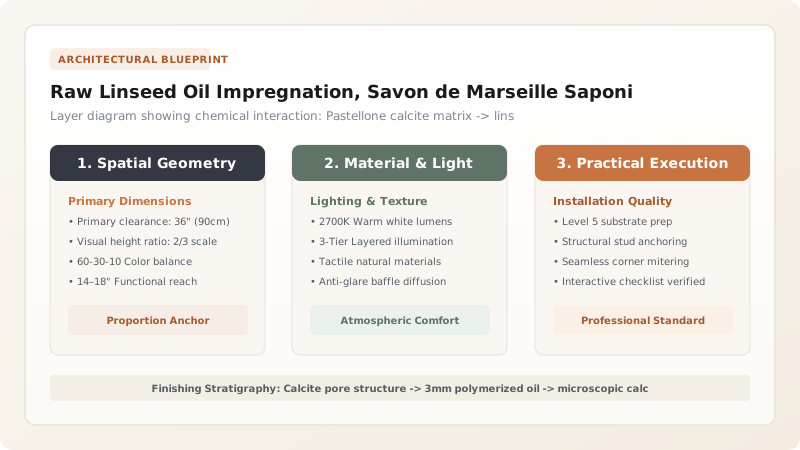
1. Raw Linseed Oil Penetration and Mineral Hue Enrichment
While boiled linseed oil (BLO) with chemical metallic driers is common in modern carpentry, traditional Venetian Pastellone masters favored olio di lino crudo (raw, cold-pressed flaxseed oil). Raw oil dries much slower than boiled oil, allowing it to penetrate twice as deep (up to 3 to 4mm) into the dense, burnished calcite matrix before polymerizing.
Thinned 50/50 with pure gum turpentine or natural citrus terpenes, raw oil is applied generously with lamb's wool applicators. As the oil fills the micro-pores between Carrara marble crystals, it shifts the refractive index from $1.50$ (air-filled pores) to $1.48$ (oil-filled pores). This optical shift eliminates surface chalkiness, causing natural mineral earth pigments—such as Rosso Veneziano and Giallo di Verona—to explode with deep, saturated, glowing warmth, resembling polished porphyry or jasper stone.
2. Chemical Saponification: The Creation of Calcium Oleate
Once the linseed oil has penetrated and dried for 48 hours, the floor undergoes its critical chemical waterproofing stage: the saponification wash (trattamento al sapone).
Artisans dissolve authentic Savon de Marseille (or traditional Venetian olive-oil soft soap) in hot water. The soap consists of soluble potassium oleate and potassium palmitate ($\text{R-COOK}$). When washed across the floor, the soap solution penetrates the remaining capillary pore throats, where an immediate ion-exchange reaction takes place with free calcium hydroxide ions:
$$2\,\text{C}_{17}\text{H}_{33}\text{COOK (Potassium Oleate)} + \text{Ca(OH)}_2 \longrightarrow (\text{C}_{17}\text{H}_{33}\text{COO})_2\text{Ca}\downarrow + 2\,\text{KOH}$$
The resulting calcium oleate is a hard, completely water-insoluble natural soap salt that crystallizes within the upper pore capillaries. It does not form a synthetic plastic film; rather, it renders the pore walls permanently hydrophobic, causing spilled wine, coffee, or water to bead up into tight spheres on the surface without penetrating.
3. Virgin Beeswax Buffing and Sustainable Floor Longevity
The crowning treatment is the application of traditional Venetian paste wax (cera d'api veneziana). The formulation combines virgin yellow beeswax (providing flexibility and a fragrant honey aroma) with hard Brazilian carnauba wax (providing scratch resistance and a high melting point), melted into pure gum spirits of turpentine.
Applied in a paper-thin haze with soft cotton cloths, the wax is allowed to haze for 20 minutes before being buffed at high speed using a commercial rotary floor polisher fitted with natural white Tampico or horsehair fiber pads. The mechanical friction warms the wax, burnishing it into an extraordinarily silky, soft-satin luster. Maintenance requires only routine damp-mopping with a few drops of Marseille soap in warm water; the floor never requires harsh chemical stripping, gaining a richer, deeper aristocratic patina with each passing decade.
Pastellone Sealing, Saponification, and Waxing Schedule
Use this reference table to calculate exact physical dimensions, ratios, and specifications before purchasing:
| Application Stage | Chemical Material / Dilution | Coverage Rate (m² / L) | Working Time / Curing Interval | Primary Functional Objective |
|---|---|---|---|---|
| First Oil Saturation | 50% Raw Linseed Oil + 50% Citrus Terpene | 15 – 20 m² / L | Penetrate 30 min; wipe excess dry | Deep 3mm capillary penetration; enriches pigment |
| Second Oil Impregnation | 80% Raw Linseed Oil + 20% Terpene | 25 – 30 m² / L | Apply after 24h; wipe excess | Fills remaining sub-surface pore volumes |
| Marseille Saponification Wash | 50g Savon de Marseille / 5L hot water | Generous wash with mop | Leave 10 min; mop up excess | Precipitates insoluble calcium oleate waterproof shield |
| Initial Beeswax Buffing | Virgin Beeswax + Carnauba paste | 40 – 50 m² / kg | Haze 20 min; buff with horsehair pad | Silky, non-slip, scratch-resistant living finish |
| Monthly Routine Washing | 1 tbsp Liquid Marseille Soap / 5L water | Damp flat mop | Clean and allow to air dry | Continuously nourishes calcium oleate barrier |
| Annual Maintenance Buff | Pure carnauba-beeswax paste | Spot-buff high-traffic lanes | Buff immediately with rotary polisher | Restores high-traffic luster without stripping |
Practical Constraints
Every successful decoration project must account for physical and environmental constraints:
Odor Management During Application
Sensitivity to Acidic Spills Before Full Wax Cure
Master Step-by-Step Finishing Protocol for Venetian Pastellone Flooring
Execute this professional sequence to achieve flawless results without backtracking:
Carbonation Verification and Vacuum Dusting
Verify Pastellone topcoat has cured for at least 14 days; vacuum thoroughly with commercial HEPA vac to remove all abrasive dust particles.
First Raw Linseed Oil Application
Mix 50% raw linseed oil and 50% citrus terpene; apply generously across floor with lamb's wool applicator, ensuring uniform saturation.
Wiping Excess Surface Oil Puddles
After 30 minutes of soaking, wipe all unabsorbed surface puddles completely dry with clean cotton towels; do NOT allow standing oil to pool.
Second Oil Coat and 48-Hour Cure
After 24 hours, apply second coat (80% oil / 20% solvent); wipe dry after 30 minutes; allow 48 hours for deep capillary polymerization.
Hot Marseille Soap Wash (Saponification)
Dissolve 50g grated pure Savon de Marseille in 5 liters of hot water; mop generously across floor; allow chemical reaction for 10 minutes; mop dry.
Beeswax-Carnauba Paste Application
Apply a paper-thin haze of authentic beeswax-carnauba paste in circular motions using soft terrycloth rags, working in 3x3 meter sections.
High-Speed Mechanical Rotary Buffing
Buff hazed wax with commercial rotary floor machine (175 RPM) fitted with natural horsehair pad to produce a luminous, silky satin glow.
Common Mistakes & Countermeasures
Avoid these costly errors that compromise aesthetics, ergonomics, and budget:
Applying linseed oil before the lime plaster has carbonated for at least 14 days
Leaving excess linseed oil pooling on the floor surface without wiping it dry
Discarding crumpled linseed-oil-soaked rags into a standard trash can
Project Execution Checklist
Track your physical progress. Checkboxes persist automatically on this device:
Frequently Asked Questions
Can I use synthetic water-based polyurethane sealer instead of linseed oil and wax?
Modern polyurethane creates a plastic film *on top* of the floor that destroys the silky mineral feel of Pastellone, suffocates the breathing lime substrate, turns yellow under sunlight, and scratches white under furniture. Traditional oil, soap, and wax penetrate *inside* the lime, creating an authentic breathable living patina that never peels and can be locally refreshed forever.
How does Savon de Marseille make a lime floor waterproof?
Savon de Marseille contains soluble potassium oleate. When it touches the calcium-rich lime floor, it undergoes an instantaneous chemical ion exchange, forming calcium oleate. Calcium oleate is completely insoluble in water and hydrophobic, causing liquid water to bead up on the surface without penetrating the pores.
How often does a Venetian Pastellone floor need to be rewaxed?
In residential living rooms and bedrooms, a light buffing with paste wax once every 12 to 18 months is sufficient. In high-traffic entrance halls or busy kitchens, high-wear pathways can be spot-refreshed every 6 months with a quick 5-minute hand polish.


