
Venetian Pastellone is one of the most prestigious and ancient continuous seamless floor systems in Western architecture, perfected across the Venetian Republic from the Renaissance through the 18th century. Engineered specifically for the unstable lagoon soils and flexible timber-beam palazzo floors of Venice, Pastellone is a breathable, multi-layered hydraulic bio-composite. Composed of non-hydraulic fat lime putty (Grassello di Calce) aged underwater for years, blended with finely pulverized pozzolanic brick dust (Cocciopesto), Carrara marble dust, and natural mineral earth pigments (such as Rosso Veneziano ochre and Terra di Siena), Pastellone is applied in successive razor-thin coats compacted by steel trowel burnishing. Deeply saturated with hot boiled linseed oil and waterproofed with pure Savon de Marseille potassium soap and beeswax, Pastellone cures into a luminous, silky-smooth, seamless mineral floor that flexes naturally with timber structural movements without cracking.
At a Glance: Key Takeaways
- Venetian Structural Flexibility: Engineered to flex safely over timber joist floor structures in historic Venetian palazzi.
- Grassello di Calce Binder: Pure high-calcium non-hydraulic lime putty aged underwater for a minimum of 24 to 36 months.
- Pozzolanic Cocciopesto Base: Finely pulverized Roman terracotta brick dust providing hydraulic setting throughout thick beds.
- Natural Mineral Earth Palette: Classic Venetian Red (Rosso Veneziano), yellow ochre, green earth (Terra Verde), and bone black.
- Intense Trowel Burnishing: Multi-stage compaction with trapezoidal stainless-steel trowels forcing lime platelets into glass-like sheen.
- Saponified Soap & Wax Seal: Hydrophobic calcium oleate barrier created by Savon de Marseille and buffed carnauba/beeswax.
- 100% Breathable & Hypoallergenic: Naturally antimicrobial, zero VOC, and highly vapor-permeable, resisting damp lagoon air.
In-Depth Guides in this Directory
Explore specialized subtopic blueprints, technical dimensions, and execution checklists:
Aged Grassello di Calce, Pozzolanic Cocciopesto, and Crack-Free Underlay Screeds
Technical materials manual on Grassello di Calce putty maturation, pozzolanic Cocciopesto reactivity, and engineering crack-free lime underlay screeds.
Natural Mineral Earth Pigments, Venetian Red Ochres, and Stainless Trowel Burnishing
Artisanal manual on compounding natural mineral pigments, Rosso Veneziano, and multi-stage stainless steel trowel burnishing for Venetian Pastellone.
Raw Linseed Oil Impregnation, Savon de Marseille Saponification, and Beeswax Buffing
Technical conservation manual for finishing Venetian Pastellone: raw linseed oil saturation, Savon de Marseille chemical saponification, and beeswax buffing.
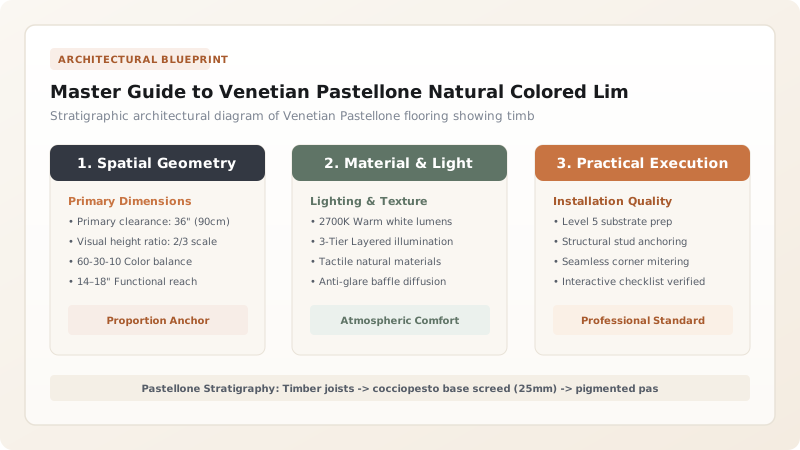
1. Lagoon Structural Physics: Why Venice Needed Seamless Lime Pavements
Constructing permanent monumental floors in Venice presents extraordinary structural engineering challenges found nowhere else. Venice is built on millions of submerged timber piles driven into soft, shifting tidal mudbanks. Furthermore, Venetian palazzi utilize flexible timber floor joists (travature in legno) spanning vast ballroom salons without intermediate interior bearing walls.
Rigid materials—such as thick stone slabs or modern Portland cement screeds—fail in Venice: their heavy deadweight overloads the timber piles, and their rigid modulus causes them to crack and shear as the wooden joists naturally flex under human crowds. Renaissance master builders developed Pastellone (literally 'large pastel') as an ultralight, flexible, continuous monolithic floor. Reaching a total finished thickness of only 15 to 30mm, Pastellone moves harmoniously with the underlying timber structure, providing an exquisite, joint-free, marble-like surface that absorbs seasonal lagoon tides without structural failure.
2. Material Science: Aged Grassello di Calce and Cocciopesto Pozzolan
Pastellone relies on an ancient Roman pozzolanic chemical reaction between fat lime and crushed ceramic:
- Grassello di Calce: High-calcium limestone ($\text{CaCO}_3 > 98\%$) is calcined in wood kilns, then slaked in clean water and aged in subterranean settling pits for at least 24 to 36 months. Aging breaks calcium hydroxide down into sub-micron hexagonal crystal platelets, conferring buttery plasticity, extreme tack, and high carbonation potential.
- Cocciopesto (Burnt Clay Pozzolan): Terracotta roof tiles and bricks fired at low temperatures ($750^\circ - 850^\circ\text{C}$) are pulverized into sharp sand and micro-flour. When blended with damp Grassello, the amorphous silica and alumina in the brick dust react chemically with calcium hydroxide, forming hydraulic calcium silicate hydrates (C-S-H) that set throughout the entire depth of the floor, even in deep, enclosed lagoon environments deprived of air.
- Marble Dust (Polvere di Marmo): Ground white Carrara marble aggregate graded from 0.1 to 0.7mm provides microscopic compressive bridging and confers a deep, translucent, light-scattering crystalline luster.
3. The Art of Burnishing, Saponification, and Wax Patination
The application of the decorative top coat is a master craft. Colored exclusively with natural mineral earth pigments—most famously Rosso Veneziano (Venetian red hematite), Giallo di Verona (yellow ochre), or Terra d'Ombra (burnt umber)—the mixture is applied in two to three paper-thin coats using specialized trapezoidal stainless steel trowels (spatola veneziana).
While the final coat is still curing, the artisan applies intense, repetitive trowel pressure at acute angles. This mechanical burnishing compresses the hexagonal lime crystals into parallel alignment, forcing free lime water to the surface and creating a natural, mirror-smooth gloss without artificial varnishes.
Once carbonated, the floor undergoes traditional finishing: hot raw linseed oil is saturated into the pores to deepen the mineral color, followed by washing with warm Savon de Marseille (olive-oil potassium soap). The soap's oleic acids react with free calcium to precipitate a waterproof calcium oleate barrier. The floor is completed with a hand-buffed coat of virgin beeswax and carnauba wax, yielding an incomparable soft, velvety, living patina that lasts for centuries.
Venetian Pastellone Stratigraphy, Thickness, and Mix Formulations
Use this reference table to calculate exact physical dimensions, ratios, and specifications before purchasing:
| Stratum Layer | Material Composition | Thickness / Depth | Application Tooling | Primary Engineering Function |
|---|---|---|---|---|
| Substrate Primer Bed | NHL 2 lime slurry + coarse sand | 3–5 mm | Notched trowel over mesh | Bonds timber/screed; stabilizes substrate |
| Cocciopesto Base Screed | Aged Grassello + coarse brick dust (0–3mm) | 15–20 mm | Wood screed bar + float | Hydraulic core absorbing timber deflection |
| Intermediate Leveling Coat | Grassello + medium brick dust + sand (0–1mm) | 4–6 mm | Steel trowel + sponge float | Eliminates shrinkage micro-cracking |
| Pastellone Color Finish | Aged Grassello + Carrara dust + mineral earth | 1.5–2.5 mm (2 coats) | Venetian stainless burnishing trowel | Silky, translucent, highly compacted color layer |
| Linseed Oil Impregnation | Raw flaxseed oil thinned with mineral spirit | Deep saturation (2 coats) | Natural lamb's wool mop | Hydrophobic capillary deep seal; enriches hue |
| Saponified Wax Buffing | Savon de Marseille + carnauba & beeswax | Micro-film (< 0.1 mm) | Rotary floor buffer + horsehair pad | Silky satin sheen; repels spills and dirt |
Practical Constraints
Every successful decoration project must account for physical and environmental constraints:
Long Multi-Stage Curing Timeline
Extreme Artisan Physical Demands
Master Application Sequence for an Authentic Venetian Pastellone Floor
Execute this professional sequence to achieve flawless results without backtracking:
Subfloor Deflection Assessment and Decoupling
Inspect timber joist subfloor; fasten 22mm marine plywood deck; lay alkali-resistant fiberglass uncoupling mesh bedded in breathable lime slurry.
Cocciopesto Base Screed Application
Blend 1 part 24-month aged Grassello lime with 2.5 parts coarse crushed terracotta brick dust (0-3mm); screed a 20mm leveling bed across the room.
Intermediate Micro-Porous Leveling
After 48 hours, trowel a 5mm intermediate coat of Grassello and fine brick dust (0-1mm); cross-hatch surface lightly with float for keying.
Mineral Pigment Paste Compounding
Disperse natural mineral pigments (Rosso Veneziano or Terra di Siena) into deionized water; blend into aged Grassello and fine Carrara marble flour.
First Pastellone Color Coat Troweling
Apply first 1mm color coat with rounded-corner stainless steel Venetian trowel, working continuously wet-on-wet across the room.
Second Color Coat and Intensive Burnishing
Apply final 1mm coat; as lime begins initial set, burnish surface with high trowel pressure at 15° angle, compacting lime platelets into mirror sheen.
Raw Linseed Oil Deep Saturation
Allow 14 days of gradual carbonation; apply raw linseed oil thinned 50% with odorless spirits, wiping excess surface puddles after 30 minutes.
Marseille Soap Wash and Beeswax Burnishing
Wash floor with hot Savon de Marseille solution to form water-repellent calcium oleate; allow 48h dry; buff with pure beeswax and carnauba paste.
Common Mistakes & Countermeasures
Avoid these costly errors that compromise aesthetics, ergonomics, and budget:
Using modern rapid-setting Portland cement or gypsum plaster to accelerate Pastellone curing
Applying synthetic epoxy or polyurethane high-gloss clear coats over historic Pastellone
Rushing the burnishing process while the lime plaster is too wet
Project Execution Checklist
Track your physical progress. Checkboxes persist automatically on this device:
Frequently Asked Questions
What is the difference between Venetian Terrazzo (Terrazzo alla Veneziana) and Pastellone?
Both are historic Venetian lime-based floors. Terrazzo incorporates large, visible chips of colored marble (up to 15–25mm) packed densely into a lime-cocciopesto mortar and ground down to reveal a mosaic of stone chips. Pastellone uses micro-pulverized marble dust and brick flour, producing a completely smooth, monolithic, seamless, pastel-like mineral surface without visible stones.
Can Pastellone be installed in wet bathrooms and showers?
Yes, exceptionally well. In historic Venice, pastellone was the primary floor for private palazzo baths. When properly treated with linseed oil and saponified with Savon de Marseille, the surface forms an insoluble, hydrophobic calcium oleate barrier that repels standing water while remaining naturally mold-resistant due to the high alkalinity of lime (pH > 12).
How do you repair scratches or cracks in a Pastellone floor?
Because Pastellone is a homogeneous mineral material, fine hairline scratches can be buffed out using fine steel wool (0000 grade) lubricated with a drop of linseed oil, followed by paste wax buffing. Deeper cracks can be seamlessly repaired using matching pigmented Grassello lime and marble flour paste.


