
Natural mineral earth pigmentation and intensive stainless trowel burnishing represent the artistic pinnacle of Venetian Pastellone finishing. Applied in two to three micro-layers totaling only 2 to 3mm in thickness, the decorative finish coat blends aged Grassello di Calce with superfine Carrara marble flour (0.1–0.3mm) and 100% natural, UV-stable, alkali-resistant mineral pigments. The classic Venetian palette is dominated by Rosso Veneziano (natural red hematite from Veneto hills), Giallo di Verona (yellow iron hydroxide ochre), Terra Verde di Brentonico (green celadonite), and Terra d'Ombra (calcined umber). As the lime begins its initial set, master craftsmen burnish the surface with rounded-corner stainless steel Venetian trowels under intense mechanical pressure. This burnishing aligns the hexagonal calcium hydroxide crystal platelets horizontally, forcing lime milk to the surface and producing a brilliant, deep, translucent satin luster without artificial chemicals.
At a Glance: Key Takeaways
- Mineral Earth Pigment Stability: 100% natural inorganic oxides (hematite, goethite, celadonite) impervious to lime alkalinity (pH 12.5).
- Rosso Veneziano (Venetian Red): Authentic hematite iron oxide mined in the Veneto region, producing legendary warm terracotta hues.
- Carrara Marble Flour (Polvere di Marmo): Micronized calcite powder (0.1–0.3mm) conferring internal luminescence and compressive strength.
- Trapezoidal Venetian Trowels: Hand-forged flexible stainless steel blades with ground rounded corners preventing surface scratch gouges.
- Platelet Compaction Mechanics: Burnishing pressure aligning hexagonal Ca(OH)2 crystals into a mirror-smooth planar orientation.
- Wet-on-Wet Double Troweling: Two successive 1mm coats applied within 4 hours, fusing into a single monolithic crystalline layer.
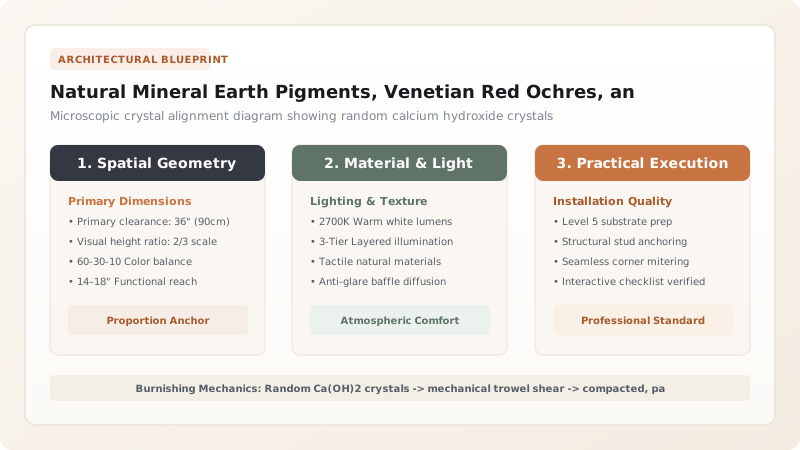
1. Mineral Earth Mineralogy: The Sacred Alkali-Resistant Palette
Lime is an intensely alkaline chemical environment: fresh Grassello di Calce has a pH of approximately 12.5 to 13.0. Modern organic aniline dyes, synthetic lakes, or universal paint tints decompose rapidly in lime, turning grey, bleaching, or turning into powdery flakes within weeks.
Pastellone requires 100% inorganic natural mineral earth pigments that are chemically impervious to high alkalinity and permanent under UV sunlight:
- Rosso Veneziano (Venetian Red): An ancient hematite iron oxide ($\text{Fe}_2\text{O}_3$) mined from volcanic basalt weathering in the Veneto hills. It produces the deep, aristocratic, warm burnt-coral and terracotta tones synonymous with Venetian palazzi.
- Giallo di Verona: Natural hydrated iron hydroxide (goethite, $\text{FeO(OH)}$) producing rich, sunny golden-ochre tones.
- Terra Verde di Brentonico: A soft, muted olive-grey mineral composed of celadonite and glauconite silicates, historically favored for private palazzo libraries and sleeping chambers.
- Terra d'Ombra Naturale: Manganese-rich natural umber from Umbria, yielding deep tobacco, chocolate, and walnut tones.
2. Carrara Marble Flour: The Secret to Translucent Depth
If you mix Grassello lime with pigment alone, it dries opaque, flat, and chalky. The secret to the luminous, water-like depth of authentic Pastellone lies in the incorporation of polvere di marmo di Carrara (micronized Carrara marble flour).
Carrara marble is 99% pure crystalline calcite ($\text{CaCO}_3$). Graded to micro-particles between 0.1mm and 0.3mm, these angular crystal grains act as millions of microscopic internal prisms. When light enters the cured translucent lime binder, the light rays penetrate beneath the surface and refract off the faceted marble crystals before bouncing back to the viewer's eye. This creates the optical phenomenon of lucidezza profonda—a deep, three-dimensional inner glow that appears alive under flickering candlelight or shimmering canal reflections.
3. The Physics of Trowel Burnishing: Transforming Mud into Glass
Burnishing (lisciatura) is not a decorative polish; it is a physical phase alignment of crystal matter. The master craftsman uses a spatola veneziana—a hand-forged trapezoidal stainless steel trowel with beveled, razor-sharp edges and rounded, non-gouging corners.
The technique follows a strict physical progression:
- Initial Leveling: The first 1mm color coat is pulled tight across the cocciopesto screed. After 3 to 4 hours, a second 1mm coat is applied wet-on-wet.
- The Critical Setting Window: As the lime begins to lose its free water sheen and shifts to a leather-hard state, burnishing commences. The artisan leans their full body weight onto the trowel, sweeping the blade across the surface in overlapping arcs at an acute angle of 10° to 15°.
- Platelet Reorientation: The immense shear pressure forces the microscopic hexagonal calcium hydroxide crystal platelets to rotate and align parallel to the floor surface. Free lime milk (calcium hydroxide dissolved in pore water) is forced to the surface, creating an ultra-dense, pore-free, glass-smooth crystalline skin that naturally repels water and stains.
Natural Mineral Pigments and Pastellone Topcoat Formulations
Use this reference table to calculate exact physical dimensions, ratios, and specifications before purchasing:
| Pigment Typology | Chemical Formula / Mineral | Maximum Pigment Load (wt %) | Resulting Color Tone | Lightfastness / Alkali Stability |
|---|---|---|---|---|
| Rosso Veneziano | Fe2O3 (Hematite earth) | 8% – 10% max of lime weight | Warm aristocratic Venetian coral red | 100% UV-permanent; impervious to lime |
| Giallo di Verona | FeO(OH) (Goethite ochre) | 6% – 8% max of lime weight | Sunlit golden honey and warm ochre | 100% UV-permanent; impervious to lime |
| Terra Verde | Celadonite / Glauconite | 5% – 7% max of lime weight | Soft muted antique sage and olive green | Excellent permanence; natural matte tone |
| Terra d'Ombra | Fe2O3 + MnO2 (Umber) | 4% – 6% max of lime weight | Rich tobacco brown and chestnut | 100% permanent; fast drying acceleration |
| Nero Vite (Vine Black) | Amorphous calcined carbon | 2% – 3% max of lime weight | Soft smoky charcoal grey to deep slate | High stability; requires alcohol wetting |
Practical Constraints
Every successful decoration project must account for physical and environmental constraints:
Seamless Continuous Execution Requirement
Sensitive Carbonation Window
Master Application and Burnishing Sequence for Pastellone Topcoats
Execute this professional sequence to achieve flawless results without backtracking:
Substrate Inspection and Dampening
Inspect cured cocciopesto screed; sponge surface with clean water to eliminate suction while leaving zero standing water puddles.
Pigment Slurry Pre-Dispersing
Mix mineral earth pigment powder with 20% isopropyl alcohol and deionized water; mull thoroughly to break all pigment lumps into silky liquid paste.
Topcoat Mortar Compounding
Blend 1 part 36-month aged Grassello lime with 1.5 parts Carrara marble flour (0.1-0.3mm) and dispersed pigment paste; mix until velvety smooth.
First Decorative Coat Troweling
Trowel a uniform 1.2mm base color coat across the room using rounded stainless steel Venetian trowel, maintaining continuous wet edge.
Second Finish Coat Wet-on-Wet
After 3 hours, apply second razor-thin 0.8mm finish coat, pulling blade tight at 30° angle to compact mortar against base layer.
Initial Stage Burnishing
As surface water evaporates, apply firm trowel strokes in broad overlapping figure-eight patterns, smoothing away all trowel lap ridges.
Final Mirror Burnishing (Lisciatura)
Apply maximum body weight on trowel held at 10° angle; sweep across firming lime to force platelets into parallel orientation, creating mirror sheen.
Moist Air Carbonation Protection
Close room windows to avoid rapid desiccating drafts; allow floor to carbonate slowly for 14 days before introducing oil finishes.
Common Mistakes & Countermeasures
Avoid these costly errors that compromise aesthetics, ergonomics, and budget:
Overloading the lime mixture with more than 10% pigment by weight
Burnishing with a standard carbon-steel mason's trowel instead of polished stainless steel
Burnishing too early while the plaster is still wet and plastic
Project Execution Checklist
Track your physical progress. Checkboxes persist automatically on this device:
Frequently Asked Questions
Can I get bright modern colors like vivid turquoise or neon orange in Pastellone?
No. Authentic Pastellone is colored exclusively with natural geological mineral earths and oxides. The palette is inherently earthy, warm, and classical: terracotta reds, ochre yellows, soft sage greens, umber browns, and charcoal blacks. Synthetic bright dyes are destroyed by the high alkalinity of lime.
Why do Venetian trowels have rounded corners?
Standard rectangular trowels have sharp 90° corners that dig into soft lime plaster when swept in curved burnishing motions, leaving deep gouges. Venetian trowels (spatole veneziane) feature hand-ground rounded corners and beveled perimeter edges, allowing the blade to glide smoothly without scratching.
Does burnishing make the floor slippery?
Surprisingly, no. While burnishing creates an optical high-gloss mirror finish, the surface is pure micro-crystalline calcium carbonate. It has high natural friction under leather or rubber footwear, providing a silky, non-slip feel (typically achieving dynamic coefficient of friction $> 0.50$).


