
Strapwork cartouches and caryatid herm pilasters represent the architectural ornamentation of Jacobean chimneypieces. Strapwork mimics interlacing, pierced leather bands chiseled in high relief with undercut shadow channels, while herm pilasters are tapered anthropomorphic columns that serve as expressive vertical dividing piers across the overmantel facade.
At a Glance: Key Takeaways
- Northern Renaissance Strapwork: Scrolling ribbons with rolled curled ears (volutes) framing heraldic armorial centers.
- Undercut Shadow Channels: Background wood relieved by 20 to 35mm to cast dramatic, crisp shadows under low firelight.
- Tapered Herm Geometry: Inverted obelisk pedestal narrowing toward the base, decorated with applied drops, strapwork, and acanthus leaves.
- Anthropomorphic Caryatid Busts: Expressive human half-figures representing virtues, seasons, or classical muses supporting upper cornices.
- Gouge & Chisel Stereotomy: Worked using specialized carving tools (sweep gouges #3 to #9, V-tools, and spoon gouges).
- Grain Direction Alignment: All high-relief carving laid out so wood grain runs continuous through delicate projecting members.
1. The Language of Strapwork: Antwerp Mannerism in English Oak
In the mid-16th century, Flemish artists in Antwerp and Fontainebleau published engraving suites depicting fantastical strapwork (Schweifwerk). English carvers adopted this visual language, carving it into dense quarter-sawn oak.
Authentic Jacobean strapwork is characterized by:
- Rolled Volute Ears: The ends of the ribbon bands curl outward in tight spirals, appearing like rolled sheet metal or stiff wet leather.
- Pierced Boss Studs: Circular and diamond bosses are drilled through the ribbon straps, as if fastened with metal rivets.
- Interlaced Symmetrical Labyrinths: Straps weave over and under one another across the central cartouche, framing a central oval field reserved for the family coat of arms.
2. Herm Pilaster Stereotomy: The Inverted Obelisk
Classical architecture used straight Corinthian or Ionic columns, but Jacobean mannerism preferred the dynamic, dramatic Herm Pilaster (term). Originating from ancient boundary markers of the god Hermes, the pilaster consists of three distinct zones:
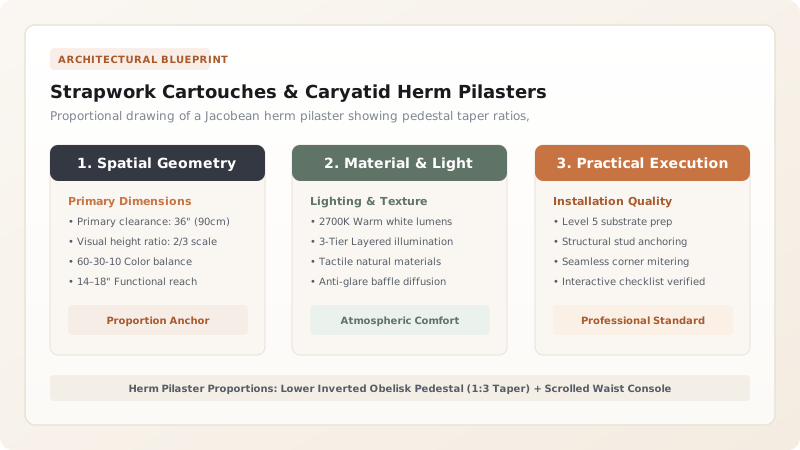
- The Inverted Taper Pedestal: The lower column shaft tapers downward at a ratio of approximately 1:3, narrowing toward a molded plinth block.
- The Scrolled Waist Console: A projecting bracket featuring double volutes and pendant fruit drops bridges the architectural pedestal to the sculpture above.
- The Caryatid Bust: A finely chiseled male (atlas) or female (caryatid) torso emerges from the pedestal, wearing classical Roman drapery and supporting the overmantel architrave.
3. Tooling Practice: Deep Undercutting for Hearth Lighting
Overmantels were historically viewed by the warm, flickering yellow light of open hearth fires and beeswax candles. To make the carving read powerfully from across the Great Hall, master carvers practiced deep undercutting.
Using fish-tail chisels and spoon-bent gouges, the carver hollows out the wood behind the strap ribbons and armorial figures, leaving them partially airborne. This creates deep black shadow cavities that contrast brilliantly against the amber, wax-polished front highlights.
Strapwork & Herm Carving Dimensional Standards
Use this reference table to calculate exact physical dimensions, ratios, and specifications before purchasing:
| Ornamental Feature | Historical Jacobean Standard | Modern Hand-Carving Criteria | Visual Function in Room |
|---|---|---|---|
| Cartouche Panel Relief | 30 to 50 mm overall relief depth | Carved from solid 50mm oak slab | Casts bold shadows under fireplace light |
| Strap Ribbon Thickness | 18 to 25 mm ribbon width | Hand-planed with smooth crown | Defines the geometric framework |
| Undercut Channel Depth | 15 to 25 mm back-cut clearance | Chiseled with spoon gouge #7 | Creates dramatic silhouette separation |
| Herm Pilaster Taper | Width narrows 25% from top to base | Accurately bandsawn before carving | Draws visual sightlines down to firebox |
| Acanthus Leaf Detailing | Puckered veins and curled lobes | Carved with #9 sweep gouge & V-parting | Enriches transition brackets and plinths |
| Finish Texture | Tool-marked (zero sandpaper fuzz) | Clean razor-chisel shear cuts | Smooth chisel facets reflect candle glints |
Wood Carving & Structural Constraints
Every successful decoration project must account for physical and environmental constraints:
Grain Direction Runout
Delicate strapwork volutes that cross diagonal grain lines will shear off under tool pressure; carvers must carve downhill relative to grain fibers.
Tool Sharpness
English white oak is dense and contains hard silica; carving gouges must be stropped on leather with green chromium oxide paste every 15 minutes.
Backing Fastener Concealment
Herm pilasters must be anchored to the main frame using blind mortises or rear pocket screws; face fasteners in decorative figures are forbidden.
Strapwork & Herm Carving Workflow
Execute this professional sequence to achieve flawless results without backtracking:
Full-Scale Charcoal Cartoon
Draft the symmetrical strapwork layout onto tracing paper at 1:1 scale, transferring lines onto the oak panel with carbon paper.
Background Routing & Grounding
Waste away the background wood to 20mm depth using a router or hand carving ground gouges, leaving strapwork in high relief.
Strapwork Profile Shaping
Round the strap ribbon edges with #3 sweep gouges, carving curled volute scrolls at ribbon terminations.
Deep Undercutting
Chisel behind the outer edges of the straps with bent spoon gouges, back-cutting at 30 degrees to create deep shadow pockets.
Herm Pilaster Sculpting
Rough out the tapered pilaster and torso on the workbench, sculpting drapery folds, facial anatomy, and acanthus waist drops.
Razor Chisel Cleanup
Clean all cuts with razor-sharp paring chisels, leaving crisp, faceted tool marks without touching sandpaper to the wood.
Common Mistakes & Countermeasures
Avoid these costly errors that compromise aesthetics, ergonomics, and budget:
Using abrasive sandpaper to smooth out hand-carved oak strapwork
Carving high-relief figures on flat-sawn oak that cups across its width
Shallow relief carving (< 10mm depth)
Project Execution Checklist
Track your physical progress. Checkboxes persist automatically on this device:
Frequently Asked Questions
What is the symbolism behind Jacobean caryatid and herm pilasters?
Herms and caryatids represented divine architecture holding up the world. On an Elizabethan hearth, they symbolized the pillars of the household—strength, fertility, hospitality, and fidelity—protecting the family lineage seated before the fire.
Were historic Tudor overmantels originally painted in bright colors?
Yes. While today we revere the dark, natural patinated oak, many 16th-century Tudor overmantels were originally enriched with vibrant polychromy—vermilion, azurite, malachite, and partial gold leaf on heraldic crests—much like contemporary Spanish artesonados.
How do you carve an armorial cartouche accurately?
Master carvers divide the shield into heraldic quadrants (quarterings), roughing out crest animals (lions rampant, eagles) in layered relief, keeping the most important family emblem at the highest elevation.


