
Ammonia fuming is a historic chemical coloration process where raw white oak is exposed to concentrated ammonia gas (NH3) inside a sealed enclosure. The gas reacts chemically with natural tannic acids deep in the wood cells, darkening the timber to an authentic chocolate-brown tone without pigment stains. The patina is completed with multiple coats of hand-buffed beeswax and carnauba paste.
At a Glance: Key Takeaways
- Tannic Acid Chemical Reaction: Ammonia gas dissolves into cell moisture to form dark, insoluble pyrogallol salts deep in wood pores.
- Zero Grain Raising: Unlike water-based stains, ammonia gas does not raise the wood grain, preserving crisp chisel-carved details.
- Penetration Depth (1 to 3mm): Color permeates deeply into the wood, ensuring that minor scratches never reveal bare white lumber beneath.
- Chatoyance Preservation: Leaves pores transparent and open, allowing medullary ray flecks to catch light with holographic brilliance.
- Carnauba & Beeswax Compound: Blended with pure gum turpentine to provide hard water-repellent protection and a velvety tactile sheen.
- Strict Respiratory Safety: Requires full-face respirator with ammonia gas cartridges and explosion-proof ventilation equipment.
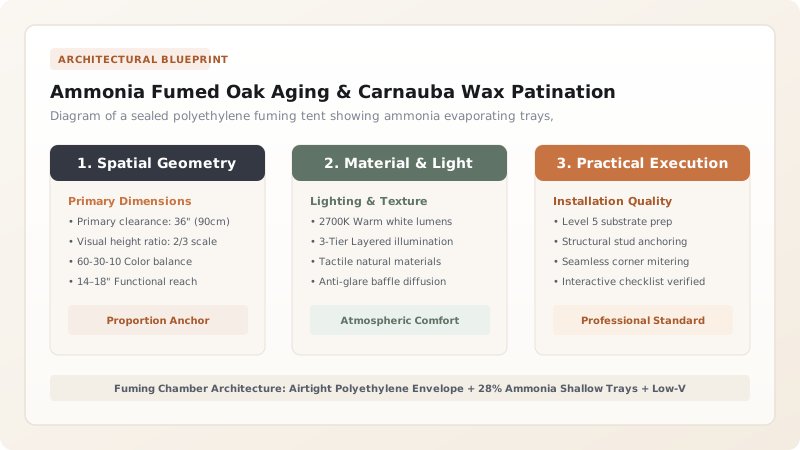
1. Chemical Foundations: Ammonia-Tannin Synthesis
Modern wood stains rely on synthetic dyes or pigment particles suspended in oil or water. These particles lodge on the wood surface, muddying the delicate grain and obscuring fine chisel marks. The historic method for aging oak—discovered in English horse stables where horse urine vapors naturally darkened oak stall boards—is ammonia fuming.
European and English oak contains high concentrations (up to \(10\%\) by weight) of natural ellagitannins and gallotannins. When exposed to anhydrous ammonia vapor inside an airtight chamber, the alkaline gas reacts with the hydroxyl groups of the tannins:
Because the color is synthesized chemically inside the wood cells rather than painted on top, it cannot chip, peel, or fade under ultraviolet daylight.
2. Workshop Chamber Setup & Safety Protocols
Ammonia fuming requires commercial 28% aqueous ammonium hydroxide (household cleaning ammonia at 3% is too weak). The process is executed inside a sealed chamber:
- An airtight enclosure is built using heavy \(6\text{-mil}\) polyethylene sheeting taped over a temporary timber framework.
- Overmantel components are stacked on wooden winding sticks with at least \(50\text{ mm}\) clearance on all sides to allow free gas circulation.
- Ammonia is poured into shallow Pyrex or polyethylene pans placed on the floor (approximately \(1\text{ liter}\) per cubic meter of chamber volume).
- A small sealed fan circulates the vapors for 18 to 48 hours, depending on the desired color depth (from honey oak to deep Jacobean ebony-brown).
3. The Traditional Wax Finish: Carnauba & Beeswax Buffing
After airing out the components for 24 hours until all ammonia odor dissipates, the timber is sealed with a traditional paste wax formulation:
- 65% Pure Bleached Beeswax: Provides elasticity, fills micro-pores, and imparts a warm honey fragrance.
- 25% Brazilian Carnauba Wax (T1): The hardest natural plant wax known; dramatically raises melting point and prevents finger smudging.
- 10% Pure Gum Spirits of Turpentine: Natural pine-resin solvent that dissolves the wax flakes and aids deep penetration.
The wax is applied with horsehair buffing brushes, allowed to haze for 20 minutes, and polished vigorously with flannel cloth to produce a warm eggshell glow.
Ammonia Fuming Durations & Color Outcomes
Use this reference table to calculate exact physical dimensions, ratios, and specifications before purchasing:
| Fuming Duration (28% NH3) | Color Depth Outcome | Tannin Reactivity Level | Recommended Historical Style |
|---|---|---|---|
| 6 to 12 Hours | Warm Golden Amber / Honey Brown | Moderate surface reaction | Early Tudor & Henry VIII domestic chambers |
| 18 to 24 Hours | Medium Antique Chestnut Brown | Full 1mm cell penetration | Elizabethan manor house Great Halls |
| 36 to 48 Hours | Deep Dark Chocolate / Espresso Brown | Deep 2.5mm dark coloration | Jacobean & Early Stuart monumental overmantels |
| Topical Tannic Acid Pre-wash | Intensifies pale low-tannin boards | Artificially boosts tannin level | Essential for matching sapwood edges to heartwood |
| Wax Buffing (3 Coats) | Silky satin eggshell luster | N/A | Traditional museum-grade conservation standard |
Safety & Chemical Constraints
Every successful decoration project must account for physical and environmental constraints:
Respiratory Hazards
28% ammonium hydroxide emits lethal concentrations of NH3 vapor; handlers must wear full-face respirators with green ammonia/methylamine cartridges (NIOSH approved) and chemical splash suits.
Sapwood Discoloration
Oak sapwood contains zero tannins and will remain stark white during fuming; sapwood edges must be pre-brushed with concentrated brewed quebracho or chestnut tea before fuming.
Explosion & Spark Safety
Electric circulating fans inside the tent must be brushless or intrinsically safe explosion-proof models to eliminate spark ignition hazards.
Ammonia Fuming & Wax Finishing Workflow
Execute this professional sequence to achieve flawless results without backtracking:
Timber Surface Final Prep
Clean carved oak parts with dry compressed air, wiping away all sawdust without water or chemical solvents.
Fuming Chamber Racking
Arrange overmantel parts inside the polyethylene fuming tent on dry wooden sticks, ensuring 50mm clearance for 360-degree gas exposure.
Ammonia Introduction & Sealing
Don full-face respirator, pour 28% ammonium hydroxide into wide shallow trays on the floor, seal tent zippers, and turn on the internal circulation fan.
Color Monitoring via Test Strips
Inspect sacrificial oak off-cut samples pulled through access ports at 12, 24, and 36 hours until target chocolate tone is reached.
Chamber Evacuation & Airing
Exhaust fumes safely through outdoors venting ductwork, allowing timber to off-gas in open air for 24 hours until completely odorless.
Carnauba-Beeswax Application & Buffing
Apply warm carnauba-beeswax paste with a shoe brush, allow 20 minutes to haze, and buff to a deep eggshell sheen with dry flannel cloths.
Common Mistakes & Countermeasures
Avoid these costly errors that compromise aesthetics, ergonomics, and budget:
Using grocery-store 3% cleaning ammonia instead of commercial 28% ammonium hydroxide
Touching bare sweaty fingers to raw oak prior to fuming
Applying modern polyurethane or lacquer over freshly fumed oak without airing out
Project Execution Checklist
Track your physical progress. Checkboxes persist automatically on this device:
Frequently Asked Questions
Can I fume an assembled overmantel that is already mounted in a house?
No. Fuming in an occupied building is extremely dangerous due to toxic ammonia fumes, which will also tarnish brass hardware and irritate lungs. Fuming must be conducted in an isolated workshop chamber before the overmantel is transported to the job site.
How do you touch up a scratch on an ammonia-fumed overmantel?
Because the color penetrates 1 to 3mm deep, minor scratches rarely show white wood. If a deep gouge cuts through the color layer, it can be touched up by dabbing concentrated tannic acid tea followed by a swab of household ammonia, and re-buffed with carnauba wax.
Does ammonia fuming weaken or damage the structural strength of oak?
No. Extensive material testing on historic furniture proves that ammonia gas exposure causes no degradation in the modulus of elasticity or compressive strength of oak timbers.


