
Quarter-sawn English oak (Quercus robur) is the definitive structural and aesthetic timber for historic overmantels. Cutting logs radially exposes the medullary rays as iridescent silvery 'ray flecks' (figure) while orienting annual growth rings nearly perpendicular to the face. This cuts seasonal wood shrinkage in half and eliminates cupping, allowing wide panels joined with internal blind splines to withstand fireplace heat cycles.
At a Glance: Key Takeaways
- Radial Medullary Rays: Cellular vascular bands running from log center to bark that shimmer under light when sliced radially.
- Minimal Tangential Movement: Radial shrinkage in English oak is only 4.0% versus 8.5% tangential shrinkage in flat-sawn lumber.
- Blind Loose-Tongue Splines: Continuous hardwood splines (10x25mm) seated in internal edge grooves, invisible on end faces.
- Animal Protein Hide Glue: Reversible, flexible collagen adhesive that moves with micro-wood expansion without brittle joint failure.
- Book-Matched Panel Layouts: Slicing adjacent planks from the same quartered flitch and opening them like a book for mirrored grain symmetry.
- Equilibrium Moisture Conditioning: Kiln-dried and conditioned to 8–10% EMC in the target room prior to final milling.
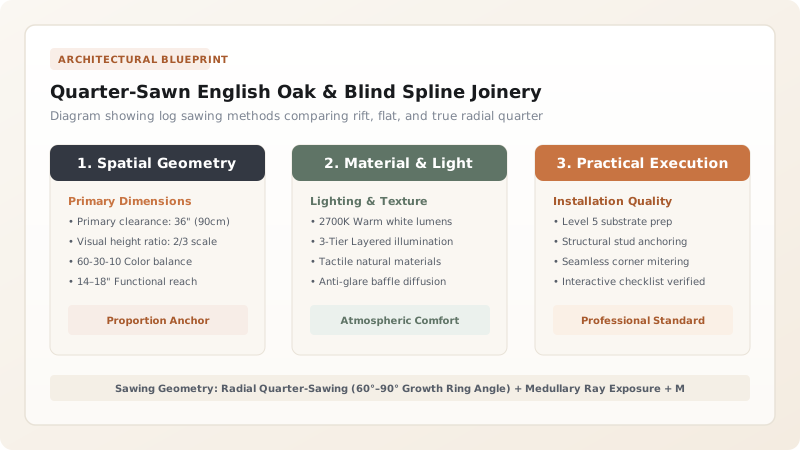
1. Timber Physics: The Dimensional Superiority of Quarter-Sawn Oak
Wood is anisotropic—it shrinks and expands by radically different amounts along its three axes. In common flat-sawn (plain-sawn) oak, growth rings run tangent to the board face, causing the wood to cup severely as moisture cycles:
Where \(C_R\) is the radial shrinkage coefficient (\(0.0016\) per \(\%\) moisture change) and \(C_T\) is tangential (\(0.0034\)). By cutting logs radially (true quarter-sawing with growth rings oriented between \(75^\circ\text{ and }90^\circ\) to the board face), the board moves strictly along its thickness, maintaining an optically flat plane across centuries of winter fires.
2. Visual Splendor: The Optics of Medullary Ray Flecks
In English white oak, medullary rays are dense ribbons of parenchymal cells that transport sap horizontally from the pith to the cambium. When sliced directly along their radial plane, these ribbons appear on the surface as undulating, silvery patches known as ray flecks, figure, or tiger oak.
These ray flecks have higher cellular density than the surrounding springwood pores. Under natural fireplace light or oil finishes, the rays refract light at different angles than the background wood, creating a three-dimensional holographic shimmer prized by Tudor joiners.
3. Joinery Craft: Blind Splines & Draw-Bored Frame Joints
Wide overmantel cartouches and panels often exceed the width of a single oak tree. Joiners edge-glue multiple quarter-sawn boards using blind loose-tongue splines (or modern compressed hardwood biscuits):
- Grooves are routed into matching board edges \(10\text{ mm}\) wide by \(12\text{ mm}\) deep, stopping \(25\text{ mm}\) short of the exposed ends.
- A solid quarter-sawn oak spline with grain running perpendicular to the seam is inserted, providing shear alignment and doubling joint surface area.
- Assembled with warm animal hide glue, the seam forms a permanent, invisible bond that will never separate under chimney heat.
Oak Sawing Methods & Performance Comparison
Use this reference table to calculate exact physical dimensions, ratios, and specifications before purchasing:
| Sawing Method | Growth Ring Angle | Ray Fleck Exposure | Dimensional Movement | Suitability for Overmantels |
|---|---|---|---|---|
| True Quarter-Sawn | 75° to 90° (strictly perpendicular) | Abundant shimmering silvery flecks | Lowest possible (4.0% radial) | Supreme; standard for all historic overmantels |
| Rift-Sawn | 45° to 75° (uniform linear grain) | Minimal / zero ray fleck figure | Very low (4.8% intermediate) | Excellent for structural stiles and pilaster cores |
| Plain-Sawn (Flat-Sawn) | 0° to 45° (tangential cathedral grain) | Zero ray flecks (rays hidden in wood) | High (8.5% tangential; cups violently) | Prohibited; causes severe warping over hearths |
| Book-Matched Flitch | Matched radial mirror faces | Symmetrical mirrored ray flecks | Balanced bilateral movement | Ideal for large central cartouche panels |
Lumber Selection & Milling Constraints
Every successful decoration project must account for physical and environmental constraints:
Yield & Cost
Quarter-sawing produces up to 30% more wood waste during log breakdown than flat-sawing, resulting in a 40%–60% price premium for clear quartered stock.
Spline Grain Orientation
If a loose tongue spline is cut with grain running parallel to the joint, it will split down its center under shear load; spline grain must run across the seam.
Acclimatization
Oak stock must reside inside the customer's heated residence for a minimum of 4 weeks to stabilize moisture content before final jointing and assembly.
Quarter-Sawn Panel Edge-Gluing Sequence
Execute this professional sequence to achieve flawless results without backtracking:
Flitch Selection & Grain Matching
Select consecutive quarter-sawn flitches, pairing boards for harmonious medullary ray fleck patterns and mirror symmetry.
Precision Edge Jointing
Flatten and square board edges using a #7 jointer hand plane until adjacent faces close with zero daylight under back-lighting.
Blind Spline Grooving
Route matching 10mm-wide grooves into board edges, stopping 25mm before panel ends to conceal the spline.
Cross-Grain Spline Milling
Mill quartered oak splines with grain running perpendicular to length, sizing them 1mm narrower than total groove depth to prevent bottoming out.
Hide Glue Application & Clamping
Brush hot liquid hide glue (60°C) along edges and splines, clamping with heavy bar clamps spaced every 300mm with cauls to ensure dead-flat alignment.
Scraping & Thickness Truing
After 24 hours of curing, scrape squeeze-out with cabinet scrapers and hand-plane the panel surface to final thickness.
Common Mistakes & Countermeasures
Avoid these costly errors that compromise aesthetics, ergonomics, and budget:
Using flat-sawn oak for overmantel panels directly above an active fireplace
Cutting loose-tongue splines with grain running length-wise along the seam
Using modern brittle PVA yellow glue in high-temperature fireplace zones
Project Execution Checklist
Track your physical progress. Checkboxes persist automatically on this device:
Frequently Asked Questions
What is the difference between English oak and American white oak?
English oak (Quercus robur) typically features darker heartwood, wilder grain swirls, and higher tannic acid content than American white oak (Quercus alba). English oak fumes to a richer, deeper chocolate brown under ammonia, while American oak fumes to a cooler grayish-brown tone.
Why do medullary rays look lighter than the surrounding wood?
The cells in medullary rays are packed densely and reflect light like polished mother-of-pearl. When raw wood is finished with oil or wax, the surrounding porous springwood absorbs more liquid and darkens, while the dense rays stay bright, creating intense silver-and-gold contrast.
How wide can a solid quarter-sawn oak panel be made without splitting?
Using quarter-sawn lumber edge-glued with blind splines, panels up to 900mm (3 feet) wide can remain stable over centuries, provided the panel is installed free-floating inside frame grooves with proper perimeter clearance.


