
An English Tudor carved oak overmantel is a monumental decorative paneling assembly erected above a fireplace breast, characteristic of 16th- and 17th-century Elizabethan and Jacobean manor architecture. Built from quarter-sawn English oak (Quercus robur), it features architectural bays framed by carved caryatid or herm pilasters, high-relief strapwork cartouches, heraldic crests, and enriched dentil cornices, traditionally finished with ammonia fuming and bees-carnauba wax.
At a Glance: Key Takeaways
- Quarter-Sawn English Oak: Cut radially to display prominent silver medullary ray flecks and ensure zero cupping across floating panels.
- Strapwork Cartouche Carving: Intricate Northern Renaissance interlacing leather-strap scrollwork framing heraldic coats of arms.
- Caryatid & Herm Pilasters: Tapered anthropomorphic vertical pilasters with female or male busts emerging from scrolled architectural pedestals.
- Traditional Frame-and-Panel Joinery: Mortise-and-tenon stiles and rails secured with cleft oak draw-bore pegs (trenails), allowing floating panel movement.
- Ammonia Fumed Aging: Exposing oak to concentrated ammonia vapors to react with natural wood tannins, producing a deep, non-fading charcoal-brown patina.
In-Depth Guides in this Directory
Explore specialized subtopic blueprints, technical dimensions, and execution checklists:
Strapwork Cartouches & Caryatid Herm Pilasters
Master Jacobean carving techniques: Northern Renaissance strapwork cartouches, undercut relief channels, and tapered caryatid herm pilaster carving.
Quarter-Sawn English Oak & Blind Spline Joinery
Master timber selection for Tudor chimneypieces: quarter-sawn Quercus robur, medullary ray fleck refraction, blind internal splines, and thermal stability.
Ammonia Fumed Oak Aging & Carnauba Wax Patination
Master historic oak finishing: 28% ammonium hydroxide gas fuming chamber, tannic acid chemical patination, and hand-rubbed carnauba-beeswax seals.
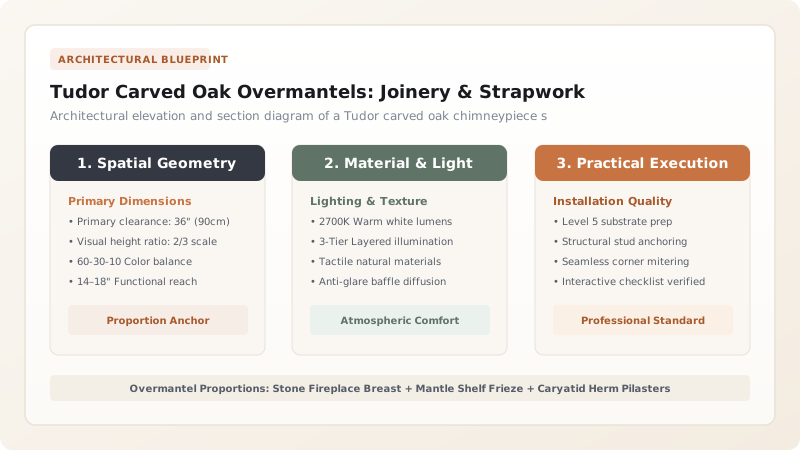
1. Architectural Anatomy: The Classical Jacobean Orders Above the Hearth
In the Great Halls of Elizabethan and Jacobean England (1558–1625), the fireplace was the ceremonial heart of domestic life. Above the stone fireplace surround, master carvers erected the Oak Overmantel as a miniature classical facade.
The assembly follows rigorous classical Renaissance proportions adapted through Flemish pattern books (such as those by Hans Vredeman de Vries):
- The Plinth & Mantle Shelf: A heavy, molded shelf resting on carved corbels, forming the horizontal base line for the upper composition.
- The Intercolumniation (Bays): Divided vertically into two or three rectangular bays by herm pilasters or fluted Ionic columns.
- The Central Cartouche: The focal center panel displays high-relief strapwork curling like rolled parchment, often centered around an armorial escutcheon or biblical scene.
- The Entablature & Cornice: Topped with a deep frieze enriched with guilloche or gadrooning, crowned by a projecting dentil cornice.

2. Iconography: Strapwork Cartouches & Caryatid Herm Pilasters
The defining visual motifs of the Jacobean overmantel are strapwork and herms:
Strapwork consists of flat, band-like ribbons perforated with circular studs and curled at the ends like cut sheet metal or stiff leather. Artisans carve strapwork with deeply undercut background channels, creating bold light-and-shadow play under flickering firelight.
Herms and Caryatids flank the central panels: tapered downward-sloping square pedestals carved with acanthus leaves that blossom into expressive sculptural human torsos. Master carving techniques in our dedicated guide on strapwork cartouche carving and caryatid herm pilasters.
3. Material & Joinery: Quarter-Sawn Ray Flecks & Floating Panels
Installing solid wood directly above a roaring open hearth exposes timber to extreme heat cycles and humidity swings (from 20% to 80% RH). Using flat-sawn oak would cause catastrophic warping and panel splitting within weeks.
Authentic overmantels utilize exclusively Quarter-Sawn English Oak (Quercus robur). Slicing logs perpendicular to growth rings exposes dramatic silvery ribbons termed medullary ray flecks and reduces wood movement by over \(50\%\). Panels are mounted in deep grooves with dry rebates—never glued—allowing them to expand and contract freely. Explore wood physics and spline joinery in quarter-sawn oak ray flecks and spline joinery.
4. Authentic Finishing: Ammonia Fuming & Carnauba-Beeswax Patina
Tudor oak was never stained with modern petroleum pigment stains, which cloud the grain and highlight scratch marks. Instead, historical artisans achieved deep, chocolate-brown tones through ammonia fuming.
The natural tannic acid inside English oak reacts with ammonia gas to create an insoluble, organic dark compound deep inside the wood cells. Finished with hand-rubbed beeswax and Brazilian carnauba paste, fumed oak exhibits an iridescent, satiny glow that improves over centuries. Master fuming workflows in ammonia fumed oak aging and carnauba wax patination.
Tudor Overmantel Architectural & Joinery Specifications
Use this reference table to calculate exact physical dimensions, ratios, and specifications before purchasing:
| Joinery Component | Traditional Tudor Standard | Modern Custom Replica Standard | Engineering Tolerance |
|---|---|---|---|
| Primary Wood Species | English Oak (Quercus robur) green/air-dried | European or White Oak (kiln-dried 8–10% EMC) | Quarter-sawn grain angle > 75° across faces |
| Stile & Rail Framing | 50mm thick with haunched mortise-and-tenon | 45–50mm thick with draw-bored oak dowels | Draw-bore hole offset 2.5mm for mechanical pull |
| Floating Field Panels | 22mm solid book-matched quartered boards | 20mm solid oak with tapered feather edges | Minimum 6mm perimeter expansion clearance in grooves |
| Carving Depth (Relief) | 25 to 50 mm deeply undercut relief | Hand-chiseled on 3D CNC rough-carved blanks | Zero machine tool marks visible on final face |
| Coloring Method | Traditional ammonia gas fuming (24–48 hrs) | 28% ammonium hydroxide fuming chamber | Natural tannin depth; zero pigment surface film |
| Topcoat & Sheen | Beeswax dissolved in gum turpentine | Hand-rubbed beeswax-carnauba paste (3 coats) | Silky matte-to-satin sheen; water-resistant |
Fireplace Clearance & Thermal Constraints
Every successful decoration project must account for physical and environmental constraints:
Combustible Clearance Codes
Modern building codes (NFPA 211 / IRC R1001.11) require combustible wood mantels projecting 38mm to be at least 150mm away from the firebox opening, increasing by 25mm distance per 25mm of extra projection.
Thermal Deflection Shield
A continuous non-combustible refractory backing board (cement board / calcium silicate) must isolate the rear of the timber overmantel from chimney masonry heat.
Panel Expansion Space
Never shoot nails or apply glue to the center carved panels; gluing floating panels causes split fractures when the fireplace is fired.
Tudor Oak Overmantel Construction Sequence
Execute this professional sequence to achieve flawless results without backtracking:
Chimney Breast Survey & Grounding
Check masonry chimney breast for plumb, installing a 12mm calcium silicate thermal insulation barrier and leveling timber furring grounds.
Quarter-Sawn Lumber Selection
Select and dimension clear quarter-sawn English oak planks, checking for distinct medullary ray fleck patterns and 8-10% equilibrium moisture.
Mortise-and-Tenon Framework
Cut haunched mortise-and-tenons on stiles and rails, boring offset holes for cleft oak draw-bore pins (trenails).
Relief Carving & Strapwork
Chisel strapwork cartouches, heraldic escutcheons, and caryatid herm pilasters using carving gouges, undercutting backgrounds for deep shadows.
Frame Assembly & Draw-Boring
Insert floating carved panels into rebated grooves, assemble the frame, and drive tapered square oak pegs through offset draw-bore holes to pull joints tight.
Ammonia Fuming & Wax Buffing
Expose the raw oak structure to ammonia fumes in a sealed tent for 36 hours until rich chocolate brown, followed by three coats of burnished beeswax.
Common Mistakes & Countermeasures
Avoid these costly errors that compromise aesthetics, ergonomics, and budget:
Gluing or face-nailing the carved center field panels into the frame grooves
Applying modern stain with polyurethane clear coat over fine oak carving
Failing to insulate the back of the overmantel from the hot chimney flue
Project Execution Checklist
Track your physical progress. Checkboxes persist automatically on this device:
Frequently Asked Questions
What is the difference between a Tudor and a Jacobean overmantel?
Tudor overmantels (early 16th century) featured Gothic-influenced linenfold panels, Tudor roses, and four-centered arch moldings. Jacobean overmantels (early 17th century under King James I) adopted Northern European Renaissance mannerism: complex scrolling strapwork, caryatid herms, obelisks, and heavy classical cornices.
Why does ammonia fuming work on oak but not on pine or maple?
Oak (especially European white oak) is rich in natural pyrogallol-type tannic acids. Ammonia vapor (NH3) reacts chemically with these tannins to form stable dark salts deep within the wood fiber. Pine and maple contain negligible tannins, so ammonia fuming produces no color change on them.
Can an original antique Tudor overmantel be fitted onto a modern gas or ethanol fireplace?
Yes, provided the fireplace opening is fitted with certified non-combustible stone or metal hearth slips that satisfy clearance codes, and heat output is deflected forward into the room rather than up the masonry breast.


