
A Churrigueresque portal is a monumental Spanish and Novohispanic (Mexican) Baroque stone entrance facade characterized by exuberant, restless architectural ornamentation that translates interior retablo (altarpiece) carving into exterior stone. Pioneered by José Benito de Churriguera, its signature features include inverted pyramidal pilasters (estípites), deeply undercut foliage garlands, broken scroll pediments, and theatrical statuary niches.
At a Glance: Key Takeaways
- Estípite Pilaster Architecture: Signature pilasters shaped like an inverted, truncated four-sided pyramid resting on secondary pedestals.
- Cantera Volcanic Freestone: Mined in central Mexico and Spain; soft when quarried for intricate undercut chiseling, hardening upon atmospheric exposure.
- Broken Segmental & Open Pediments: Split classical pediments curling into dynamic scroll volutes to cradle theatrical statuary niches.
- Lush High-Relief Garlands: Deeply undercut cornucopias, acanthus foliage, pomegranates, and cherubs carved with dramatic raking shadows.
- Multi-Tiered Retablo Facade: Portal designed as a stone altarpiece organized into architectural registers (cuerpos) and vertical axes (calles).
In-Depth Guides in this Directory
Explore specialized subtopic blueprints, technical dimensions, and execution checklists:
Estípite Inverted Pyramidal Pilasters & Stone Undercutting
Master Churrigueresque stereotomy: inverted pyramidal estípite pilaster geometry, 4-tier anatomical stacking, and 100mm cantera stone undercutting.
Cantera Stone Foliage Garlands & Cornucopia Reliefs
Crafting Churrigueresque ornamentation: deeply undercut cantera stone fruit garlands, cascading cornucopias, acanthus scrolls, and cherub mascarons.
Broken Pediments, Statuary Niches & Volute Buttresses
Master Churrigueresque architectural crowns: broken segmental pediments, theatrical statuary niche framing, and structural S-scroll volute buttresses.
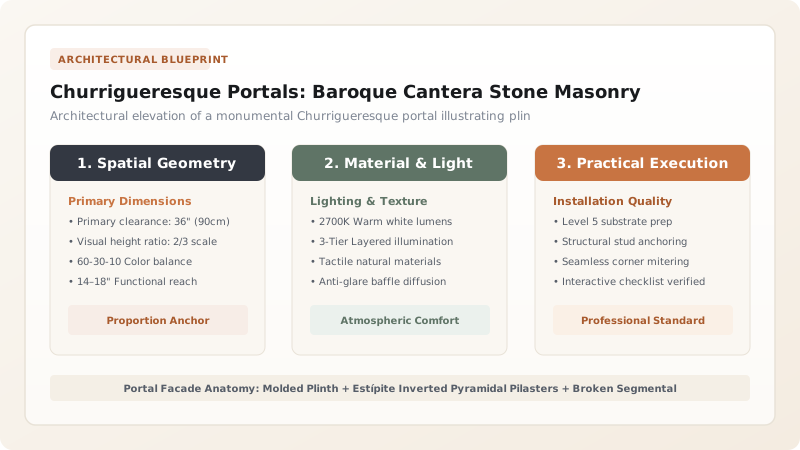
1. Architectural Philosophy: The Retablo-Facade & Ultra-Baroque Dynamism
Developed in Spain during the late 17th century by the Churriguera family and carried to theatrical heights in New Spain (Mexico) by architects Lorenzo Rodríguez and Jerónimo de Balbás, Churrigueresque architecture completely discarded classical Renaissance restraint.
The movement transformed the church portal from a passive entrance into an exuberant retablo-fachada (altarpiece-facade). Solid planar walls were broken into pulsating layers of projecting moldings, undulating entablatures, and deep shadow cavities. The composition is organized along vertical calles (streets/lanes) and horizontal cuerpos (tiers), framing the doorway with an overwhelming sensory display of theological drama.

2. The Estípite: Anatomy of the Inverted Pyramidal Pilaster
The single most defining invention of the Churrigueresque style is the estípite. Unlike a classical column—which tapers gently upward (entasis) to suggest physical support—an estípite is an inverted, truncated pyramid that tapers downward toward the ground.
The estípite destabilizes classical visual gravity, creating an illusion that the monumental stone structure floats in divine suspension. Each estípite consists of four vertically stacked anatomical segments:
- The Dado / Plinth: A cubic pedestal carved with strapwork or mascarons.
- The Estípite Body: The inverted pyramid with its narrowest point resting upon the pedestal.
- The Cubo / Interlocking Block: A projecting cubic capital enriched with cherub heads or fruit swags.
- The Corinthian / Composite Capital: An exuberant crowning capital supporting a broken entablature.
Explore full stereotomy in our deep dive on estípite inverted pyramidal pilaster geometry and undercutting.
3. Materiality: Cantera Stone & Undercut Foliage Garlands
Achieving the extreme three-dimensional depth of Churrigueresque carving requires specialized stone. In New Spain, master masons utilized Cantera (volcanic tuff):
- Quarry Softness & Atmospheric Curing: When fresh from the quarry, cantera contains quarry sap, allowing sculptors to chisel paper-thin undercut foliage, fruit garlands, and lace-like drapery with fine gouges. Upon drying, silica crystallization petrifies the stone into durable ashlar.
- Chromatic Resonance: Available in rich natural tones—rose cantera (cantera rosa), gold, and silver-gray—the stone casts dramatic chiaroscuro contrasts under brilliant equatorial sunlight. Master garland carving in cantera foliage garlands and cornucopia reliefs.
4. Structural Dramatic Closures: Broken Pediments & Volute Buttresses
The portal terminates in towering, broken segmental pediments that fracture open to cradle monumental statuary niches. S-shaped volute buttresses flank the upper tiers, functioning both as dynamic Baroque scrolls and as active compressive props that transmit seismic lateral loads back into the primary church walls. Explore pediment and volute mechanics in broken pediment niche sculptures and volute buttresses.
Churrigueresque Stone Portal Engineering & Stereotomy Parameters
Use this reference table to calculate exact physical dimensions, ratios, and specifications before purchasing:
| Architectural Element | Historic Spanish / Novohispanic Standard | Modern Restoration / Conservation Standard | Stereotomy Criteria |
|---|---|---|---|
| Primary Stone Type | Cantera volcanic tuff (Mexico) / Salamanca sandstone (Spain) | High-density fine-grained volcanic ashlar / sandstone | Compressive strength > 25 MPa; water absorption < 6% |
| Estípite Taper Ratio | Width narrows 30% to 40% from top to waist | Hand-carved from monolithic solid stone blocks | True geometric inverted pyramid with 4 faceted relief faces |
| Relief Carving Depth | 75 to 150 mm deeply undercut relief | 3D CNC roughing + artisan master gouge finishing | Sufficient undercut to produce high-contrast raking shadows |
| Pediment Configuration | Broken segmental with scrolling volute ears | Reinforced with concealed 316 stainless steel pins | Open center throat creates seating shelf for saint niche |
| Joint Mortar Bedding | Hot-slaked non-hydraulic lime putty + volcanic pozzolan | Natural Hydraulic Lime (NHL 2.0 or 3.5) with local stone dust | Joint width 3 to 5mm; 100% breathable and salt-tolerant |
| Seismic Tie Anchoring | Hand-forged wrought iron cramps set in lead | Grade 316 stainless steel cramps with lime grout | Resists lateral shear displacement under seismic shaking |
Material & Environmental Constraints
Every successful decoration project must account for physical and environmental constraints:
Cantera Quarry Freshness
Stone must be carved while moist with quarry sap; allowing blocks to dry completely before sculpting increases chiseling effort four-fold and risks brittle fractures.
Salt & Freeze-Thaw Attack
Volcanic tuff is porous. In cold climates with winter freezing, unsealed cantera stone absorbs water and spalls aggressively; breathable silane-siloxane sealers are mandatory.
Seismic Shear Anchoring
Monumental projecting Churrigueresque cornices cantilever far out from facades; they must be tied deep into structural brick/stone walls with heavy stainless steel anchor cramps.
Churrigueresque Stone Portal Erection Sequence
Execute this professional sequence to achieve flawless results without backtracking:
Substrate & Footing Preparation
Lay heavy basalt or hard limestone foundation plinths leveled to 0.5mm across the portal threshold.
Cantera Block Extraction & Roughing
Quarry volcanic cantera blocks and rough-saw to outer bounding dimensions using diamond gang saws while wet.
Estípite & Foliage Carving
Chisel inverted pyramidal estípites, drapery, and fruit garlands on the banker bench using gouges, undercutting backgrounds to 100mm depth.
Course-by-Course Hoisting & Cramping
Lift carved ashlar blocks using shear legs and Lewis pins, bedding courses in NHL 2 lime mortar and pinning joints with stainless steel cramps.
Broken Pediment & Niche Keying
Erect the upper tier broken segmental pediments and lock central statue niche canopies with monolithic keystone voussoirs.
Volute Buttress Anchoring & Pointing
Install flanking S-scroll volutes to tie upper tiers to the facade, pointing all joints with matching color-graded stone dust lime mortar.
Common Mistakes & Countermeasures
Avoid these costly errors that compromise aesthetics, ergonomics, and budget:
Pointing historic cantera stone joints with modern Portland cement mortar
Failing to tie projecting broken pediments back into the primary church facade wall
Shallow, flat relief carving (< 25mm depth) that lacks true Baroque undercutting
Project Execution Checklist
Track your physical progress. Checkboxes persist automatically on this device:
Frequently Asked Questions
Who was José Benito de Churriguera?
José Benito de Churriguera (1665–1725) was a Spanish master architect and sculptor from Madrid. Renowned for his monumental wooden altarpieces, his style was so influential and revolutionary that his surname gave birth to the term 'Churrigueresque' to describe the ultra-baroque Spanish movement.
What is the difference between European and Mexican Churrigueresque?
While Spanish Churrigueresque remained heavily focused on gilded wooden church retablos, Mexican Churrigueresque (Ultra-Baroque) exploded onto exterior stone facades. Masterpieces like the Mexico City Metropolitan Tabernacle and Santa Prisca in Taxco pushed stone carving to unprecedented density and 3D projection.
How is cantera stone protected from urban pollution and acid rain?
Restoration teams treat clean, desalted cantera stone with ethyl silicate stone consolidants to strengthen crumbling mineral grains, followed by vapor-permeable fluoropolymer or silane water repellents that shed acidic rainwater without trapping internal moisture.


