
Foliage garlands, cascading cornucopias (horns of plenty), and acanthus scrolls represent the botanical ornamentation of Churrigueresque portals. Carved from volcanic cantera stone, these high-relief festoons combine classical European acanthus motifs with indigenous Mexican flora (pomegranates, maize, and cacao pods), chiseled in high relief with deep undercutting that casts dramatic chiaroscuro shadows.
At a Glance: Key Takeaways
- Syncretic Botanical Iconography: European acanthus scrolls interwoven with New World botanical symbols of abundance (cacao, sunflowers, maize).
- High-Relief Cornucopia Spouts: Horns of plenty spilling cascades of stone fruit that drape over portal jambs and window hoods.
- Cantera Rosa Carving Workability: Fine-grained volcanic tuff with easy chisel workability when moist, hardening naturally upon air drying.
- Hand-Auger Undercutting: Drilled starter holes behind delicate fruit clusters to permit spoon gouges to carve free-floating stone ribbons.
- Chiaroscuro Under Sunlight: Designed specifically for high-contrast equatorial sun, turning background stone into velvety shadow.
- Non-Destructive Salt Remediation: Cleaned with sepiolite or cellulose poultices to draw out sub-surface capillary salts without abrasion.
1. Iconography: The Fusion of European & Indigenous Flora
While Spanish Baroque treatises prescribed classical acanthus spinosus and laurel wreaths, Novohispanic Churrigueresque portals developed a unique syncretic botanical vocabulary.
Indigenous stone carvers (tlacuilos) working under Franciscan and Jesuit friars infused traditional Catholic retablo portals with symbols of American abundance:
- Cornucopias (Horns of Plenty): Spiraling horns carved on portal spandrels that spill realistic bunches of grapes, pomegranates, and blooming passionflowers.
- New World Harvest: Intricately rendered ears of maize, cacao pods, squash blossoms, and sunflowers interwoven into classical European festoons.
- Cherub Mascarons: Angelic infant faces emerging directly from acanthus calyxes, their cheeks rounded and hair carved in cascading ringlets.
2. Sculptural Technique: From Quarry Sap to Deep Undercutting
The technical triumph of Churrigueresque fruit garlands is that individual grapes, leaves, and ribbon ties appear fully detached from the stone wall.
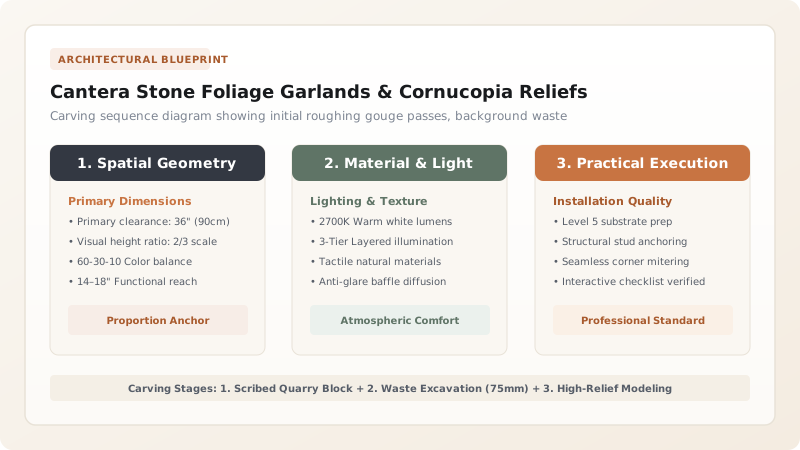
This is accomplished using a multi-step reduction sequence on the stone mason's bench (el banco):
- The Roughing Pass: The outline of the garland is transferred onto the wet cantera block. Large waste sections are hogged out using tooth chisels and point chisels.
- The Relief Pass: The fruit masses and acanthus leaves are shaped using #5 to #8 sweep wood-carver gouges.
- The Undercut Pass: Artisans drill pilot holes beneath the fruit with hand augers, inserting narrow spoon-bent gouges to clear away the stone behind. The garland is left connected only by hidden structural stone bridges, creating airborne loops.
3. Conservation: Protecting Fragile Cantera Carving
Because undercut leaves are often only \(10\text{ to }15\text{ mm}\) thick, they are highly vulnerable to stone decay. Atmospheric sulfur dioxide reacts with moisture to form gypsum crusts that blister the delicate volcanic matrix.
Conservators treat weathered cantera reliefs with ethyl silicate consolidants (tetraethyl orthosilicate / TEOS). The liquid penetrates deep into microscopic pore fissures and reacts with humidity to deposit pure amorphous silica (\(\text{SiO}_2\)), reinforcing crumbling stone crystals without altering breathability or natural color.
Cantera Relief Carving Tooling & Depth Standards
Use this reference table to calculate exact physical dimensions, ratios, and specifications before purchasing:
| Carving Process Stage | Tooling Specification | Relief Projection Standard | Visual / Structural Purpose |
|---|---|---|---|
| Massing & Hogging | Heavy point chisel & stone club | Waste removed down to 100mm | Establishes primary 3D compositional planes |
| Foliage Modeling | Tooth chisel & #7 sweep gouges | Leaves modeled with 20mm undulations | Creates organic, undulating leaf surfaces |
| Deep Undercutting | Hand drill / spoon-bent gouge | Back-cut 50 to 90mm behind fruit | Suspends fruit in mid-air; dramatic shadow |
| Surface Texturing | Rifflers & fine rasp files | Serrated veins & fruit skin textures | Softens light reflection; eliminates harsh tool ridges |
| Consolidation Treatment | Ethyl silicate (TEOS) brush soak | Penetrates 15 to 25mm into stone | Strengthens weathered tuff against frost spalling |
Carving & Durability Constraints
Every successful decoration project must account for physical and environmental constraints:
Fragility of Airborne Loops
Undercut fruit garlands must never be used as rigging attachment points during hoisting; lifting straps will instantly snap delicate stone festoons.
Bird Nesting Prevention
Deep undercuts attract nesting pigeons whose acidic droppings dissolve cantera stone; stainless steel wire deterrent mesh must be discreetly fitted.
Acid Cleaning Prohibition
Muriatic (hydrochloric) acid must never be used to clean cantera stone; acid reacts with volcanic iron oxides, permanently staining stone orange.
Foliage Garland Carving & Mounting Sequence
Execute this professional sequence to achieve flawless results without backtracking:
Clay Maquette Modeling
Sculpt a 1:1 scale clay model of the garland to verify fruit grouping, undercutting depths, and shadow behavior under raking light.
Cantera Block Scribing
Transfer profile points from the clay model to the freshly quarried cantera block using calipers and pointing machines.
Waste Trench Excavation
Hog out background areas to 100mm depth with pneumatic carving chisels, leaving raised stone cylinders for the garlands.
Undercutting Behind Festoons
Bore pilot holes behind fruit clusters and carve away stone with spoon gouges until light passes freely behind the festoon.
Detail Tooling & Veining
Incise fine veins onto acanthus leaves, carve seeds into pomegranate cores, and tool delicate drapery folds with riffler files.
Consolidation & Hydrophobic Seal
Apply two saturate coats of ethyl silicate consolidant followed by a breathable oligomeric siloxane water repellent.
Common Mistakes & Countermeasures
Avoid these costly errors that compromise aesthetics, ergonomics, and budget:
Pressure-washing historic cantera stone carvings with high pressure (> 50 bar)
Leaving undercut stone ribbons without sufficient structural support bridges
Applying polyurethane or silicone coatings to make stone 'waterproof'
Project Execution Checklist
Track your physical progress. Checkboxes persist automatically on this device:
Frequently Asked Questions
What gives Mexican cantera stone its distinctive pink color?
Cantera rosa gets its soft pink hue from finely dispersed trace iron oxides and volcanic feldspar minerals deposited during catastrophic volcanic eruptions millions of years ago in central Mexico.
How did colonial sculptors achieve such intricate carving in outdoor stone?
Volcanic cantera tuff contains high moisture content (quarry sap) when freshly cut, giving it a soft consistency similar to dense chalk. This allowed carvers to work with fine woodworking gouges before the stone cured into hard rock upon atmospheric exposure.
What is the iconographic meaning of the pomegranate on Baroque portals?
In Christian iconography, the pomegranate symbolizes the resurrection of Christ, eternal life, and the unity of the Church (many seeds held within a single rind), making it a dominant motif on Latin American Catholic cathedral facades.


