
Ashlar stone quoining is the classical architectural practice of reinforcing building corners with finely dressed, square-cut stone blocks laid in alternating long-and-short bond arrangements. Combined with historic masonry pointing using breathable Natural Hydraulic Lime (NHL 2 or NHL 3.5) mortars and historical joint tooling profiles (such as tuck pointing, weathered struck, or bird's beak), quoining stabilizes structural corners against lateral shear while allowing stone facades to breathe without trapping destructive moisture.
At a Glance: Key Takeaways
- Structural Corner Bonding: Alternating 'long-and-short' ashlar blocks (e.g., 600mm and 300mm face lengths) physically interlocking outer facade with inner masonry core.
- Breathable Hydraulic Lime: Formulated with Natural Hydraulic Lime (NHL 2 or NHL 3.5) and sharp graded aggregate, ensuring mortar is softer than adjacent stone.
- Historical Pointing Profiles: Tuck pointing, flush ribbon joints, and weather-struck profiles shedding water while highlighting masonry geometry.
- Vapor-Permeable Dynamics: High vapor permeability (\(\mu \le 15\)) preventing freeze-thaw spalling and sub-surface moisture traps caused by hard portland cement.
- Hand-Dressed Margin Drafts: Fine chiseling featuring 20-30mm smooth perimeter margins enclosing rustic, broached, or rock-faced centers.
In-Depth Guides in this Directory
Explore specialized subtopic blueprints, technical dimensions, and execution checklists:
Ashlar Quoin Dimensions: Bond Overlap & Chiseled Margins
Technical guide to sizing, cutting, and detailing ashlar stone quoin blocks: long-and-short bond ratios, corner shear resistance, chisel margin drafting, and rustication.
NHL Lime Mortar: Mix Ratios & Aggregate Matching
Technical guide to historic mortar formulation: Natural Hydraulic Lime (NHL 2, 3.5, 5), sand sieve grading, petrographic aggregate matching, and carbonation chemistry.
Tuck Pointing & Ribbon Joints: Profiles & Weather Tooling
Craftsmanship guide to historic tuck pointing, ribbon joints, weather-struck bevels, stopping mortar formulation, and lime putty ribbon placement.
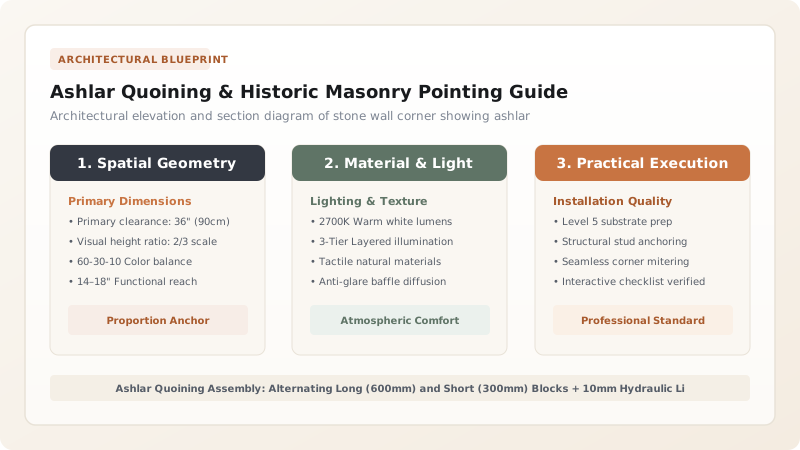
1. Architectural Quoining: Classical Geometry & Long-and-Short Bonds
Dating back to classical Roman aqueducts and perfected in Renaissance and Georgian palazzi, Quoins (from the French coin, meaning corner or wedge) provide both structural reinforcement and optical framing for masonry buildings.
The corner of a masonry structure is subject to bidirectional lateral shear forces, localized seismic torsion, and differential settlement. Ashlar quoins resolve these forces through Alternating Bond Geometry:
- Long-and-Short Work: The canonical classical proportion pairs a long block (typically 600mm to 900mm in face length) with a short block (typically 300mm to 450mm). On the adjacent corner face, the order reverses, creating an interlocking \(2:1\) tooth overlap that ties the two orthogonal wall planes into a monolithic corner column. Detailed block dimensions are covered in ashlar quoin block dimensions and bond overlap.
- Rusticated & Drafted Margins: The stone face often features a smooth, chisel-drafted margin (20-30mm wide) around the perimeter, framing a pitched, vermiculated, or broached central field. This creates crisp shadowlines that visually anchor the building's vertical edges.
- Differential Stone Compatibility: Quoin stones are quarried from dense limestones (e.g., Portland Stone, Indiana Limestone, Bath Stone) or fine-grained sandstones. The compressive strength of the quoin stone must exceed that of the infill fieldstone or brickwork by at least 25%.

2. Historic Mortar Science: Natural Hydraulic Lime (NHL) vs. Portland Cement
The single greatest cause of catastrophic stone decay in historic structures is the improper application of modern Ordinary Portland Cement (OPC):
The golden rule of conservation masonry mandates that Mortar Must Always Be Sacrificial (weaker and more vapor-permeable than the stone):
- The Portland Cement Trap: Portland cement cures into an impermeable, rigid rock (compressive strength \(> 35\text{ MPa}\)). When water enters the wall, it cannot escape through the cement joints. Trapped behind the joint, rising damp and freeze-thaw cycles exert immense pressure, blowing off the face of the historic stone (face-spalling).
- Natural Hydraulic Lime (NHL): Sourced from calcined siliceous/argillaceous limestone, NHL mortars set through an initial hydraulic reaction followed by slow atmospheric carbonation:
$$\text{Ca(OH)}_2 + \text{CO}_2 \longrightarrow \text{CaCO}_3 + \text{H}_2\text{O}$$NHL 2 (feebly hydraulic) and NHL 3.5 (moderately hydraulic) yield compressive strengths between 2.0 and 5.0 MPa, offering micro-flexibility, autogenous self-healing of hairline cracks, and exceptional water vapor transmission (\(\mu \approx 10-15\)). In-depth mix ratios are analyzed in lime mortar ratios and aggregate matching.
3. Historic Pointing Profiles: Tuck Pointing & Weather-Struck Tooling
Joint tooling dictates the visual character and weather-shedding longevity of stone facades:
- Tuck Pointing: Invented in 18th-century England, tuck pointing is an optical illusion technique where wide, irregular stone joints are filled with a 'stopping mortar' colored to match the surrounding stone. A narrow 3mm to 6mm groove is cut down the center of the damp stopping mortar and 'tucked' with an ultra-fine ribbon of pure white lime putty, creating the illusion of razor-straight, expensive ashlar masonry across irregular stonework. Master the technique in tuck pointing and ribbon joint profiles.
- Weather-Struck Jointing: The joint is tooled with a backward-sloping bevel (sloping inward 10-15 degrees from top to bottom). This profile creates a clean lower shadowline while shedding driving rainwater cleanly over the stone face below.
- Bird's Beak & Ribbon Profiles: Featuring a central projecting triangular apex or raised convex bead, these decorative joints add dramatic depth to rusticated quoin blocks and formal estate entrances.
Stone Quoin & Lime Pointing Specification Matrix
Use this reference table to calculate exact physical dimensions, ratios, and specifications before purchasing:
| Exposure Condition | Stone Hardness | Recommended Lime Grade | Binder-to-Sand Ratio | Joint Profile | Sacrificial Index |
|---|---|---|---|---|---|
| Sheltered Facades / Interiors | Soft Chalk / Soft Limestone | NHL 2 (Feebly Hydraulic) | 1 : 3 Sharp Silica Sand | Flush or Light Recessed | High (Very Soft, Permeable) |
| General Facades (Moderate Rain) | Medium Limestone / Sandstone | NHL 3.5 (Moderately Hydraulic) | 1 : 2.5 Graded River Sand | Weather-Struck / Tuck Pointing | Optimal Conservation Balance |
| Severe Coastal / Parapets | Dense Granite / Hard Basalt | NHL 5 (Eminently Hydraulic) | 1 : 2 Coarse Grit Sand | Weather-Struck Bevel | Moderate Compressive Strength |
| Historic Optical Renovation | Irregular Rubble Stone | NHL 2 + Stone Dust Infill | 1 : 3 Color-Matched Sand | Authentic English Tuck Pointing | High (Sacrificial Lime Ribbon) |
Quoining & Lime Pointing Constraints
Every successful decoration project must account for physical and environmental constraints:
Carbonation Rate & Frost Sensitivity
Lime mortars take 30 to 90 days to achieve full carbonation; installations must be executed in frost-free seasons (ambient temperatures between 8°C and 25°C).
Raking-Out Depth
When repointing historic joints, old failed mortar must be raked out to a depth equal to twice the joint width (minimum 20-25mm) using non-impact oscillating tools or hand chisels.
Hessian Sacking Hydration
Newly pointed lime joints must be shielded from drying sun and wind using damp hessian (burlap) sheets misted daily for at least 7 to 10 days to prevent rapid shrinkage cracking.
No Angle Grinders
Using rotary angle grinders to rake historic joints inevitably cuts into adjacent ashlar stone edges, permanently disfiguring corner quoin margins.
Master Step-by-Step Ashlar Quoining & Pointing Protocol
Execute this professional sequence to achieve flawless results without backtracking:
Corner Foundation & Plumb Datum
Establish two vertical piano-wire plumb bobs along the corner axes. Verify foundation footing can support point loads > 0.35 MPa.
Bedding Preparation
Mix NHL 3.5 lime mortar with well-graded sharp sand (1:2.5 ratio). Spread a 10-12mm bed on the stone footing, leaving a 25mm recess for final pointing.
Setting the Long Quoin Block
Position the long quoin stone (600mm) using nylon lifting straps. Tap into position with a wooden mallet, checking plumb on both perpendicular faces.
Setting the Alternating Short Quoin
On the succeeding course, set the short quoin stone (300mm), ensuring a 150-200mm vertical bond overlap that interlocks with the interior core masonry.
Infill Rubble Backing
Back the quoin blocks with rubble or brick core masonry, infilling voids with lime mortar slurry to form a solid, unyielding corner pillar.
Joint Raking & Cleaning
Before mortar hardens fully, rake back bed and perp joints to a depth of 20-25mm. Flush joints with clean water mist to remove dust.
Pointing & Curing
Pack damp joints with color-matched NHL mortar using a thin pointing iron. Tool the face to the specified profile (weather-struck or tuck), drape with damp burlap, and mist daily for 10 days.
Common Mistakes & Countermeasures
Avoid these costly errors that compromise aesthetics, ergonomics, and budget:
Repointing historic stone with Portland cement or polymer-modified mortar
Using a high-speed angle grinder to rake out historic mortar joints
Allowing lime mortar to dry out rapidly in direct sun and wind
Project Execution Checklist
Track your physical progress. Checkboxes persist automatically on this device:
Frequently Asked Questions
What is the primary structural function of corner quoin blocks?
Quoins reinforce the weakest structural part of a masonry building. Because two intersecting walls meet at a corner, alternating quoin blocks tie both walls together, resisting outward thrust from roof trusses, distributing building weight, and preventing diagonal corner shear cracking.
How do you match the color and texture of historic pointing mortar?
Analyze a clean sample of original historic mortar by acid digestion (dissolving the lime binder to isolate the sand). Match the exact color, particle sizing (sieve analysis), and geological type of the sand aggregate, as sand constitutes 70% of the visible mortar face.
What is the difference between NHL 2, NHL 3.5, and NHL 5?
NHL 2 is feebly hydraulic (compressive strength ~2 MPa), ideal for soft limestone and interior work. NHL 3.5 is moderately hydraulic (strength ~3.5 MPa), the standard for exterior wall facades. NHL 5 is eminently hydraulic (strength ~5 MPa), used for severe exposure such as seawalls, parapets, and chimneys.


