
Natural Hydraulic Lime (NHL) mortar is formulated by dry-blending pure calcined hydraulic limestone binders (classified under EN 459-1 as NHL 2, NHL 3.5, or NHL 5) with clean, sharp-grained, sub-angular sand aggregates at volume ratios between 1:2 and 1:3. Matching historic mortars requires acid dissolution testing to determine original aggregate sieve distributions, mineralogy, and color, ensuring the replacement mortar is softer and more vapor-permeable than the adjacent masonry.
At a Glance: Key Takeaways
- EN 459-1 Classification: NHL 2 (feebly hydraulic, 2 MPa), NHL 3.5 (moderately hydraulic, 3.5 MPa), NHL 5 (eminently hydraulic, 5 MPa).
- Optimal Volume Ratios: 1 part NHL binder to 2.5 parts well-graded sharp sand (void ratio balanced).
- Acid Dissolution Analysis: Dissolving historic binder in 10% hydrochloric acid to isolate and analyze original sand particles.
- Sharp Angular Sand Matrix: 0.1mm to 3.0mm graded silica/quartz sand providing structural particle interlocking without shrinkage cracking.
- Water-Binder Ratio: Maintained between 0.50 and 0.55 by weight, mixed in roller-pan or paddle mixers for 10-15 minutes to maximize plasticity.
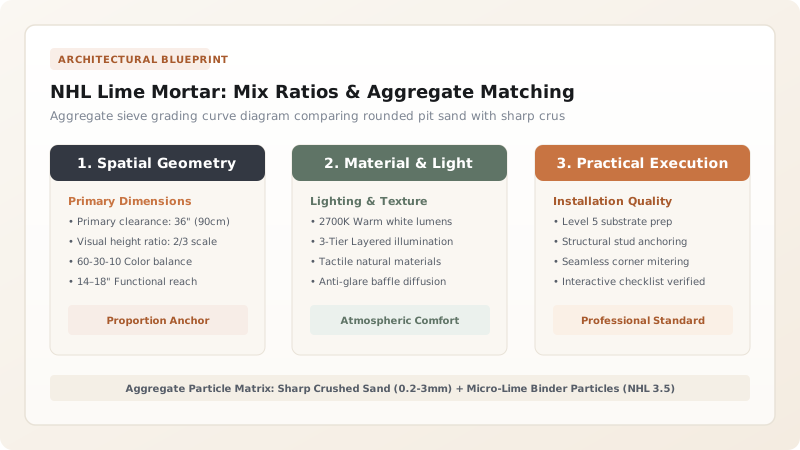
1. Natural Hydraulic Lime Chemistry: The Dual-Set Mechanism
Unlike non-hydraulic air lime (lime putty, \(\text{CL 90}\)) which cures solely by absorbing carbon dioxide, Natural Hydraulic Lime (NHL) possesses a unique dual-curing chemical mechanism:
European Standard EN 459-1 categorizes NHL into three distinct structural performance grades:
- NHL 2 (Feebly Hydraulic): Derived from limestone with 5-10% reactive silica and alumina. Achieves 28-day compressive strength of \(\approx 2.0\text{ MPa}\). Highly vapor-permeable (\(\mu \approx 10\)), ideal for soft sandstones, limestones, and internal lime plastering.
- NHL 3.5 (Moderately Hydraulic): Sourced from stone with 10-15% argillaceous clay content. Achieves \(\approx 3.5\text{ to } 4.5\text{ MPa}\). The universal benchmark for exterior masonry, stone quoin bedding, and general facade pointing.
- NHL 5 (Eminently Hydraulic): Contains 15-20% reactive silicates, achieving \(\approx 5.0\text{ to } 7.5\text{ MPa}\). Used for severe coastal exposures, chimneys, parapets, and below-damp-course foundations. Read stone quoin applications in our ashlar quoining hub.

2. Aggregate Grading: Sieve Analysis & Void-Filling Dynamics
The strength and weather resistance of a lime mortar are governed primarily by the Grading of the Sand Aggregate:
- The Void Ratio Principle: When clean sand is poured into a container, the air voids between grains occupy roughly 33% to 38% of total volume. The volume of lime binder must precisely match or slightly exceed this void space (yielding the canonical 1:2.5 or 1:3 ratio). If too little lime is used, the mortar has dry porosity; if too much lime is used, excessive shrinkage cracking occurs.
- Full-Spectrum Sieve Curve: Sand must not be uniform 'play sand'. It must contain a continuous gradation across standard wire sieves:
- Passing 2.36mm (No. 8): 95 - 100%
- Passing 1.18mm (No. 16): 70 - 85%
- Passing 600µm (No. 30): 40 - 60%
- Passing 300µm (No. 50): 15 - 30%
- Passing 150µm (No. 100): 2 - 8%
- Washed Sharp Sand: Sand must be thoroughly washed to eliminate clay and silt fines (< 2% sub-0.075mm material). Grains must be sub-angular to angular to optimize mechanical friction. Learn block cutting in ashlar quoin dimensions.
3. Historic Mortar Analysis: Acid Dissolution & Color Matching
Conservation standards (such as Historic England and US National Park Service Preservation Brief 2) require empirical matching of historic mortars:
- Acid Dissolution Protocol: A sound 50-gram sample of original historic mortar is dried, weighed, and submerged in a 10% dilute Hydrochloric Acid (\(\text{HCl}\)) bath. The acid dissolves the calcium carbonate lime binder, releasing carbon dioxide gas. The remaining insoluble residue (the sand and pozzolan) is washed, dried, and weighed to establish the exact original Binder-to-Aggregate Weight Ratio.
- Optical Petrography: The isolated sand is inspected under a binocular microscope (20x-40x) to identify mineral composition (e.g., iron-stained quartz, feldspar, marine shell fragments, crushed coal slag).
- Natural Color Matching: Mortar color should derive 100% from the natural aggregate. Artificial iron oxide pigments should be avoided or limited to < 1% by weight, as synthetic pigments alter water absorption and fade unevenly under UV exposure. Master joint finishes in tuck pointing and ribbon profiles.
Natural Hydraulic Lime (NHL) Formulation Matrix
Use this reference table to calculate exact physical dimensions, ratios, and specifications before purchasing:
| Lime Grade | Compressive Strength (28d) | Vapor Diffusion (μ) | Mix Ratio (Binder:Sand) | Best Sand Sizing | Recommended Masonry Substrate |
|---|---|---|---|---|---|
| NHL 2 (Feebly Hydraulic) | 1.5 - 2.5 MPa | μ = 8 - 12 | 1 : 2.5 (Volume) | 0.1 - 2.0 mm Sharp Sand | Soft historic sandstone, chalk, friable limestone |
| NHL 3.5 (Moderately Hydraulic) | 3.5 - 4.5 MPa | μ = 12 - 16 | 1 : 2.5 (Volume) | 0.2 - 2.8 mm Graded River Sand | Standard stone ashlar, historic clay brick, quoins |
| NHL 5 (Eminently Hydraulic) | 5.0 - 7.5 MPa | μ = 18 - 22 | 1 : 2.0 (Volume) | 0.5 - 3.5 mm Coarse Grit | Hard granite, slate, parapet coping, damp basements |
| Lime Putty (CL 90 Non-Hydraulic) | 0.8 - 1.5 MPa | μ = 5 - 8 | 1 : 3.0 (Volume) | 0.1 - 1.5 mm Fine Quartz | Fine interior tuck pointing ribbons, museum masonry |
Lime Mortar Formulation Constraints
Every successful decoration project must account for physical and environmental constraints:
Mixing Time Requirements
Lime mortars cannot be whipped quickly; they require a minimum 10-15 minute intensive shearing cycle in a pan mixer or paddle tub to activate the binder.
Temperature Curing Window
Never apply lime mortars if ambient temperatures are expected to drop below 5°C (41°F) within 30 days of application; freezing completely destroys uncarbonated lime.
Water Cleanliness
Water must be potable, pH neutral, and free of iron or sulfate ions; hard tap water can induce early salt crystallization in the pore network.
Batch Consistency
Measuring binders and sands by shovels produces massive batch-to-batch variations; all ingredients must be accurately gauged using calibrated volume boxes or weight scales.
Lime Mortar Batching, Mixing & Quality Testing Protocol
Execute this professional sequence to achieve flawless results without backtracking:
Sieve Sand Grading
Screen sand through brass sieves to verify compliance with EN 13139 aggregate grading curves for masonry mortar.
Gauge Box Batching
Measure 1 volume part NHL 3.5 binder and 2.5 volume parts dry sharp sand using calibrated wooden gauge boxes.
Dry Pre-Blending
Add sand and lime to a clean mechanical pan mixer or paddle tub; blend dry for 3 minutes until uniform color is achieved.
Water Addition
Gradually introduce clean potable water, aiming for a water-to-binder ratio of approximately 0.50 to 0.55 by weight.
Intensive Shearing Mix
Mix for a full 10 to 12 minutes to develop maximum plasticity and air-entrained workability.
Workability Check
Perform a trowel-turn test; the mortar should hold a clean 45-degree angle on the trowel face without slumping or releasing free water.
Application Within Pot Life
Utilize mixed mortar within 2 hours. Do not attempt to re-temper stiffened mortar by adding extra water after initial hydraulic set begins.
Common Mistakes & Countermeasures
Avoid these costly errors that compromise aesthetics, ergonomics, and budget:
Adding Portland cement ('gauging') to make NHL mortar set faster
Using round, wind-blown builder's pit sand with excessive clay fines
Re-tempering stiffened lime mortar with water after 2 hours
Project Execution Checklist
Track your physical progress. Checkboxes persist automatically on this device:
Frequently Asked Questions
Can I use hydrated lime from a hardware store (Type S or Type N) for historic repointing?
Generally no. Hardware store hydrated lime is non-hydraulic air lime that requires blending with cement or pozzolan to set in thick joints. Authentic historic masonry requires factory-certified Natural Hydraulic Lime (NHL) complying with EN 459-1.
What happens if the mortar is stronger than the surrounding stone?
When thermal expansion or ground movement occurs, stresses concentrate in the softest component. If the mortar is harder than the stone, the stone itself cracks and spalls while the cement joint remains intact, destroying the irreplaceable historic fabric.
Why does lime mortar self-heal micro-cracks over time?
This phenomenon, called autogenous healing, occurs because uncarbonated calcium hydroxide dissolves in migrating rainwater. As water evaporates at the surface of a hairline crack, the calcium reacts with atmospheric CO2, precipitating new calcium carbonate crystals that physically seal the fissure.


