
Conserving Armorican granite exposed to coastal Atlantic marine environments requires understanding rock microstructure and chemical weathering. Centuries of wind-driven salt spray deposit sea salts (principally halite, NaCl) inside granite pore capillaries. Cyclic sub-florescence creates expansive crystallization pressures exceeding 50 MPa that cause granular disintegration (arenization). Conservation involves preserving beneficial biogenic patinas, extracting harmful salts with cellulose poultices, and consolidating micro-fissures using ethyl silicate.
At a Glance: Key Takeaways
- Halite Crystallization Damage: Phase changes between dissolved salt and crystals exert destructive 50+ MPa sub-florescence pressure.
- Arenization (Granite Sandy Rot): Selective kaolinitic weathering of feldspar crystals causing granite to crumble into loose sand.
- Biogenic Crust Protection: Stable saxicolous lichen crusts that shield stone surfaces from wind erosion should not be aggressively stripped.
- Cellulose Pulp Desalination: Non-destructive extraction of soluble salts using deionized water and Arbocel poultice compresses.
- Ethyl Silicate Consolidation: Depositing amorphous silica glass within micro-fissures to restore cohesive stone strength.
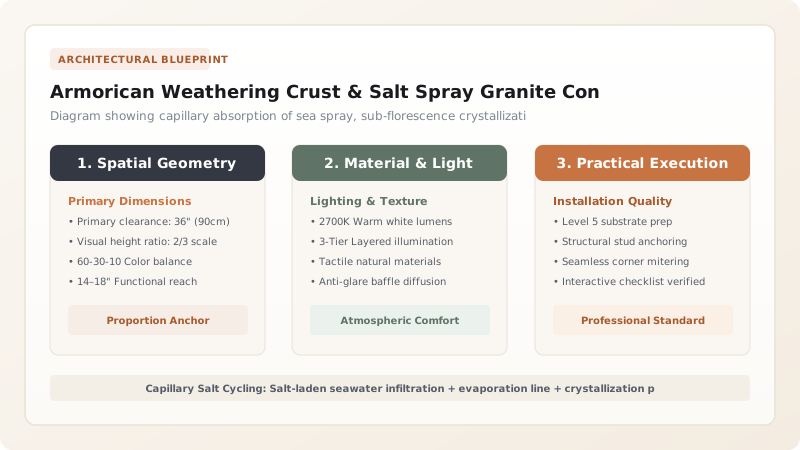
1. Halite Sub-Florescence & Granular Arenization
Granite is generally considered an indestructible stone, but in coastal marine zones it suffers from a specific destructive pathology termed arenization (from the Latin arena, meaning sand). Wind-blown Atlantic sea spray deposits sodium chloride (\(\text{NaCl}\)) and magnesium sulfate (\(\text{MgSO}_4\)) onto the rock surface.
As moisture evaporates, dissolved ions migrate into the microscopic pore spaces between quartz and feldspar crystals. Under relative humidity cycling (crossing the halite equilibrium threshold of 75.3% RH at 20°C), repeated dissolution and crystallization occur. The growth of salt crystals inside confined capillaries generates expansive pressures:
These crystallization pressures can exceed 50 to 100 MPa, far outstripping the tensile cleavage resistance of feldspar and mica grains. Over decades, the granite surface delaminates and crumbles into loose granite sand (arène granitique).
2. The Role of Saxicolous Lichen Patinas
Historic Breton granite facades are often covered in vibrant golden, grey, and olive-green lichens (such as Xanthoria parietina and Caloplaca marina). Conservation science has revised earlier views that all biological growth must be eradicated.
While endolithic lichens with deep hyphae can produce oxalic acid that micro-etches feldspars, many saxicolous (surface-dwelling) lichen crusts form a protective biogenic skin. This crust shields the underlying granite from violent wind-scour, rain-wash erosion, and thermal shock. Indiscriminate chemical biocide washing often exposes fragile, pre-weathered granite directly to accelerated salt decay.
3. Desalination Protocols & Silicic Consolidation
When granite quoins suffer active salt flaking, intervention must begin with non-destructive desalination. Cellulose fiber poultices (such as Arbocel BWW40) soaked in deionized water are applied to the stone in 15mm-thick blankets.
As the poultice slowly evaporates outward, capillary action draws moisture and dissolved salt ions out of the stone core and concentrates them within the disposable cellulose pack. Once salt concentrations are reduced below safety thresholds (< 0.1% by weight), friable decayed zones are stabilized by vacuum-impregnation with tetraethyl orthosilicate (TEOS / ethyl silicate), which reacts with atmospheric moisture to deposit pure amorphous silica bridges between weakened mineral crystals.
Breton Granite Degradation Mechanisms & Interventions
Use this reference table to calculate exact physical dimensions, ratios, and specifications before purchasing:
| Pathology / Symptom | Underlying Chemical / Physical Cause | Harm Level | Recommended Conservation Treatment |
|---|---|---|---|
| Arenization / Sanding | Halite crystallization bursting feldspar grains | Critical (Loss of detail) | Poultice desalination + Ethyl silicate (TEOS) consolidation |
| Black Gypsum Crust | Atmospheric sulfur dioxide reacting with lime mortar | Moderate (Surface skin) | Low-pressure micro-abrasive sponge or ammonium carbonate pack |
| Saxicolous Lichen Colonization | Natural biological colonization on damp stone | Low (Mostly benign) | Leave intact unless actively producing deep sub-surface pitting |
| Rust Staining / Iron Pyrite Bleed | Oxidation of internal iron sulfides to ferric oxides | Aesthetic / Low | Ammonium citrate chelating poultice (pH neutral) |
Maritime & Environmental Constraints
Every successful decoration project must account for physical and environmental constraints:
Continuous Salt Re-Deposition
Coastal buildings within 500m of the shoreline re-accumulate marine salts; preventative maintenance requires bi-annual water washdowns.
Consolidant Curing Times
Ethyl silicate requires 21 to 28 days of relative humidity between 50% and 75% to fully hydrolyze into silica glass.
Protocol for Field Desalination and Consolidation of Coastal Granite Quoins
Execute this professional sequence to achieve flawless results without backtracking:
Quantitative Salt Profiling
Drill micro-core samples at 5mm depth increments; measure electrical conductivity to map salt concentration gradients.
Surface De-Dusting & Gentle Pre-Wash
Vacuum loose crumbling granite sand; wash gently with warm deionized water at < 1.5 bar pressure.
Cellulose Pulp Poultice Application
Apply 15mm layer of deionized water and Arbocel cellulose pulp; seal with micro-perforated film to allow controlled 72-hour drying.
Salt Extraction Monitoring
Peel dried poultice; test extracted salt content with silver nitrate test strips; repeat 2–3 cycles until conductivity drops < 250 µS/cm.
Ethyl Silicate (TEOS) Consolidation
Apply tetraethyl orthosilicate consolidant by continuous low-pressure spray until stone reaches saturation refusal.
Hydrophobic Breathable Protection
Apply breathable oligomeric siloxane water-repellent (minimum vapor permeability retention > 85%) on extreme windward gales.
Common Mistakes & Countermeasures
Avoid these costly errors that compromise aesthetics, ergonomics, and budget:
Pressure washing weathered granite with high-pressure (> 100 bar) water jets
Applying film-forming silicone or acrylic waterproofing sealers on granite facades
Project Execution Checklist
Track your physical progress. Checkboxes persist automatically on this device:
Frequently Asked Questions
Can crumbling granite quoins be patched with stone repair mortar?
Yes, but only using mineral-based, non-hydraulic lime mortars formulated with crushed granite aggregate matching the original stone grain. Epoxy or acrylic patching compounds must never be used on exterior granite because their thermal expansion rate is three times higher than the stone, causing patch detachment.
How does sea salt cause damage to stone even when it never freezes?
Salt damage occurs primarily through crystallization pressure rather than frost action. When salt water evaporates in stone pores, salt crystals grow. Because the crystals require more volume than the liquid solution, they press outward against pore walls with enormous mechanical force every time the humidity changes.


