
Ashlar Quoin Dressing and Lime-Sand Cavity Jointing are the structural keystones of traditional Breton stone construction. Large granite blocks are dressed into square ashlar quoins using bush-hammers and pitching chisels to form alternating header-stretcher corner ties. These structural pillars frame rubblestone wall fields, bedded in breathable natural hydraulic lime (NHL 2 or 3.5) mortars formulated with coarse alluvial sands that permit continuous moisture evaporation while resisting Atlantic freeze-thaw cycles.
At a Glance: Key Takeaways
- Header-Stretcher Quoin Bonding: Long stones (headers) extending 700mm inward, alternating with short stretchers along the corner.
- Bush-Hammered Texture (Bouchardage): 16-point to 25-point steel hammers creating non-slip, stippled matte granite surfaces.
- Drafted Margins (Ciselures): Hand-chiseled 20mm perimeter borders ensuring razor-straight visual alignment and plumb joints.
- Lime-Sand Mortar Permeability: NHL 2 / 3.5 natural hydraulic lime mortar allowing vapor diffusion > 15 perms.
- Cavity Void Grouting: Core voids filled with lime-aggregate slurry without creating impermeable structural shear planes.
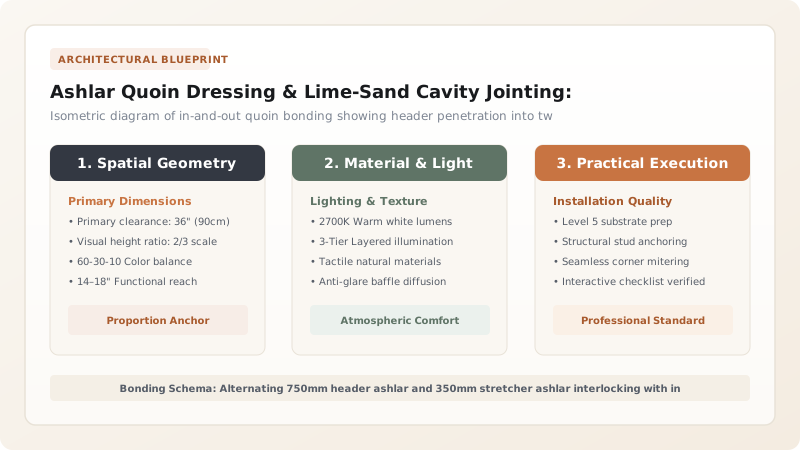
1. Ashlar Quoin Dressing: From Quarry Block to Plumb Line
Granite is an unyielding, non-stratified rock that cannot be split along bedding planes like sandstone or limestone. Breton stonemasons employed plug-and-feather wedges to split monumental quarry blocks along the rock's natural grain (the rift and grain directions dictated by micro-fissures in quartz crystals).
Once split into rough cuboids, the mason establishes a reference face by cutting a chiselled draft margin (ciselure) 15mm to 25mm wide along all four perimeter edges using a flat carbide-tipped chisel. The interior panel is then leveled and textured using a bush-hammer (boucharde) containing an array of pyramidal teeth. This yields a velvety, stippled surface that diffuses light beautifully across the facade.
2. Structural Bonding: The In-and-Out Quoin System
Corner quoins are not decorative veneers; they form the primary rigid structural columns of the building. Masons alternate between:
- Header Quoins (Panneresses): Large stones extending 600mm to 800mm deep along one wall face while presenting a narrow 300mm face on the return.
- Stretcher Quoins (Boutisses): Stones rotated 90° on the next course, reversing the long face onto the adjoining wall.
The long tail of each header interlocks with the interior rubble wythe, anchoring the two intersecting walls together and preventing the building corners from splitting open outward under roof thrust.
3. Lime-Sand Mortar Formulation & Breathable Jointing
The mortar in historic Breton masonry acts as a flexible, breathable cushion, never as an adhesive glue. Dense granite has nearly zero water absorption (0.2% to 0.4%), meaning that all wind-driven moisture penetrating facade micro-cracks must evaporate out through the mortar joints.
The traditional mix utilizes Natural Hydraulic Lime (NHL 2 or NHL 3.5) blended with sharp, washed alluvial river sand in a 1:2.5 to 1:3 volume ratio. Fine sea sand is strictly avoided due to residual sodium chloride that attracts hygroscopic moisture and causes recurring salt bloom efflorescence.
Breton Stonemasonry Mortar Formulation Guidelines
Use this reference table to calculate exact physical dimensions, ratios, and specifications before purchasing:
| Mortar Application | Lime Binder | Aggregate Specification | Compressive Strength (28d) | Vapor Permeability |
|---|---|---|---|---|
| Ashlar Quoin Bed Joints | NHL 2 (Feebly Hydraulic) | Coarse river sand (0–3mm) 1:2.5 | 2.0 - 3.0 MPa | High (> 25 Perms) |
| Rubble Wall Core Grouting | NHL 3.5 + 10% Pozzolan | Well-graded grit (0–5mm) 1:3 | 3.5 - 5.0 MPa | Moderate (18 Perms) |
| Exposed Coastal Pointing | NHL 3.5 (Moderately Hydr.) | Sharp quartz sand (0–2mm) 1:2 | 3.5 - 4.5 MPa | High (> 20 Perms) |
| Interior Fireplace Jambs | Fat Lime CL90 (Air Lime) | Crushed limestone + brick dust | 1.0 - 1.5 MPa | Very High (> 30 Perms) |
Material & Labor Constraints
Every successful decoration project must account for physical and environmental constraints:
Tungsten Tool Wear
Working dense quartz-rich granite dulls high-carbon steel chisels rapidly; masons use tungsten carbide-tipped tooling.
Winter Working Limits
Lime mortar cannot be applied below 5°C or when freezing conditions are expected within 14 days.
Protocol for Repointing and Re-Bedding Historic Granite Quoins
Execute this professional sequence to achieve flawless results without backtracking:
Raking Out Defective Cement Mortars
Rake out hard modern cement pointing to a depth of at least 25mm to 35mm using hand chisels without nicking granite margins.
Cavity Washing & Substrate Wetting
Flush joints thoroughly with low-pressure potable water to remove pulverized dust and pre-dampen dry internal stones.
Mortar Batching & Whipping
Mix NHL 3.5 lime and sharp sand dry; add clean water to stiff peanut-butter consistency and whip vigorously for 10 minutes.
Deep Joint Packing
Pack mortar into deep voids in 10mm increments using iron pointing keys, ramming tightly to ensure zero internal air voids.
Flush Splayed Finish
Finish joint slightly recessed (2mm) behind the chiselled margin; brush lightly with a stiff coir brush as mortar stiffens to expose sand grain.
Damp Curing Protection
Cover wall with damp hessian burlap and breathable windbreak tarps for a minimum of 7 days to prevent rapid dehydration.
Common Mistakes & Countermeasures
Avoid these costly errors that compromise aesthetics, ergonomics, and budget:
Applying 'ribbon' or raised strap pointing that overlaps the face of the granite
Using unwashed beach sand containing marine sea salts
Project Execution Checklist
Track your physical progress. Checkboxes persist automatically on this device:
Frequently Asked Questions
Why are granite quoin surfaces bush-hammered instead of polished smooth?
A polished granite surface is slick and reflects light harshly, which was considered inappropriate for rustic vernacular architecture. Bush-hammering provides a uniform, matte, light-absorbing stippled texture that harmonizes with adjoining rough rubblestone while remaining non-slip and resistant to visible scratching.
How can you tell if an old stone wall has cement repointing that needs removal?
Cement pointing is typically uniform dull-grey, extraordinarily hard (cannot be scratched with a copper coin), and often displays hairline shrinkage cracks pulling away from the stone face with water staining along the lower edges.


