
Execute authentic Moroccan Tadelakt by applying natural Marrakech hydraulic lime plaster over a keyed substrate. Burnish and compress the wet plaster using a smooth semi-precious river stone (agate, basalt, or ceramic) in small circular motions, then treat with pure olive oil black soap (*Savon Noir*); the soap chemically reacts with the lime to create an insoluble, 100% waterproof calcium stearate hydrophobic surface.
At a Glance: Key Takeaways
- Marrakech Lime Mineralogy: Naturally hydraulic lime containing silica, quartz sand, and clay quarried from the High Atlas Mountains.
- Hand-Held River Stone Compression: Smooth basalt or agate stones compact the plaster under heavy pressure, closing all microscopic pores.
- Chemical Saponification Reaction: \(\text{Calcium Hydroxide} + \text{Potassium Oleate (Black Soap)} \to \text{Calcium Oleate / Stearate}\) (Waterproof Soap Stone).
- 100% Seamless Monolithic Curvature: Eliminates all tile grout lines in showers, integrated sinks, and sculpted soaking tubs.
- Natural Breathable Hydrophobic Defense: Repels liquid water completely while remaining vapor-permeable to prevent trapped moisture.
In-Depth Guides in this Directory
Explore specialized subtopic blueprints, technical dimensions, and execution checklists:
Marrakech Lime: High Atlas Geology & Hydraulic Mineralogy
Master authentic Moroccan Tadelakt geology: Marrakech Plateau limestone calcination, reactive dicalcium silicates (C2S), coarse silica aggregates, and natural hydraulic setting.
Tadelakt Stones: River Stone Hardness (Mohs 7) & Burnishing
Master Moroccan Tadelakt stone polishing mechanics: selecting natural basalt and agate stones (Mohs 7), circular burnishing kinematics, and micro-pore compaction.
Tadelakt Saponification: Olive Oil Black Soap Chemistry
Master Moroccan Tadelakt chemical saponification: potassium oleate black soap (*Savon Noir*), calcium stearate formation, hydrophobic lotus effect, and shower maintenance.
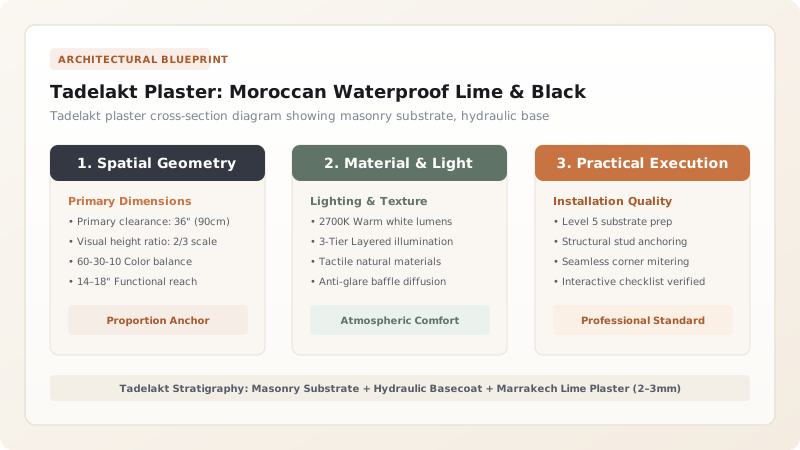
1. Mineral Craftsmanship: Marrakech Hydraulic Lime & River Stone Burnishing
Originating over 2,000 years ago in the hammams and riads of Marrakech, Tadelakt (from Arabic dalaka, to rub or knead) is the world's original seamless waterproof plaster.
Unlike Venetian plaster, Tadelakt is crafted from Natural Hydraulic Lime quarried in the Marrakech Plateau containing un-slaked lime chunks and silica aggregates. Plasterers polish the surface by hand using a Hard Semi-Precious River Stone (Hardness 7 on Mohs scale). Master geology in Marrakech hydraulic lime mineral composition and stone techniques in river stone hand burnishing.

2. Chemical Saponification: Olive Oil Black Soap (*Savon Noir*)
The secret to Tadelakt's legendary waterproof durability is not a synthetic chemical sealer, but ancient organic chemistry.
Brushing Olive Oil Black Soap (*Savon Noir*) onto the fresh lime triggers a Saponification Reaction, converting the surface into Insoluble Waterproof Calcium Stearate (Lime Soap). Explore the chemistry in black soap saponification chemistry and coordinate with Moroccan riad architecture and zellij tile.
Moroccan Tadelakt vs Venetian Marmorino vs Microcement
Use this reference table to calculate exact physical dimensions, ratios, and specifications before purchasing:
| Plaster Technology | Waterproof Capability | Chemical Sealing Mechanism | Curved Organic Flexibility |
|---|---|---|---|
| Authentic Moroccan Tadelakt (Optimal) | 100% Waterproof (Bathtubs & Showers) | Chemical Saponification (Calcium Stearate) | 5 / 5 (Seamless organic bowls & curves) |
| Venetian Plaster (Marmorino) | Water-Resistant (Walls only) | Wax / Potassium soap buffing | 3 / 5 (Flat walls / Columns) |
| Polymer Microcement | 100% Waterproof | Synthetic Polyurethane Topcoat | 4 / 5 (Modern flat industrial look) |
| Traditional Glazed Tile | 100% Waterproof Tiles (Grout Leaks) | Topical Grout Sealers | 1 / 5 (Rigid angular tile joints) |
Stone Drag Gouging Constraints
Every successful decoration project must account for physical and environmental constraints:
Burnishing with a River Stone That Has Sharp Edges or Microscopic Pits Scratching Plaster
Using an un-polished stone with sharp edges gouges deep permanent tracks into soft lime plaster; strictly use water-tumbled natural river stones with a Mohs hardness of 7+ (such as agate, basalt, or jasper) that have been hand-lapped on diamond sharpening stones until glass-smooth.
How to Apply, Stone-Polish, and Soap Authentic Moroccan Tadelakt
Execute this professional sequence to achieve flawless results without backtracking:
Apply Coarse Hydraulic Lime Basecoat to Masonry
Trowel 1/2" NHL 3.5 basecoat over brick, concrete, or cement board; float with wood float to leave tooth.
Mix Authentic Marrakech Tadelakt Lime with Water
Blend genuine Marrakech lime with clean water (approx 35% water by weight) and natural earth pigments; let slake 30m.
Apply First 2mm Base Layer of Tadelakt
Trowel uniform 2mm layer onto dampened substrate; allow to firm up for 30 to 45 minutes.
Apply Second 1.5mm Finishing Layer and Trowel Smooth
Apply second coat; smooth with flexible plastic spatula or stainless steel trowel to close surface.
Burnish Surface with Polishing Stone in Circular Arcs
While plaster is firm (leather-hard), compress in small circular strokes with polished basalt river stone.
Brush Pure Olive Oil Black Soap (*Savon Noir*)
Dilute olive oil black soap 1:5 in warm water; brush generously across surface to trigger saponification.
Final Stone Polish Through Soap Slurry
Work polishing stone through soapy lather to drive calcium stearate deep into pores; wipe dry with soft cloth.
Common Mistakes & Countermeasures
Avoid these costly errors that compromise aesthetics, ergonomics, and budget:
Using Synthetic Acrylic Venetian Plaster and Calling It Tadelakt
Project Execution Checklist
Track your physical progress. Checkboxes persist automatically on this device:
Frequently Asked Questions
Can Moroccan Tadelakt be used to build a solid sculpted bathtub or shower pan?
Yes! In Morocco, entire bathtubs, sinks, and hammam soaking pools are sculpted from solid masonry and sealed with Tadelakt. The saponified lime soap surface is 100% impervious to standing water.


