
Moroccan Tadelakt achieves 100% waterproof performance through chemical saponification. When pure olive oil black soap (*Savon Noir*, potassium oleate) is applied to damp lime plaster (\(\text{Ca(OH)}_2\)), a chemical reaction forms insoluble calcium oleate/stearate (lime soap), creating a permanent hydrophobic, water-beading barrier deep within the plaster pores.
At a Glance: Key Takeaways
- Authentic Moroccan Black Soap (*Savon Noir*): Traditional potassium soap made from crushed black olives and potassium hydroxide.
- Chemical Saponification Equation: \(\text{Ca(OH)}_2 + 2\text{C}_{17}\text{H}_{33}\text{COOK} \to \text{Ca(C}_{17}\text{H}_{33}\text{COO)}_2 + 2\text{KOH}\).
- Insoluble Calcium Stearate Hydrophobic Layer: Replaces soluble calcium hydroxide, rendering the outer 1mm completely impervious to water.
- The Lotus Effect (Water Contact Angle > 110°): Water droplets bead into tight spherical pearls that roll off without wetting the wall.
- Vapor-Permeable Breathability Maintained: Repels liquid water droplets while allowing microscopic water vapor molecules to breathe.
- Periodic Black Soap Wash (Every 6 Months): Washing with diluted black soap naturally re-saponifies and heals micro-scratches.
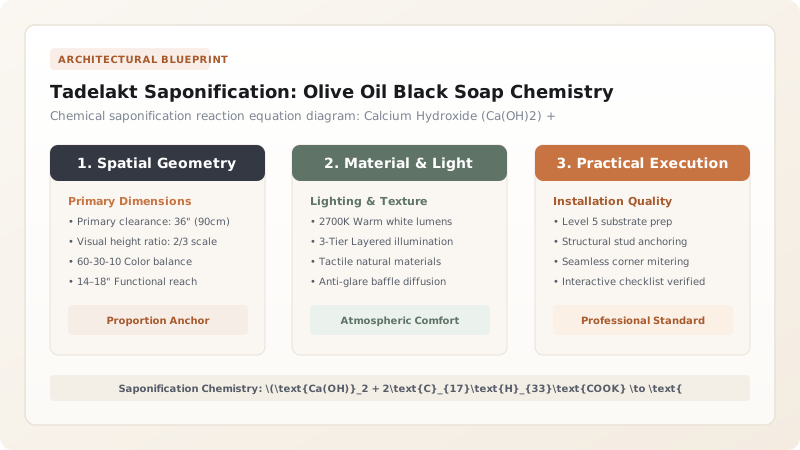
1. Organic Chemistry: The Saponification Reaction & Calcium Stearate
Traditional builders in the West apply plastic sealers (polyurethane or silicone) to waterproof walls. These coatings trap moisture behind the film, eventually peeling and yellowing.
Tadelakt uses True Chemical Saponification. When Olive Oil Black Soap (*Savon Noir* - rich in Potassium Oleate) is brushed onto the fresh alkaline lime wall, it reacts with free calcium ions to form Insoluble Calcium Stearate / Oleate (Lime Soap):
$$\text{Ca(OH)}_2 + 2\text{C}_{17}\text{H}_{33}\text{COOK} \to \text{Ca(C}_{17}\text{H}_{33}\text{COO)}_2 + 2\text{KOH}$$
This creates an integral hydrophobic barrier that cannot peel, chip, or flake because it is chemically bonded to the stone matrix. Learn mineralogy in Marrakech lime composition.

2. Hydrophobic Beading & Long-Term Shower Maintenance
The saponified surface exhibits the Lotus Effect: water droplets bead into spherical pearls (Contact Angle > 110°) that roll off instantly.
To maintain your Tadelakt shower, clean every 6 months with a 1:10 Dilution of Olive Oil Black Soap in Warm Water, wiping down with a soft cotton cloth. Review stone burnishing in river stone hand burnishing and explore Tadelakt plaster hub.
Tadelakt Saponification vs Synthetic Shower Sealers
Use this reference table to calculate exact physical dimensions, ratios, and specifications before purchasing:
| Sealing Technology | Chemical Bond Type | Vapor Breathability | Lifespan & Maintenance |
|---|---|---|---|
| Olive Oil Black Soap Saponification (Optimal) | Covalent Chemical Bond (Calcium Stearate) | 100% Breathable (Vapor-permeable) | Centuries (Self-heals with black soap wash) |
| Topical Polyurethane Clear Sealer | Mechanical Plastic Film Adhesion | 0% Non-Breathable (Traps moisture) | FAILS: Peels and blisters in 18 months |
| Silane/Siloxane Penetrating Sealer | Organosilicon Repellent | High Breathability | Requires chemical re-application every 2 years |
| Raw Beeswax Topcoat Only | Waxy Surface Barrier | Moderate Breathability | Good for walls / Softens in hot steam showers |
Acidic Bathroom Cleaner Destruction Constraints
Every successful decoration project must account for physical and environmental constraints:
Commercial Acidic Bathroom Cleaners (Bleach / Vinegar) Eating Saponified Lime
Acidic limescale removers and household vinegar react violently with calcium carbonate and calcium stearate, etching rough white craters into polished Tadelakt; strictly ban acidic and bleach cleaners, cleaning Tadelakt exclusively with pure water and olive oil black soap.
How to Prepare Black Soap and Execute Saponification on Tadelakt
Execute this professional sequence to achieve flawless results without backtracking:
Source 100% Pure Moroccan Olive Oil Black Soap (*Savon Noir*)
Verify soap is made purely from black olives, olive oil, and potassium hydroxide without synthetic detergents.
Dilute Black Soap Paste 1:5 in Warm Distilled Water
Dissolve 200g of soft black soap paste in 1 liter of warm water, whisking until a frothy golden lather forms.
Brush Soapy Solution Evenly Across Polished Tadelakt
Apply soap lather generously over the freshly stone-burnished plaster using a wide natural bristle brush.
Let Soap Penetrate and React for 5 to 10 Minutes
Allow the soap solution to soak into open plaster pores to trigger the calcium stearate chemical reaction.
Burnish Through Soap Lather with Polishing Stone
Polish with basalt river stone through the slippery soap lather to drive the calcium stearate deep into the matrix.
Wipe Away Excess Surface Residue with Microfiber Cloth
Gently wipe away milky soap residue with dry microfiber towel; let cure 7 days before using shower.
Common Mistakes & Countermeasures
Avoid these costly errors that compromise aesthetics, ergonomics, and budget:
Using Commercial Liquid Dish Soap Instead of Authentic Olive Oil Black Soap
Project Execution Checklist
Track your physical progress. Checkboxes persist automatically on this device:
Frequently Asked Questions
How soon can a newly Tadelakted shower be used?
Allow the saponified Tadelakt shower to cure for at least 7 to 10 days before direct water exposure. This allows initial carbonation and full crystallization of the calcium stearate hydrophobic shield.


