
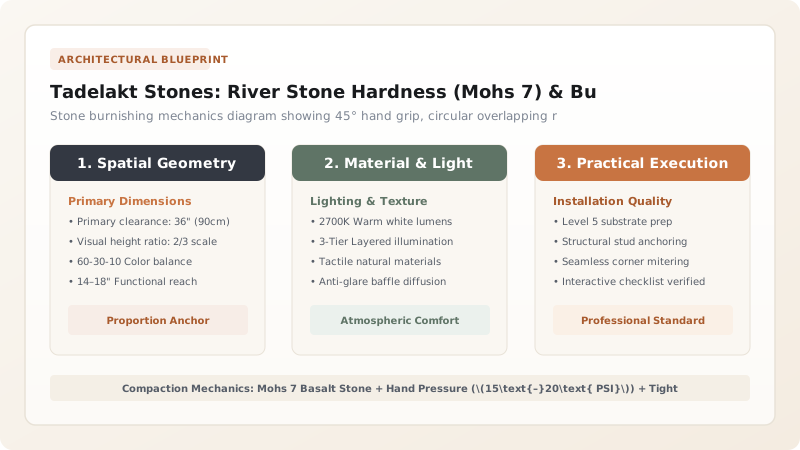
Burnish Moroccan Tadelakt using natural, semi-precious river stones (such as basalt, agate, or jasper) with a Mohs hardness of 7 or higher. Hold the stone flat against the leather-hard plaster and execute tight, overlapping circular rosette strokes under 15 to 20 lbs of hand pressure, compacting the mineral grain and closing microscopic capillary pores.
At a Glance: Key Takeaways
- Mohs Hardness 7+ Stone Selection: Agate, basalt, jade, or dense river jasper with zero surface pitting or micro-fissures.
- Ergonomic Oval Palm Shape: 2"–3" wide rounded river pebbles fit naturally into the palm to prevent hand fatigue over hours of burnishing.
- The Rosette Circular Motion: Polishing in continuous tight figure-8 and spiral rosettes prevents directional trowel ridge lines.
- The Leather-Hard Tactile Window: Plaster must yield under stone pressure without sticking to the stone face or denting deeply.
- Mechanical Pore Collapse: Compresses the 2mm plaster layer down by 15% in thickness, creating an ultra-dense waterproof surface.
1. Tool Mineralogy: Basalt, Agate & Mohs Hardness 7 Criteria
Standard marble or limestone pebbles (Mohs hardness 3) are too soft to burnish Tadelakt; the abrasive quartz sands in the plaster will scratch the stone, which then scratches the wall. Master plasterers use Semi-Precious Gemstones with a Mohs Hardness of 7 or Higher.
Dense Black Basalt, Water-Washed Agate, or Jasper River Stones possess a glass-hard crystalline structure. The stone must have at least one Flat, Micro-Polished Working Face. Learn stone geology in Marrakech lime mineralogy.

2. Circular Kinematics: The Rosette Technique & Compaction Pressure
Stone polishing is a mechanical compaction process, not mere smoothing. The artisan applies 15 to 20 lbs of Direct Hand Pressure in tight, overlapping circular motions known as Rosettes.
This collapses the microscopic air voids between quartz sand grains, forcing un-slaked lime cream to the surface to create a seamless, velvety sheen. Explore saponification in black soap chemistry and review Tadelakt plaster hub.
Tadelakt Polishing Stones Comparison
Use this reference table to calculate exact physical dimensions, ratios, and specifications before purchasing:
| Stone Material | Mohs Hardness | Surface Flatness & Texture | Burnishing Suitability |
|---|---|---|---|
| Natural Polished Agate Stone (Optimal) | Mohs 7.0 (Extreme hardness) | Glass-smooth / Zero porosity | 100% Perfect for high-gloss mirror sheen |
| Dense Black Basalt River Pebble | Mohs 6.0 to 6.5 | Silky smooth / Ergonomic palm grip | Traditional Moroccan Hammam Standard |
| Ceramic Hand-Cast Polishing Stone | Mohs 8.0 (Industrial ceramic) | Engineered precision flat face | Excellent modern alternative |
| Limestone / Marble Pebble (Avoid) | Mohs 3.0 (Too soft) | Scratches easily / Soft | FAILS: Scratches and ruins plaster |
Stone Edge Digging Gouge Constraints
Every successful decoration project must account for physical and environmental constraints:
Tilting the Polishing Stone on Edge Gouging Deep Circular Scars in Soft Plaster
Tipping the stone even 5 degrees digs the stone's perimeter edge into soft lime; keep the stone 100% flat against the wall plane, using palm pressure and flexible wrist rotations to glide smoothly across curved surfaces.
How to Hand-Burnish Tadelakt with a Polishing Stone
Execute this professional sequence to achieve flawless results without backtracking:
Lap and Polish Working Face of River Stone
Sand stone face on 1000-grit diamond sharpening plate with water until perfectly flat and scratch-free.
Wait for Tadelakt Leather-Hard Stage
Allow fresh plaster to firm for 30–60 minutes until finger press leaves faint matte mark with zero stickiness.
Execute First Dry Stone Compaction Pass
Hold stone flat in palm; polish in continuous 2-inch circular rosettes with 15 lbs pressure across entire wall.
Inspect Surface for Micro-Crazing or High Spots
Level any ridges with flat stone passes; stone pressure drives unslaked lime paste to seal micro-cracks.
Apply Olive Oil Black Soap Solution Generously
Brush diluted black soap over compacted plaster; stone will glide with silky hydro-planing action.
Execute Final Wet Saponification Stone Polish
Work stone through soap lather in tight overlapping circles to seal pores and create liquid-repellent skin.
Common Mistakes & Countermeasures
Avoid these costly errors that compromise aesthetics, ergonomics, and budget:
Starting Stone Polishing While Plaster is Still Wet and Mushy
Project Execution Checklist
Track your physical progress. Checkboxes persist automatically on this device:
Frequently Asked Questions
How many stones do you need for a Tadelakt project?
Artisans typically use two stones: a larger 3-inch flat stone for expansive flat walls, and a smaller 1-inch pointed oval pebble for tight inside corners, around faucets, and organic bathtub drain curves.


