
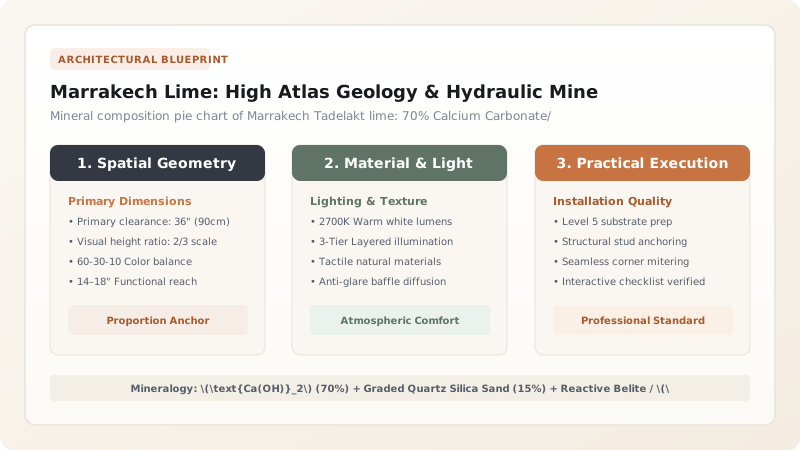
Authentic Moroccan Tadelakt lime is a naturally hydraulic lime quarried exclusively from the High Atlas Mountains surrounding Marrakech. It contains approximately 70% calcium hydroxide, 15% graded quartz silica sand, 10% reactive dicalcium silicates (\(\text{C}_2\text{S}\) belite), and 5% clay minerals, giving it dual hydraulic (underwater) and carbonation curing capabilities.
At a Glance: Key Takeaways
- Marrakech Plateau Geology: Ancient marine limestone deposits naturally interstratified with quartz sand and aluminosilicate clay.
- Wood-Fired Traditional Kiln Firing: Calcined at low temperatures (850°C–950°C) with olive wood and palm fronds, preserving natural minerals.
- Dicalcium Silicate Belite (\(\text{C}_2\text{S}\)): Imparts hydraulic setting power, allowing the plaster to cure in continuously wet shower environments.
- Integrated Graded Quartz Aggregates (0–2mm): Raw Tadelakt lime includes its own natural aggregates without needing added sand.
- Un-Slaked Quicklime Nodules (*Grains de Chaux*): Microscopic un-slaked lime particles react during stone burnishing to fill micro-voids.
1. Geological Mineralogy: The High Atlas Plateau & Wood-Fired Kilns
Unlike pure Italian calcite (which produces non-hydraulic fat lime), the limestone quarried outside Marrakech contains natural impurities of Silica (\(\text{SiO}_2\)), Alumina (\(\text{Al}_2\text{O}_3\)), and Quartz Sands.
When burned in traditional wood-fired kilns, the silica combines with calcium to form Dicalcium Silicate (\(\text{C}_2\text{S}\) / Belite). When mixed with water, these silicates hydrate into an insoluble crystalline network that cures underwater. Learn stone burnishing in river stone hand burnishing.

2. Dual Curing Mechanics: Hydraulic Hydration + Atmospheric Carbonation
Authentic Tadelakt possesses a unique Dual Curing Mechanism:
1. Hydraulic Silicate Hydration: Provides rapid structural strength within 24 hours even in 100% humid shower enclosures.
2. Long-Term Carbonation: Absorbs atmospheric \(\text{CO}_2\) over 12 months, petrifying the lime matrix into marble stone. Explore soap waterproofing in black soap saponification and review Tadelakt plaster hub.
Marrakech Tadelakt Lime vs Standard Lime Types
Use this reference table to calculate exact physical dimensions, ratios, and specifications before purchasing:
| Lime Type | Hydraulic Setting Index | Integrated Quartz Sand | Suitability for Wet Showers |
|---|---|---|---|
| Marrakech Tadelakt Lime (Optimal) | Naturally Hydraulic (C2S Belite) | YES (Natural 0–2mm quartz included) | 100% Certified for Direct Water Submersion |
| Italian Aged Grassello di Calce | 0.0 Non-Hydraulic (Pure Calcite) | NO (Requires adding marble flour) | Dry walls only (Dissolves under direct shower) |
| Commercial NHL 3.5 Hydraulic Lime | Hydraulic (Manufactured) | NO (Requires adding washed sand) | Good basecoat / Lacks Tadelakt luster |
| Portland Cement / White Stucco | High Hydraulic (Fast) | YES | Rigid / Lacks stone polishing plasticity |
Sifting Aggregate Un-Slaked Lump Constraints
Every successful decoration project must account for physical and environmental constraints:
Large Un-Slaked Lime Nodules (>3mm) Popping and Pitting Tadelakt Wall Weeks After Curing
Traditional Marrakech lime contains occasional oversized unslaked quicklime chunks; if not hydrated during initial mixing, they absorb air moisture months later, popping out and leaving pits in the finished wall; sift dry Tadelakt powder through a 1mm mesh sieve before mixing, and let the wet paste slake in water for 30 minutes.
How to Slake, Mix, and Prepare Genuine Marrakech Tadelakt
Execute this professional sequence to achieve flawless results without backtracking:
Sift Dry Marrakech Lime Through 1mm Sieve
Sift raw powder to separate oversized limestone nodules while retaining beneficial quartz sands.
Weigh Clean Distilled Water (35% Ratio by Weight)
Measure 3.5 liters of clean water for every 10 kg (22 lbs) of dry Tadelakt powder into mixing tub.
Disperse Natural Earth Pigments in Water
Dissolve lime-proof dry oxide pigments in warm water before adding lime powder to ensure color uniformity.
Add Sifted Tadelakt Powder to Pigment Water
Sprinkle powder into water; let soak (slake) undisturbed for 15 minutes to allow hydration.
Mix with Spiral Paddle Drill Mixer at Low Speed
Mix at 400 RPM for 3 minutes until a thick, pliable clay-like paste is formed; do not whip in air.
Let Rest for 30 Minutes Under Damp Cloth
Allow paste to mature for 30 minutes; give a brief 30-second remix before applying to wall.
Common Mistakes & Countermeasures
Avoid these costly errors that compromise aesthetics, ergonomics, and budget:
Adding Extra Water to Make Tadelakt Runny Like Paint
Project Execution Checklist
Track your physical progress. Checkboxes persist automatically on this device:
Frequently Asked Questions
Can you buy authentic Marrakech Tadelakt outside of Morocco?
Yes! Certified ecological plaster distributors (such as Tierrafino, Kreidezeit, and Stucco Italiano) import genuine raw High Atlas lime bags directly from Morocco, complete with lab-tested mineral certificates.


