
Design authentic Moroccan Riad courtyards using an inward-facing quadripartite layout centered on an octagonal zellij mosaic water fountain. Clad lower walls in hand-chiseled glazed terracotta tile geometry (*zellij*), frame colonnade openings with intricately hand-carved white gypsum plaster arches (*geb* and *muqarnas*), and enclose upper balconies with carved Atlas cedar *mashrabiya* screens.
At a Glance: Key Takeaways
- Hand-Chiseled Zellij Mosaic Geometry: Hand-cut glazed terracotta tesserae assembled upside-down into 8, 16, and 24-point Islamic star patterns.
- Hand-Carved Gypsum Plaster Lace (*Geb*): Damp marble-dust plaster hand-carved with chisel gouges into intricate arabesques and calligraphy.
- Three-Dimensional Honeycomb Vaulting (*Muqarnas*): Geometric corbeled stalactite niche transitions bridging square pillars into horseshoe arches.
- Central Octagonal Marble Fountain: Provides acoustic tranquility and micro-climate evaporative cooling to the shaded courtyard floor.
- Carved Atlas Cedar Mashrabiya Lattice Screens: Perforated wooden screens providing privacy, ventilation, and dramatic geometric light patterns.
In-Depth Guides in this Directory
Explore specialized subtopic blueprints, technical dimensions, and execution checklists:
Zellij Mosaics: Hand-Cut Geometry & Star Math
Master Moroccan zellij tile craft: Fez grey clay firing, hand-chiseling with the manqash hammer, 8/16-point star geometry (Khatam), reverse-face assembly, and lime mortar backing.
Geb Plaster: Carved Arabesques & Muqarnas Vaults
Master Moroccan plaster craftsmanship: damp gypsum-marble dust formulation (geb), open-working chisel carving techniques, muqarnas stalactite honeycomb vaults, and polylobed arches.
Riad Architecture: Fountains & Cedar Mashrabiya
Master Moroccan courtyard micro-climate engineering: octagonal marble water fountains, hidden recirculating plumbing, turned Atlas cedar mashrabiya lattices, and evaporative cooling.
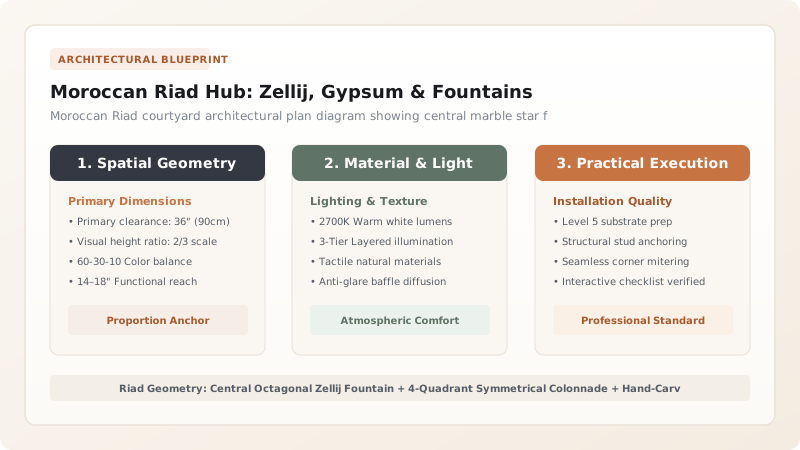
1. Architectural Philosophy: The Inward Oasis & Zellij Geometric Mosaics
A Moroccan Riad (from Arabic *Riyad*, meaning 'Garden') features plain, windowless exterior walls to maintain complete family privacy and keep desert heat out. Inside, it opens into a Breathtaking Sunlit Central Courtyard (Oasis).
The ground level is wrapped in Zellij (Hand-Cut Glazed Terracotta Mosaics) crafted using 8-point and 16-point geometric stars (*Khatam*). Master zellij cutting in hand-cut zellij terracotta tile mosaics and explore Moroccan waterproof tadelakt plaster.

2. Carved Gypsum Plaster (*Geb*) & Central Cooling Water Fountains
Above the tile wainscoting, arches are crowned with Hand-Carved Gypsum Plaster (*Geb*) and Tiered *Muqarnas* Stalactite Vaults.
Master plaster carving in carved gypsum plaster geb and muqarnas and engineer courtyard hydraulics in central marble fountains and cedar mashrabiya.
Courtyard Architectural Elements Comparison
Use this reference table to calculate exact physical dimensions, ratios, and specifications before purchasing:
| Courtyard Element | Traditional Craft Material | Structural / Decorative Role | Visual & Sensory Impact |
|---|---|---|---|
| Lower Wainscoting (Optimal) | Hand-Cut Zellij Terracotta Tiles | Waterproof wall base / High traffic zone | 5 / 5 (Vibrant geometric jewel tones) |
| Colonnade Arches & Friezes | Hand-Carved Gypsum (*Geb*) | Light diffusion / Arabesque relief | 5 / 5 (Intricate lacy white shadowplay) |
| Central Courtyard Fountain | Solid Carved Carrara / Moroccan Marble | Micro-climate cooling / White noise | 5 / 5 (Soothing bubbling water ambiance) |
| Upper Balcony Screens | Atlas Cedar Wood (*Mashrabiya*) | Privacy lattice / Cross-ventilation | 4 / 5 (Fragrant cedar / Filtered light) |
Plaster Moisture Efflorescence Destruction Constraints
Every successful decoration project must account for physical and environmental constraints:
Water Splashing from Courtyard Fountain Migrating into Gypsum Plaster Causing Chalky Peeling
Gypsum plaster is water-soluble; splashing fountain spray causes gypsum plaster to dissolve, soften, and crumble; maintain a minimum 36-inch tall zellij tile wainscot barrier above finished floor level before beginning carved gypsum plasterwork.
How to Design and Construct a Moroccan Riad Courtyard
Execute this professional sequence to achieve flawless results without backtracking:
Layout Quadripartite Courtyard and Fountain Centerpoint
Establish symmetrical 4-pillar colonnade with central water supply and drainage plumbing for fountain.
Install Underground Fountain Basin and Waterproof Membrane
Pour reinforced concrete fountain basin; waterproof with 2 coats of elastomeric membrane and tadelakt.
Assemble Hand-Cut Zellij Mosaic Panels on Courtyard Floor
Layout upside-down zellij tesserae; pour mortar backing; set finished mosaic panels on floors and lower walls.
Frame Horseshoe Arches with Reinforced Masonry Lath
Construct horseshoe and polylobed arch armatures from steel rebar and expanded metal lath.
Apply Slow-Setting Gypsum-Marble Dust Plaster Bed
Trowel 1-inch thick layer of fine gypsum plaster mixed with marble powder over arch faces.
Hand-Carve Geometric Geb Patterns and Muqarnas Vaults
While plaster is leather-hard, hand-carve arabesques, kufic calligraphy, and muqarnas stalactite niches.
Fit Carved Atlas Cedar Mashrabiya Balcony Screens
Install lathe-turned cedar wood mashrabiya screens into upper floor window and loggia openings.
Common Mistakes & Countermeasures
Avoid these costly errors that compromise aesthetics, ergonomics, and budget:
Using Machine-Printed Flat Ceramic Tiles in Place of Hand-Cut Zellij
Project Execution Checklist
Track your physical progress. Checkboxes persist automatically on this device:
Frequently Asked Questions
How does a central Riad courtyard cool the home naturally without air conditioning?
During the night, cool desert night air sinks into the courtyard, cooling the thick stone and masonry walls. During the day, the central fountain evaporates water, dropping air temperatures by 10°F–15°F, while hot air rises and escapes through the open roof.


